
A Minoan connection?
But why had the constellation system introduced by Eudoxus not been updated by its makers to take account of the changing position of the celestial pole?
As we have seen, the constellations introduced by Eudoxus and described by Aratus in the Phaenomena refer to the position of the celestial pole around a thousand years earlier. By the time of Aratus, the shift in position of the celestial pole meant that certain stars mentioned in the Phaenomena were now permanently below the horizon from latitude 36° north, while others not mentioned by Aratus had by then come into view. Oddly, Eudoxus himself seems not to have been bothered by these anomalies, if he even noticed them; but the great Greek astronomer Hipparchus (fl.146–127 BC) recognized the differences and was understandably critical.
Professor Archie Roy of Glasgow University has argued that the Babylonian constellations reached Egypt (and hence Eudoxus) via some other civilization; he proposes that they were the Minoans who lived on Crete and the surrounding islands off the coast of Greece, including Thera (also known as Santorini). Crete lies between 35° and 36° north, which is the right latitude, and the Minoan empire was expanding between 3000 and 2000 BC, which is the right date.
What’s more, the Minoans were in contact with the Babylonians through Syria from an early stage. Hence they must have been familiar with the old Babylonian constellations, and they could well have adapted the Babylonian star groups into a practical system for navigation.
But the Minoan civilization was wiped out around 1550 BC by the explosive eruption of a volcano on the island of Thera about 120 km north of Crete. It was one of the greatest natural catastrophes in the history of civilization, the probable origin of the legend of Atlantis. Professor Roy supposes that Minoan refugees brought their knowledge of the stars to Egypt after the eruption, where it was eventually encountered by Eudoxus in unchanged form over a thousand years later.
Professor Roy’s thesis is an attractive one, for it is easy to imagine the Minoans utilizing the Babylonian constellation system in the way that he describes. In addition, many star myths are centred on Crete. However, it must be admitted that there is no direct evidence, such as wall paintings or star lists like those of the Babylonians, to demonstrate any Minoan interest in astronomy. So, for now, the theory that the Minoans were middlemen to our constellation system remains nothing more than an appealing speculation.
The mythographers
The Phaenomena of Aratus was immensely popular and became an essential part of the culture not just during the Greek era but for many centuries afterwards. It was translated several times into Latin, often with extensive commentaries by its translators and editors, and medieval versions were highly illustrated.
For our purposes the most useful version is a Latin adaptation of Aratus attributed to Germanicus Caesar (15 BC–AD 19), which has more information about the identification of certain constellations than Aratus’s original. According to the classicist David B. Gain this Latin version of the Phaenomena could have been written either by Germanicus himself or by his uncle (and adoptive father) Tiberius Caesar, but in this book I refer to the author simply as Germanicus.
After Aratus, the next landmark in our study of Greek constellation lore is Eratosthenes (c.276–c.194 BC), to whom an essay called the Catasterisms is attributed. Eratosthenes was a Greek scientist and writer who worked in Alexandria at the mouth of the Nile. The Catasterisms gives the mythology of 42 separate constellations (the Pleiades cluster is treated individually), with a listing of the main stars in each figure.
The version of the Catasterisms that survives is only a summary of the original, made at some unknown date, and it is not even certain that the original was written by the real Eratosthenes; hence the author of the Catasterisms is usually referred to as pseudo-Eratosthenes. The antiquity of his sources is certain, though, because he quotes in places from a long-lost work on astronomy by Hesiod (c.700 BC).
Another influential source of constellation mythology is a book called Poetic Astronomy by a Roman author named Hyginus, apparently written in the second century AD. We do not know who Hyginus was, not even his full name – he was evidently not C. Julius Hyginus, a Roman writer of the first century BC.
Poetic Astronomy is based on the constellations listed by Eratosthenes (Hyginus differs only by including the Pleiades under Taurus), but it contains many additional stories. Hyginus also wrote a compendium of general mythology called the Fabulae. As with the Phaenomena of Aratus, many illustrated versions of Hyginus’s writings on astronomy were produced in medieval and Renaissance times.
Marcus Manilius, a Roman author of whom virtually nothing is known, wrote a book called Astronomica around the year AD 15, clearly influenced by the Phaenomena of Aratus. Manilius’s book deals mostly with astrology rather than astronomy, but it contains numerous insights into constellation lore and I have quoted him a number of times.
The names of three other mythologists appear frequently on the following pages, and although they are not astronomers they must be introduced before we return to the history of the constellations. Foremost among them is the Roman poet Ovid (43 BC–AD 17), who recounts many famous myths in his books the Metamorphoses, which deals with transformations of all kinds, and the Fasti, a treatise on the Roman calendar.
Apollodorus was a Greek who compiled an almost encyclopedic summary of myths known as the Library some time in the late first century BC or in the first century AD. Finally there is the Greek writer Apollonius Rhodius (Apollonius of Rhodes) whose Argonautica, an epic poem on the voyage of Jason and the Argonauts composed in the third century BC, includes much mythological information. These are the main sources for the stories in this book (see also here for a complete list of sources and references).
Ptolemy’s 48 constellations
Greek astronomy reached its pinnacle with Ptolemy (c.AD 100–c.178) who, like Eratosthenes before him, worked in Alexandria, Egypt. Around AD 150, Ptolemy produced a summary of Greek astronomical knowledge usually known by its later Arabic title of the Almagest meaning ‘the greatest’.[note] At its heart was a catalogue of over a thousand stars arranged into 48 constellations (Table 1), with estimates of their brightness, based largely on the observations of the Greek astronomer Hipparchus three centuries earlier.
Table 1: The 48 constellations listed by the Greek astronomer Ptolemy
in the Almagest, second century AD (modern Latin names)
Andromeda
Aquarius
Aquila
Ara
Argo Navis (now subdivided into Carina, Puppis, and Vela)
Aries
Auriga
Boötes
Cancer
Canis Major
Canis Minor
Capricornus
Cassiopeia
Centaurus
Cepheus
Cetus
Corona Australis
Corona Borealis
Corvus
Crater
Cygnus
Delphinus
Draco
Equuleus
Eridanus
Gemini
Hercules
Hydra
Leo
Lepus
Libra
Lupus
Lyra
Ophiuchus
Orion
Pegasus
Perseus
Pisces
Piscis Austrinus
Sagitta
Sagittarius
Scorpius
Serpens
Taurus
Triangulum
Ursa Major
Ursa Minor
Virgo
Ptolemy did not identify the stars in his catalogue by means of Greek letters, as astronomers do today, but described their position within each constellation figure. For instance, the star in Taurus which Ptolemy referred to as ‘the reddish one on the southern eye’ is known today as Aldebaran. At times, this system became cumbersome: ‘The northernmost of the two stars close together over the little shield in the poop’ is how Ptolemy struggled to identify a star (now called Xi Puppis) in the constellation of Argo Navis.
The tradition of describing stars by their positions within a constellation had already been established by Eratosthenes and Hipparchus. Clearly, the Greeks regarded the constellations not merely as assemblages of stars but as true pictures in the sky. Identification would have been easier if they had given the stars individual names, but Ptolemy added only five stars to the six named by Aratus four centuries earlier: Altair (which Ptolemy called Aetos, Greek for eagle); Antares; Canopus (which was too far south for Aratus to have seen); Regulus (which Ptolemy called Basiliskos); and Vega (which he called Lyra, the same name as its constellation).
Ptolemy’s descriptions, based partly on earlier visualizations and partly on his own interpretations, defined the constellation figures for future generations. As he wrote in his introduction to the catalogue, ‘The descriptions which we have applied to the individual stars as parts of the constellation are not in every case the same as those of our predecessors … in many cases our descriptions are different because they seem to be more natural and to give a better proportioned outline to the figures described’.
It would be difficult to overemphasize the influence of Ptolemy on astronomy; the constellation system we use today is essentially Ptolemy’s, modified and extended. Mapmakers in Europe and Arabia used his constellation figures for over 1,500 years, witness this passage from the preface to the Atlas Coelestis by Britain’s first Astronomer Royal, John Flamsteed, published in 1729:
‘From Ptolemy’s time to ours the names that he made use of have been continued by the ingenious and learned men of all nations; the Arabians always used his forms and names of the constellations; the old Latin catalogues of the fixed stars use the same; Copernicus’s catalogue and Tycho Brahe’s use the same; so do the catalogues published in the German, Italian, Spanish, Portuguese, French and English languages. All the observations of the ancients and moderns make use of Ptolemy’s forms of the constellations and names of the stars so that there is a necessity of adhering to them, that we may not render the old observations unintelligible by altering or departing from them.’
Arabic influences
After Ptolemy, Greek astronomy went into permanent eclipse. By the eighth century AD the centre of astronomy had moved east from Alexandria to Baghdad where Ptolemy’s work was translated into Arabic and received the name Almagest by which we still know it. Al-Ṣūfī (AD 903–86), one of the greatest Arabic astronomers (also known by the Latinized name of Azophi), produced his own version of the star catalogue in the Almagest called the Book of the Fixed Stars in which he introduced many Arabic star names.
Al-SŪFĪ’s BOOK OF THE FIXED STARS
Ἁbd al-Raḥmān al-Ṣūfī (903–986), known also by his Latinized name of Azophi, was an Arabic astronomer who produced a revised and updated version of the star catalogue in Ptolemy’s Almagest called the Book of the Fixed Stars (in Arabic, Kitāb al-Kawākib al-Thābita) around AD 964. As well as a translation of Ptolemy’s catalogue, this book contained a listing of the Arabs’ own star names, magnitudes determined by al-Ṣūfī himself, and two drawings of each constellation, one as it is seen in the sky and one reversed right to left as it would appear on a celestial globe. The oldest surviving copy, reputedly made by his son around AD 1010, is preserved in the Bodleian Library, Oxford (MS Marsh 144).
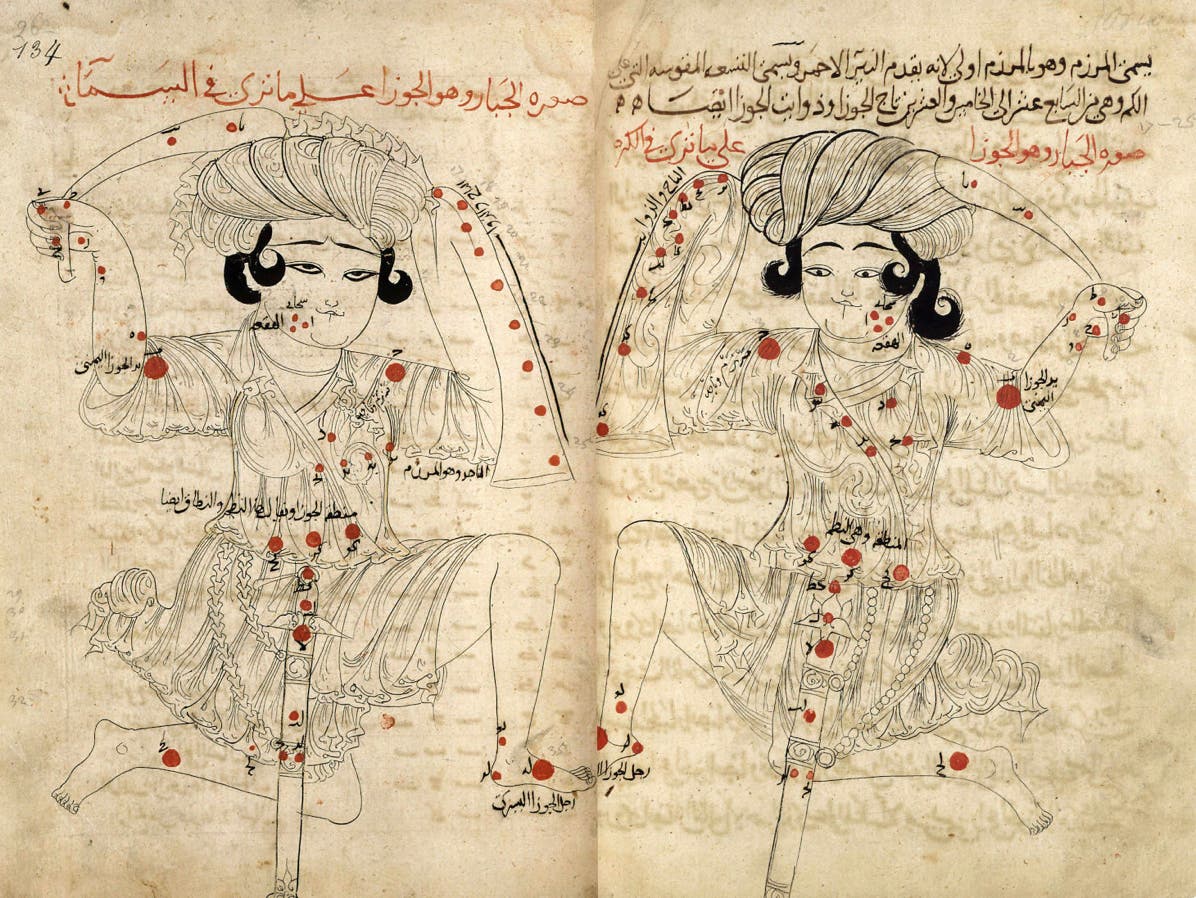
An Arabic depiction of Orion, as seen from Earth (left) and a mirror-image, from a 13th-century copy of al-Ṣūfī’s Book of the Fixed Stars. In this version, Orion’s shield has become a long sleeve, typical of Islamic dress. (© Bibliothéque National de France.)
Bedouin Arabs had their own names for various bright stars, an example being Aldebaran which we have inherited from them. They also had a very different star lore from the Greeks, and commonly regarded single stars as representing animals or people. For example, the stars we know as Alpha and Beta Ophiuchi were regarded by the Arabs as a shepherd and his dog, while neighbouring stars made up the outlines of a field with sheep. Elsewhere could be found camels, gazelles, ostriches, and a family of hyenas.
Some of the Arabic names were already so many centuries old that their meanings were lost even to al-Ṣūfī and his contemporaries, and they remain unknown today. Other star names used by al-Ṣūfī and his compatriots were direct translations of Ptolemy’s descriptions. For example, the star name Fomalhaut comes from the Arabic meaning ‘mouth of the southern fish’, which is where Ptolemy had described it in the Almagest.
Another rich source of Arabic star names were astrolabes, star-finding devices like a flattened celestial sphere invented by the Greeks but developed to the height of sophistication by the Arabs. Each astrolabe had a rotating disk with decorative pointers that indicated the positions of various bright stars, the names of which were engraved on the pointer to assist identification.
From the tenth century onwards, the translated works of Ptolemy were reintroduced into Europe by Islamic Arab incursions. There they were re-translated from Arabic into Latin, the scientific language of the day. The Spanish city of Toledo, in particular, is said to have become a veritable translation factory during the 12th century and scholars flocked there from all over western Europe to study the marvellous new works – not just on astronomy but mathematics and all other branches of science.
So it is through this roundabout route of old Greek writings being transmitted through Arabic hands and then translated back into Latin in Europe in the middle ages that we have ended up with a polyglot system of Greek constellations with Latin names containing stars with a mixture of Arabic and Greek titles.
© Ian Ridpath. All rights reserved
Its original name in Greek was Μαθηματικὴ Σύνταξις (Mathematike Syntaxis). It was also known as Syntaxis mathematica in Latin.