
Genitive: Hydrae
Abbreviation: Hya
Size ranking: 1st
Origin: One of the 48 Greek constellations listed by Ptolemy in the Almagest
Greek name: Ὕδρος (Hydros)
Hydra is the largest of the 88 constellations, winding over a quarter of the way around the sky. Its head is south of the constellation Cancer, the crab, while the tip of its tail lies between Libra, the scales, and Centaurus, the centaur. The total length from its westernmost boundary to the easternmost one is 102°.5. Yet for all its size there is nothing prominent about Hydra. Its only star of note is second-magnitude Alphard, a name that comes from the Arabic al-fard appropriately meaning ‘the solitary one’. Bode on his Uranographia atlas gave it the alternative name Unuk es Schudscha, from the Arabic unuk al-shujā, neck of the serpent. Both names were originally given by al-Ṣūfī in his Book of the Fixed Stars (AD 964).
Eratosthenes and Ptolemy both called the constellation Ὕδρος (Hydros), which is the male form of the name; but this water snake is actually female, so they were in error. Aratus correctly used the feminine form, Ὕδρη (Hydra). There is now also a male water snake in the sky, the small southern constellation Hydrus, introduced by Dutch navigators at the end of the 16th century. Ptolemy listed 25 stars in Hydra plus two so-called ‘unformed’ stars outside the main figure. One of these has since been absorbed into Hydra as C Hydrae, while the other now lies within Hevelius’s new constellation Sextans, although because of inaccurate positional information its exact identity is uncertain (Alpha, Epsilon, and 24 Sextantis have all been suggested as Ptolemy’s unformed star).
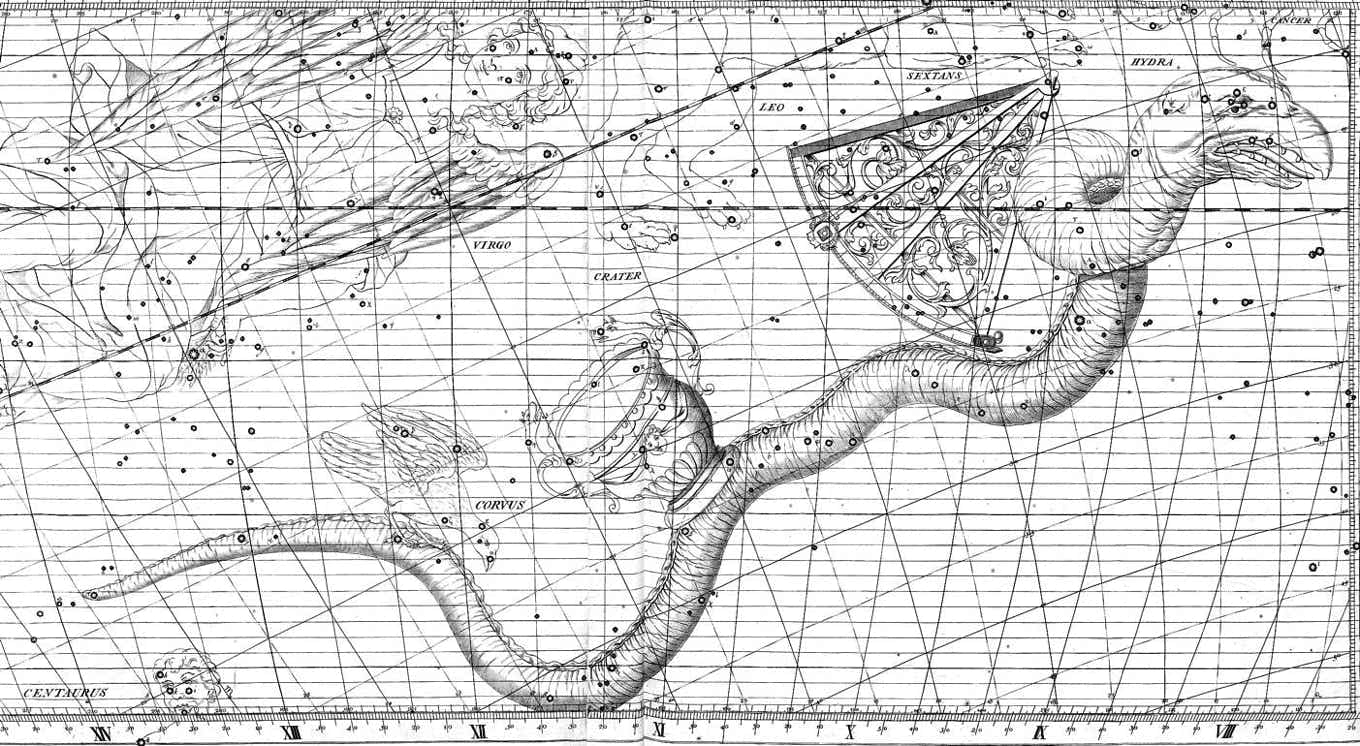
Hydra winds across the pages of John Flamsteed’s Atlas Coelestis (1729). On its back are Corvus and Crater, associated with it in legend. Because of the constellation’s extreme length, fold-outs were required to fit it on one chart. On Johann Bode’s Uranographia atlas of 1801, the head and tail of Hydra overlap onto neighbouring charts. In that atlas, Bode gave Hydra the alternative name Serpens Aquaticus. Above its front half lies Sextans, invented by Hevelius.
Legends of the Hydra
The water-snake features in two legends. First, and most familiar, the Hydra was the creature that Heracles fought and killed as the second of his famous labours. The Hydra was a multi-headed creature, the offspring of the monster Typhon and the half-woman, half-serpent called Echidna. Hydra was thus the sister of the dragon that guarded the golden apples, commemorated in the constellation Draco. Hydra reputedly had nine heads, the middle one of which was immortal. In the sky, though, it is shown with one head only – perhaps this is the immortal one.
Hydra lived in a swamp near the town of Lerna, from where it sallied forth over the surrounding plain, eating cattle and ravaging the countryside. Its breath and even the smell of its tracks were said to be so poisonous that anyone who breathed them died in agony.
Heracles rode up to the Hydra’s lair in his chariot and fired flaming arrows into the swamp to force the creature into the open, where he grappled with it. The Hydra wrapped itself around one of his legs; Heracles smashed at its heads with his club but no sooner had one head been destroyed than two grew in its place. To add to Heracles’s worries, a huge crab scuttled out of the swamp and attacked his other foot, but Heracles stamped on the crab and crushed it. The crab is commemorated in the constellation Cancer.
Heracles called for help to his charioteer Iolaus who burned the stump of each head as soon as it was struck off to prevent others growing in its place. Finally Heracles cut off the immortal head of the Hydra and buried it under a heavy rock by the roadside. He slit open the body of the Hydra and dipped his arrows in its poisonous gall.
A second legend associates the water-snake with the constellations of the Crow (Corvus) and the Cup (Crater) that lie on its back. In this story, the crow was sent by Apollo to fetch water in the bowl, but loitered to eat figs from a tree. When the crow eventually returned to Apollo it blamed the water-snake for blocking the spring. But Apollo knew that the crow was lying, and punished the bird by placing him in the sky, where the water-snake eternally prevents him from drinking out of the bowl.
Chinese associations
In Chinese astronomy, Hydra contained three constellations after which lunar mansions were named. First of these was Liu, also the name of the 24th lunar mansion. Liu consisted of the stars we visualize as the head of Hydra (Theta, Omega, Zeta, Rho, Epsilon, Delta, Sigma, and Eta Hydrae) but in Chinese astronomy it marked the head of the Red Bird of the South. Liu means willow, a traditional symbol of mourning and of rebirth; in this context, it may be significant that the preceding lunar mansion in Cancer was called Ghosts. Chinese constellations could have more than one characterization, and in this case Liu was also said to represent a chef. He is conveniently placed in the sky immediately north of Waichu, the outer kitchen, where animals were prepared for sacrifice. Waichu consisted of a ring of six stars, including C and F Hydrae.
South of Waichu was a single star (probably 12 Hydrae, although also identified in some sources as Lambda Velorum) called Tianji, representing an assessor who decided whether animals were old enough to be sacrificed. This is another example, common in the Chinese sky, of several constellations in one area forming a theme.
The second Chinese constellation in present-day Hydra with an eponymous lunar mansion (the 25th) was Xing (‘star’), also known as Qixing (‘seven stars’), which consisted of a chain of seven stars centred on Alpha Hydrae (Alphard); the chain started at Iota Hydrae in the north and ended at 26 Hydrae in the south. Xing marked the neck of the Red Bird. Alphard itself was known as Niao, the Bird Star.
The third Chinese constellation within modern Hydra to give its name to a lunar mansion (the 26th) was Zhang, a name referring to an outstretched net, possibly for catching birds in flight. It consisted of six stars including Lambda, Mu, and Upsilon-1 Hydrae. Zhang was also seen as the bow of an archer, who was represented by the stars of neighbouring Crater.
Two stars south of Crater (possibly Beta and Xi Hydrae) formed Junmen, the gate of a military camp. Four other stars in this same area formed Tusikong, a minister of works. Qingqiu, ‘green hill’, is a particularly awkward constellation to pin down. Originally a ring of seven faint stars in Centaurus, it was displaced northwards into Hydra as the effects of precession carried the more southerly stars out of view. Sun and Kistemaker’s recreation of the Chinese sky in the 3rd century AD places Qingqiu partly in Centaurus, overlapping the border into Hydra just south of Corvus. But another chart from a later era shows it in the area formerly occupied by Junmen and Tusikong, thereby replacing those figures.
Closer to the tail of Hydra, Gamma and Pi Hydrae formed Ping, representing a senior law lord or appeal court judge. Two other Chinese constellations near the tip of the Hydra’s tail have judicial themes: Dunwan (possibly 54 and 58 Hydrae, but also placed by some in Lupus) which symbolized trials and interrogation; and Zhewei, seven faint stars spanning the border with Libra, representing executioners or beheadings.
© Ian Ridpath. All rights reserved
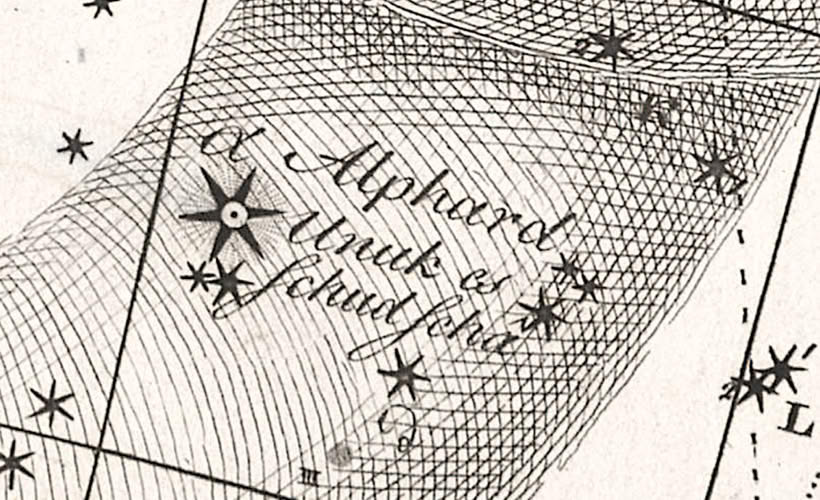
Johann Bode gave Alphard the alternative name Unuk es Schudscha on Chart XIX of his Uranographia atlas of 1801.