

Genitive: Coronae Australis
Abbreviation: CrA
Size ranking: 80th
Origin: One of the 48 Greek constellations listed by Ptolemy in the Almagest
Greek name: Στέφανος Nότιος (Stephanos Notios)
Corona Australis was known to the Greeks not as a crown but as a wreath, which is how it is depicted on old star maps. Aratus did not name it as a separate constellation but referred to it simply as a circlet of stars beneath the forefeet of Sagittarius. Hyginus said it was a wreath cast off by the archer ‘as by one at play’.
Its first recorded mention as a separate constellation appears to be in the first century BC by the Greek astronomer and mathematician Geminus of Rhodes in his survey of astronomy called Introduction to the Phenomena. He gave it the name Νότιος στέφανος (Notios stephanos, the southern crown), whereas Ptolemy in the Almagest two centuries later reversed the name as Στέφανος νότιος (Stephanos notios). The northern crown, which we call Corona Borealis, was known to the Greeks simply as Στέφανος (Stephanos). Geminus said that the arc of stars was also known as a canopy (Οὐρανίσκος), as found over a throne, although he did not explain whose throne it might be.
Dürer Latinized the name to Corona Meridionalis on his chart of 1515, followed by Bayer in his Uranometria atlas of 1603, but Plancius labelled it ‘Corona Austra.’ on his globe of 1598 and it was this version, with ‘Austra.’ expanded to Australis, that became established, with the influential support of Halley and Hevelius.[note]
Ptolemy listed 13 component stars in the southern crown, although one of them has since been reassigned to the adjoining modern figure Telescopium, where it is known as Alpha Telescopii. Bayer allocated Greek letters to Ptolemy’s 13 stars in his Uranometria, but Lacaille relabelled the constellation in his Coelum Australe Stelliferum of 1763 and it is Lacaille’s letters that are still used today.
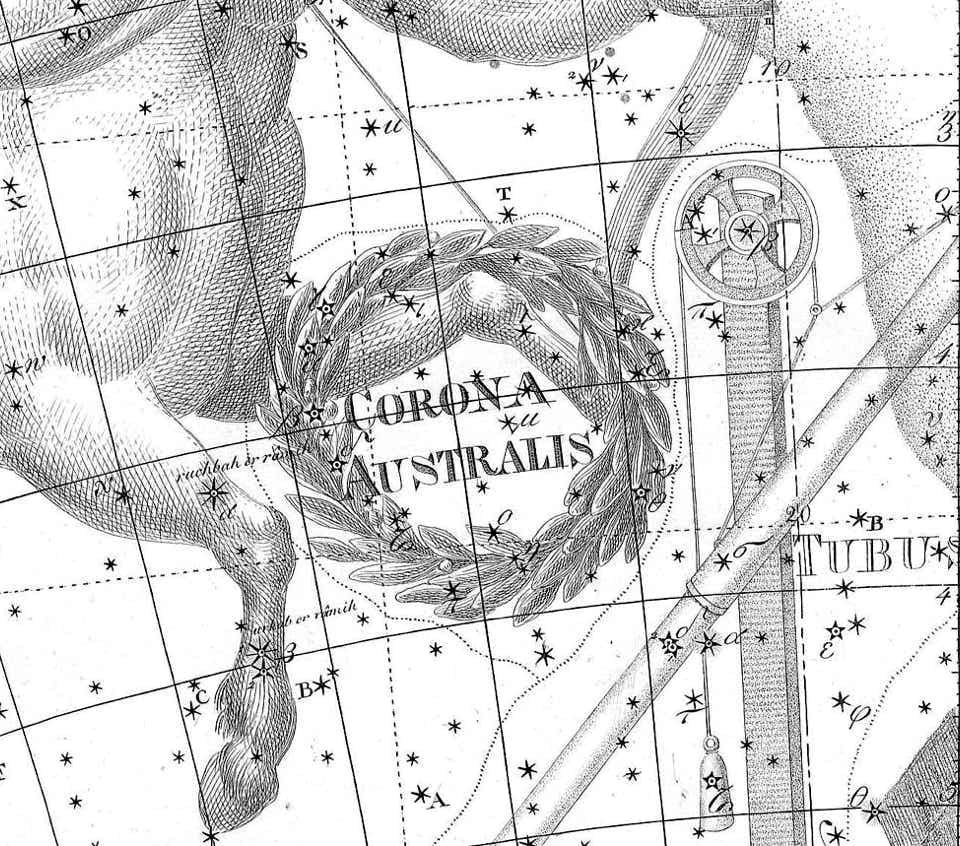
Corona Australis, depicted as a laurel wreath at the forefeet of Sagittarius, on Chart XV of the Uranographia of Johann Bode (1801). Johann Bayer in his Uranometria atlas of 1603 showed it as being composed of ivy leaves.
None of the stars of Corona Australis is brighter than fourth magnitude and there seem to be no legends associated with it, unless this is the crown placed in the sky by Dionysus after retrieving his dead mother from the Underworld. Hyginus gives this myth under the Northern Crown (Corona Borealis) but it seems out of place there and he may have confused the two constellations. If so, the wreath would be made of myrtle leaves, for Dionysus left a gift of myrtle in Hades in return for his mother, and the followers of Dionysus wore crowns of myrtle.
Chinese associations
Chinese astronomers saw the stars of Corona Australis as forming a large turtle with a strong shell, Bie, positioned on the banks of the celestial river, the Milky Way. Fourteen stars were involved. One depiction restricts Bie to the stars of present-day Corona Australis, although an alternative view shows it extending further south to include Alpha Telescopii. Not far away in the Chinese sky was another turtle, Gui, in the area we know as Ara.
© Ian Ridpath. All rights reserved

Corona is a feminine noun in Latin and the adjective Australis can be feminine or masculine, whereas the adjective Austrinus (as in Piscis Austrinus) is masculine and Australe is neuter, as in Triangulum Australe.