Genitive: Carinae
Abbreviation: Car
Size ranking: 34th
Origin: Part of the original Greek constellation Argo Navis
The smallest but most prominent of the three parts into which the ancient Greek constellation of Argo Navis, the ship of the Argonauts, was divided by the French astronomer Nicolas Louis de Lacaille in his first catalogue of the southern stars, published in 1756. In that catalogue he gave it the French name Corps du Navire. His final catalogue, Coelum australe stelliferum, appeared in 1763 containing the same three subdivisions but with Latin instead of French names. Although usually described as the keel, Carina represents the main body or hull of the ship. The other two parts are Puppis, the poop or stern, and Vela, the sails.
Carina inherited the two brightest stars of the dismantled Argo; they are now labelled Alpha Carinae (better known as Canopus) and Beta Carinae (Miaplacidus). Canopus, a creamy white giant just over 300 light years away, is in fact the second-brightest star in the entire sky; it marks the blade of one of the ship’s two steering oars. Eratosthenes and Ptolemy both spelled the star’s name Κάνωβος (Kanobos); Canopus is the Latinized version.
Canopus and other stars
Canopus was not mentioned by Aratus in the Phaenomena (c.275 BC), because the star was below the horizon from Greece in his day. The name first appears with his somewhat younger contemporary Eratosthenes who was based farther south, at Alexandria in northern Egypt. From there he could see Canopus low in the south, as could Ptolemy, who worked at Alexandria four centuries later. It was the most southerly star that Ptolemy catalogued in his Almagest, and by some way: the next most southerly was the present-day Tau Puppis, over 3° to the north.
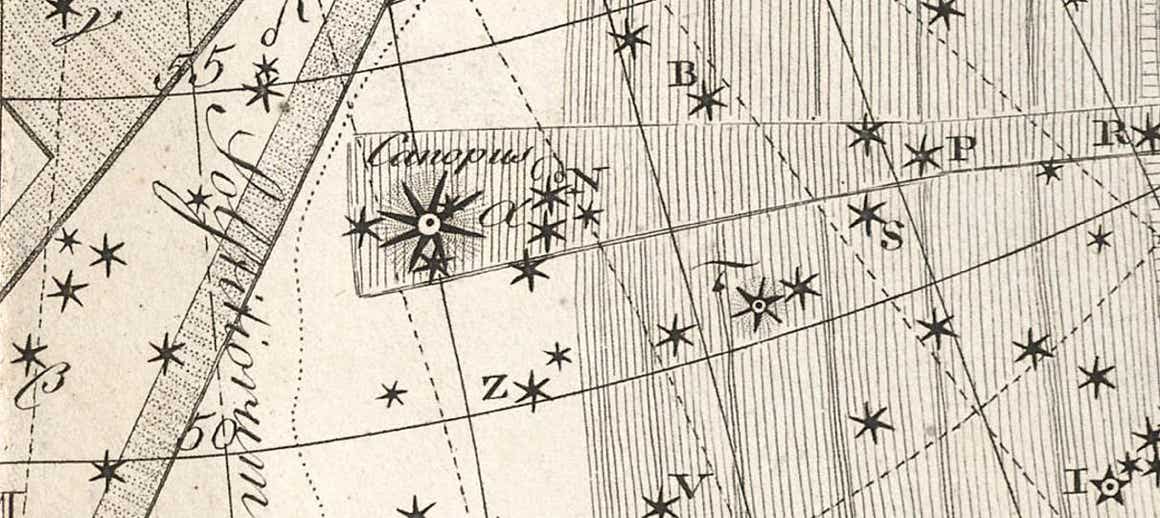
Canopus sparkles on the steering oar of Argo Navis, as seen on Plate XX
of the Uranographia of Johann Bode (1801).
Greek writers such as Conon (c.280–c.220 BC) and Strabo (64/63 BC–c.AD 24) tell us that Canopus is named after the helmsman of the Greek King Menelaus. On Menelaus’s return from Troy with Helen his fleet was driven off-course by a storm and landed in Egypt. There Canopus died of a snake bite; Helen killed the snake, and she and Menelaus buried Canopus with full honours. On that site grew the city of Canopus (the modern Abu Qir) at the mouth of the Nile. Fittingly, modern space probes now use Canopus as a navigation star. Eratosthenes also knew this star by the name Περίγειος (i.e. Perigeios, or Perigee), in reference to the fact that it remained close to the horizon; this name appeared in Eratosthenes’s entry on Eridanus, not Argo.
The Arabs called Canopus Suhail, a name of uncertain meaning. In one story Suhail was said to be the brother of Sirius and Procyon, who were his sisters. Sirius crossed the Milky Way into the southern sky to be with him, while Procyon was left behind on the northern side of the Milky Way, crying and hence dimmer than her southern siblings.
Beta Carinae is called Miaplacidus, but the origin of the name is unknown. The second-magnitude stars Epsilon and Iota Carinae, along with Delta and Kappa Velorum to the north in Vela, form a cruciform shape known as the False Cross, sometimes mistaken for the true Southern Cross. Epsilon Carinae is called Avior, a name given in or around 1937 by the UK’s Nautical Almanac Office for use in The Air Almanac, a navigation guide produced for the Royal Air Force. The RAF specified that all navigation stars should have proper names, so this name was coined for the otherwise unnamed Epsilon Carinae.
Eta Carinae and the Keyhole
The constellation contains a unique star, Eta Carinae, that flared up to become brighter than Canopus in 1843, but has since faded to the edge of naked-eye visibility. Astronomers now think that Eta Carinae is a close pair of hot, very massive stars. They cannot be seen directly because they are embedded in a cloud of gas called the Homunculus Nebula that was ejected during the great eruption. One or both of the stars will one day explode as a supernova.
Eta Carinae lies in front of a much larger area of glowing gas known as the Eta Carinae nebula or simply the Carina nebula, catalogued as NGC 3372. Silhouetted against the bright background next to Eta Carinae is a bulbous mass of dark gas and dust known as the Keyhole nebula from its distinctive shape. This was beautifully sketched by John Herschel from his observations made at the Cape of Good Hope in 1834–38.
Chinese associations
In ancient China, Canopus was known as Laoren, ‘old man’, or sometimes Nanji Laoren, ‘old man of the south pole’. He was equated with Shouxing, the god of longevity.
Carina also once contained part of a large Chinese constellation called Qifu, a storehouse for musical instruments, the rest of which was in Centaurus and Vela. However, as the effect of precession gradually carried Qifu below the southern horizon the constellation was repositioned to the north on later star maps, farther into Centaurus and out of Carina entirely.
© Ian Ridpath. All rights reserved
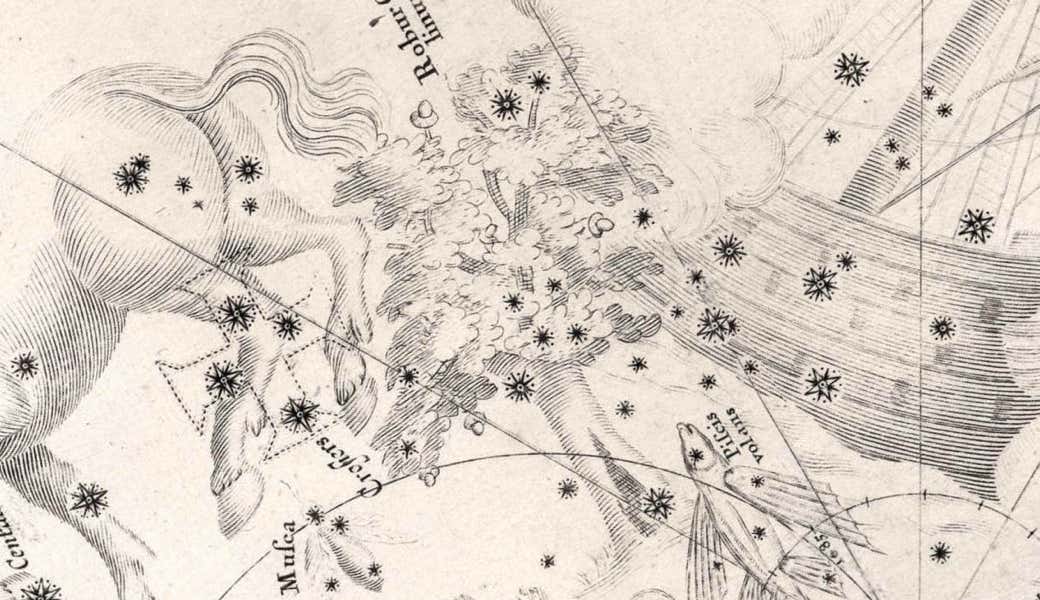
The Southern Cross, left of centre, and the False Cross at right, seen against the hull of Argo, on Edmond Halley’s southern star chart of 1678. Halley’s short-lived invention of Robur Carolinum lies between them. The modern designations of the stars in the False Cross are Kappa and Delta Velorum (top and right of the cross), and Iota and Epsilon Carinae (left and bottom), all of second magnitude.
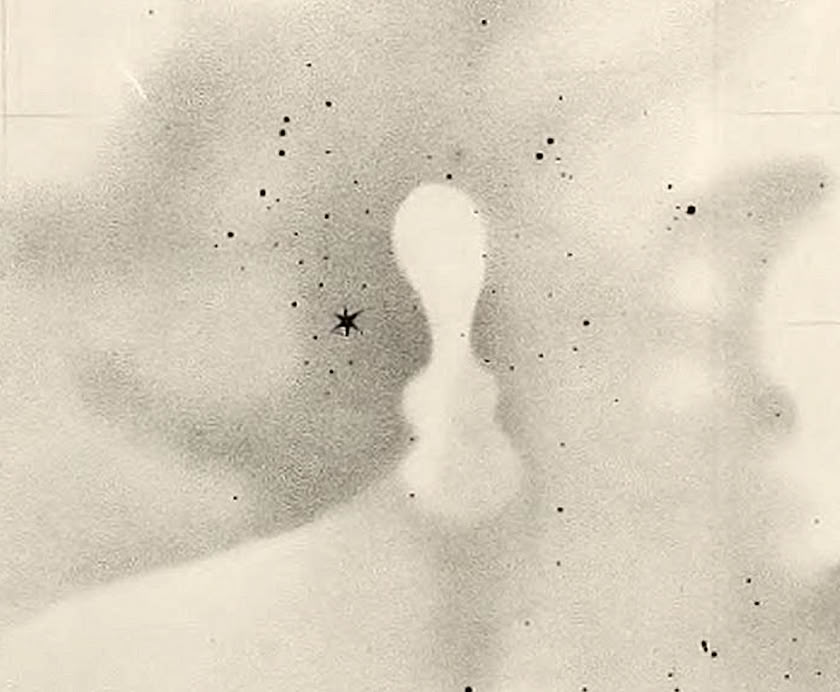
John Herschel’s negative drawing of the area around Eta Carinae, which was then known as Eta Argus, published in 1847 in his Results of Astronomical Observations made at the Cape of Good Hope. The star to the left of centre is Eta Carinae, while to the right of it is the bulbous nebula now known as the Keyhole, although Herschel himself did not call it that.