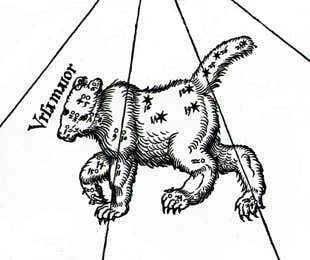


Genitive: Tauri
Abbreviation: Tau
Size ranking: 17th
Origin: One of the 48 Greek constellations listed by Ptolemy in the Almagest
Greek name: Ταῦρος (Tauros)
Taurus (Ταῦρος in Greek) is a distinctive constellation, with star-tipped horns and a head defined by a V-shaped group of stars. Two Greek bull-myths were associated with Taurus. Usually it was said to represent Zeus in the disguise he adopted for another of his extramarital affairs, this time as the bull that carried away Europa, daughter of King Agenor of Phoenicia.
Europa liked to play on the beach with the other girls of Tyre. Zeus instructed his son Hermes to drive the king’s cattle from their pastures on the mountain slopes towards the shore where the girls were playing. Adopting the shape of a bull, Zeus surreptitiously mingled with the lowing herd, awaiting his chance to abduct Europa. There was no mistaking who was the most handsome bull. His hide was white as fresh snow and his horns shone like polished metal.
Europa was entranced by this beautiful yet placid creature. She adorned his horns with flowers and stroked his flanks, admiring the muscles on his neck and the folds of skin on his flanks. The bull kissed her hands, while inwardly Zeus could hardly contain himself in anticipation of the final conquest. The bull lay on the golden sands and Europa ventured to sit on his back. At first, she feared nothing when the bull rose and began to paddle in the surf. But she became alarmed when it began to swim strongly out to sea. Europa looked around in dismay at the receding shoreline and clung tightly to the bull’s horns as waves washed over the bull’s back. Craftily, Zeus the bull dipped more deeply into the water to make her hold him more tightly still.
By now, Europa had realized that this was no ordinary bull. Eventually, the bull waded ashore at Crete, where Zeus revealed his true identity and seduced Europa. He gave her presents that included a dog that later became the constellation Canis Major. The offspring of Zeus and Europa included Minos, king of Crete, who established the famous palace at Knossos where bull games were held.
An alternative story says that Taurus may represent Io, another illicit love of Zeus, whom the god turned into a heifer to disguise her from his wife Hera. But Hera was suspicious and set the hundred-eyed watchman Argus to guard the heifer. Hera, furious at this, sent a gadfly to chase the heifer, who threw herself into the sea and swam away.
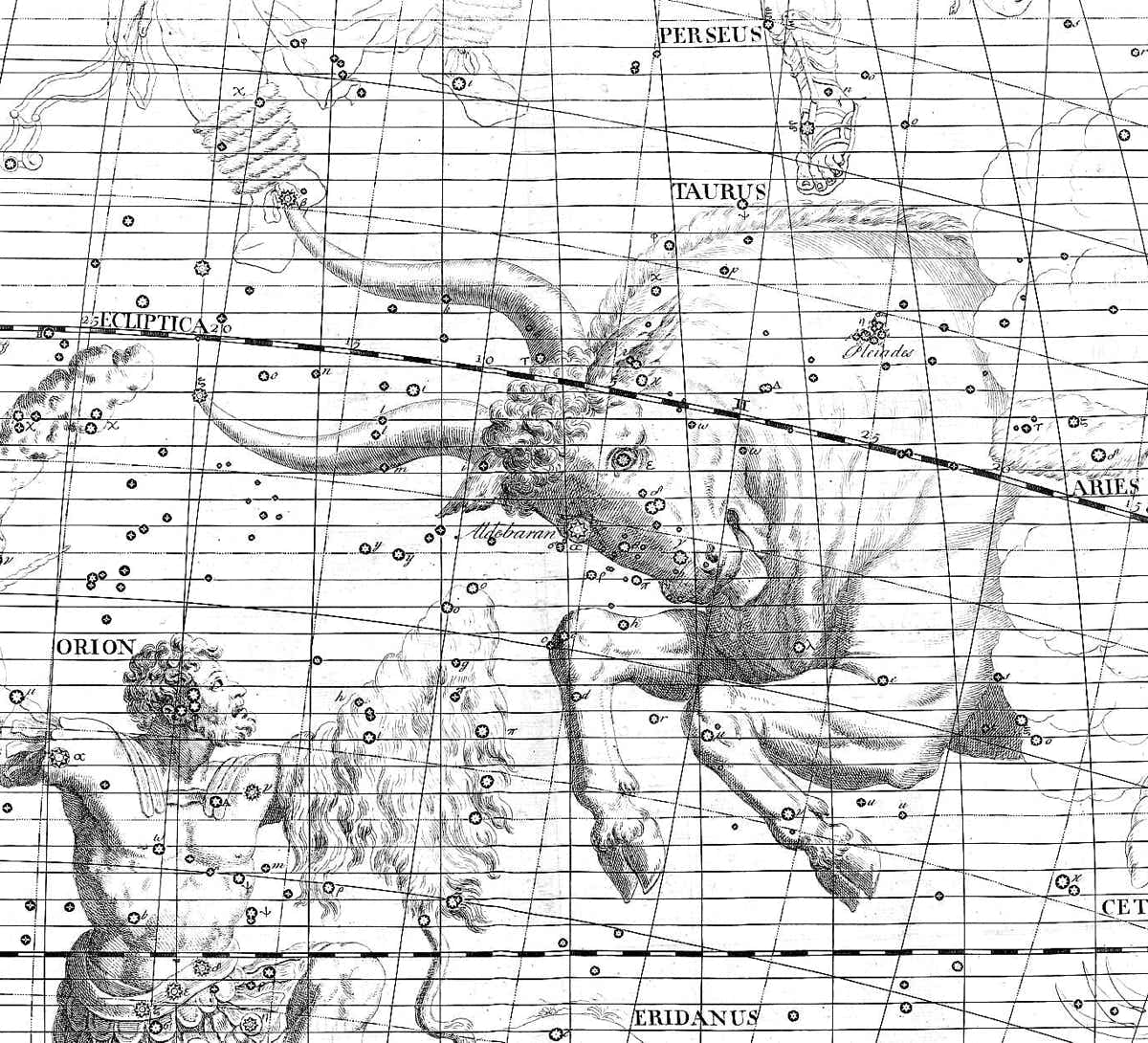
Taurus charges with head down towards Orion, as depicted in the Atlas Coelestis of John Flamsteed (1729). Only the front part of the bull is shown in the sky. The bull’s eye is marked by the reddish star Aldebaran, while on his back is the Pleiades star cluster. One horn ends at the right foot of Auriga.
In the sky, only the front half of the bull is shown. This can be explained mythologically by assuming that the hind quarters are submerged. In reality, there is no space in the sky to show the complete bull, for it is too big. The constellations Cetus and Aries lie where the bull’s hind quarters would otherwise be. Taurus shares with Pegasus this uncomfortable fate of having been sliced in half in the sky. Adding to the awkwardness, Taurus moves across the sky backwards, as though retreating from Orion.
Aratus described the bull as ‘crouching’, and star maps have traditionally depicted Taurus with its front legs folded, perhaps lowering itself to entice Europa onto its back. Manilius described the bull as lame and drew a moral from it: ‘The sky teaches us to undergo loss with fortitude, since even constellations are fashioned with limbs deformed’, he wrote.
The Hyades – the face of the bull
The face of Taurus is marked by the V-shaped group of stars called the Hyades (Ὑάδες in Greek). Ovid in his Fasti asserts that the name comes from the old Greek word hyein, meaning ‘to rain’, so that Hyades means ‘rainy ones’, because their rising at certain times of year was said to be a sign of rain. In mythology the Hyades were the daughters of Atlas and Aethra the Oceanid. Their eldest brother was Hyas, a bold hunter who one day was killed by a lioness. His sisters wept inconsolably – Hyginus says they died of grief – and for this they were placed in the sky. Hence it seems equally likely that their name comes from their brother Hyas. In another story, the Hyades were nymphs who nursed the infant Dionysus in their cave on Mount Nysa, feeding him on milk and honey. The Romans had a different name: they called the Hyades suculae meaning ‘piglets’.
The mythographers were massively confused about the names and even the number of the Hyades. They are variously described as being five or seven in number. Ptolemy listed five Hyades in his star catalogue. Hyginus alone gives four different lists of their names, none of which agrees completely with the list of five originally given by Hesiod, viz: Phaesyle, Coronis, Cleia, Phaeo, and Eudore. Astronomers have avoided the problem by not naming any of the stars of the Hyades. The brightest star in Taurus, Aldebaran, marking the eye of the bull, appears to be a member of the Hyades but is in fact a foreground object 67 light years away, less than half the distance of the cluster, which lies 150 light years away.
Binoculars and small telescopes show many more members of the Hyades than are visible to the naked eye. In all, astronomers now estimate that several hundred stars belong to the cluster. The members of the Hyades are moving through space together, and in 1908 the American astronomer Lewis Boss (1846–1912) published a famous diagram showing their paths converging towards a point near Betelgeuse.
© Ian Ridpath. All rights reserved
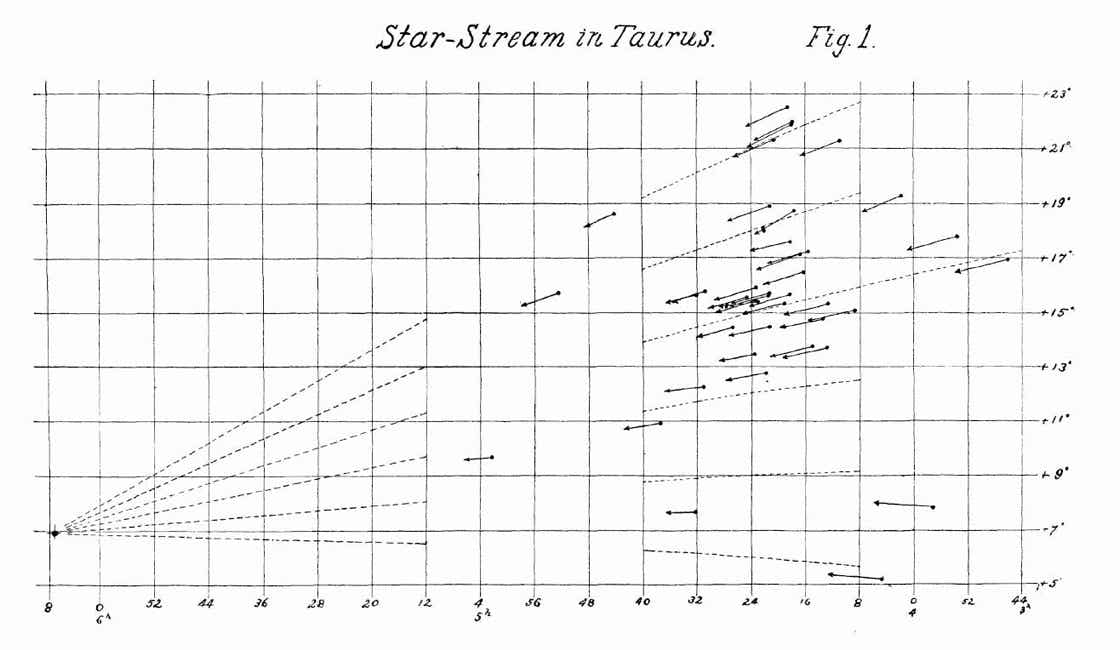
Lewis Boss’s diagram of the motion of the stars of the Hyades, published in The Astronomical Journal in 1908. The stars in the cluster are moving away from us on near-parallel paths through space at a speed of about 40 km/s. Perspective makes them appear to converge on a point near the bright star Betelgeuse (not shown on this diagram). The arrows indicate the motion of the respective stars over 50,000 years. As the cluster recedes it will gradually become smaller and fainter.