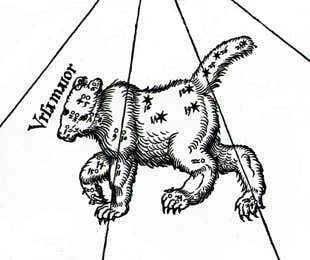


Genitive: Serpentis
Abbreviation: Ser
Size ranking: 23rd
Origin: One of the 48 Greek constellations listed by Ptolemy in the Almagest
Greek name: Ὄφις (Ophis)
This constellation is unique, for it is divided into two parts – Serpens Caput, the head, and Serpens Cauda, the tail. Nevertheless, astronomers regard it as a single constellation. Serpens represents a huge snake held by the constellation Ophiuchus. Its Greek name was Ὄφις (Ophis), but in the Almagest Ptolemy gave it as Ὄφις Ὀφιούχου (Ophis Ophiouchou), i.e. the serpent of the serpent-holder, presumably to prevent confusion with the other celestial serpents Draco and Hydra.
In his left hand Ophiuchus grasps the top half of the snake, while his right hand holds the tail. The mythologists including Aratus and Hyginus described Serpens as being coiled around the waist of Ophiuchus, but most star atlases show the snake simply passing between his legs or across his body (for an illustration of the full tableau, see Ophiuchus).
In mythology, Ophiuchus was identified as the healer Asclepius (Aesculapius in Latin). His connection with snakes is attributed to the story that he once killed a snake that was miraculously restored to life by a herb placed on it by another snake. Asclepius subsequently used the same technique to revive dead people. Snakes are the symbol of rebirth because they periodically shed their skins, a process known as ecdysis.
There is a species of snake known as the Aesculapian snake (Zamenis longissimus) native to Greece and Italy which can grow to over 6ft long, making it one of the largest in Europe. These snakes are not venomous and were used in healing rituals in ancient Greece in temples called Asclepieia. This is presumably the type of snake that Ophiuchus/Asclepius is meant to be holding, albeit exaggerated in size.
Ptolemy in the Almagest listed the stars of Ophiuchus and Serpens as separate constellations, but mythologists such as Eratosthenes and Hyginus dealt with them together. One of the few celestial map makers to show Serpens separately was Johann Bayer, who devoted a double-page chart of his Uranometria atlas to each of the Ptolemaic constellations; however, the snake also appeared in more shadowy form on Bayer’s chart of Ophiuchus. Other major celestial chart makers such as Hevelius, Flamsteed, and Bode followed the mythologists in treating Ophiuchus and the snake as a composite figure, with the snake partly obscured by the body of Ophiuchus.
A constellation divided
When Eugène Delporte came to define the official constellation boundaries in the late 1920s, he was faced with the problem of how to separate the intertwined figures of Ophiuchus and Serpens. His solution, originally proposed by the American astronomer Benjamin Gould in his Uranometria Argentina catalogue of 1879, was to chop Serpens into the two halves that we see today, the head on one side of Ophiuchus and the tail on the other. The head is by far the larger half, covering an area over twice that of the tail (428 square degrees against 208). From the western border to the east, the official boundaries of Serpens span nearly 57° of sky, just over half the length of Hydra, the water snake, which is the largest constellation of all.
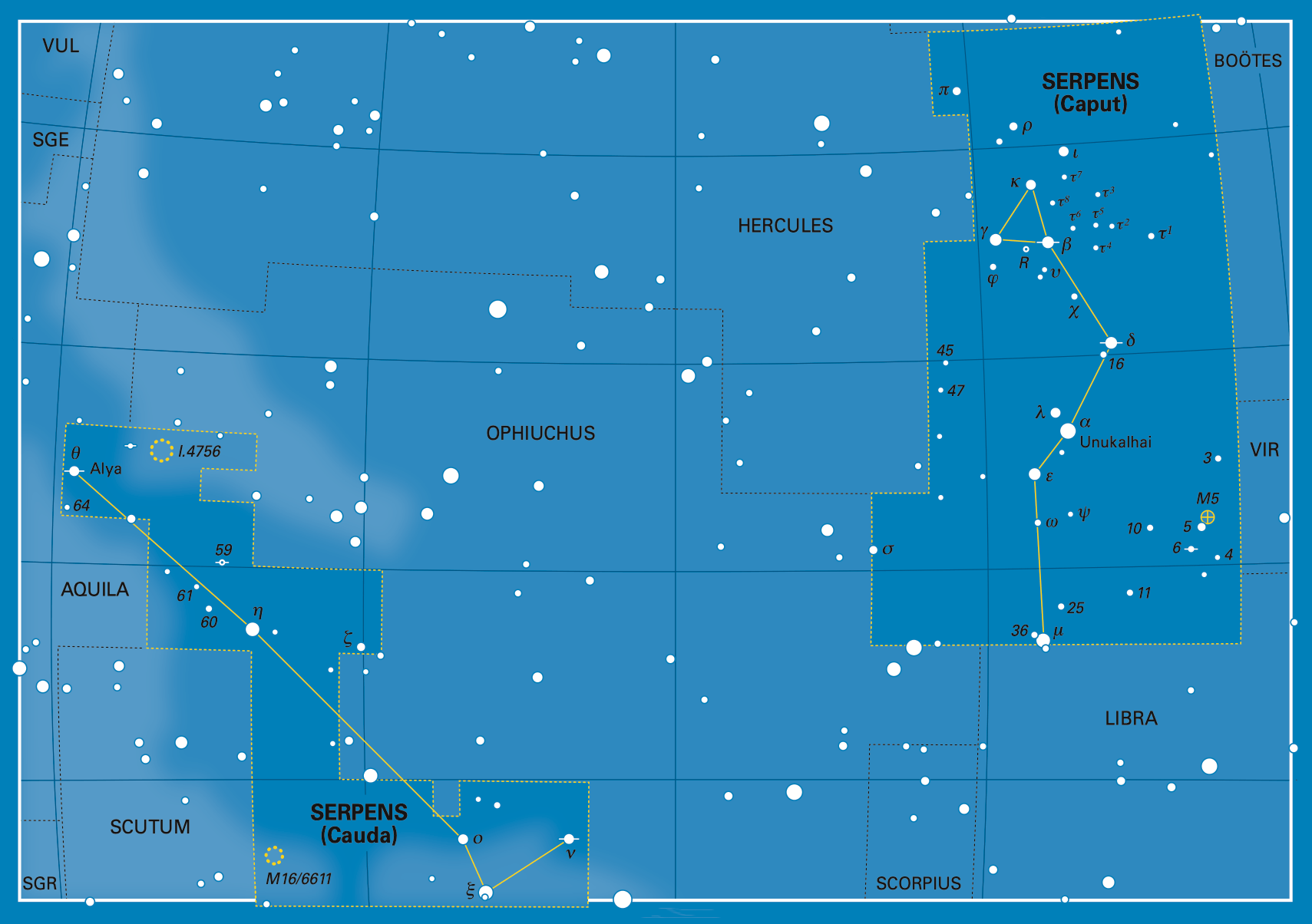
Serpens as it appears on a modern star chart by Wil Tirion, with the head of the snake (Serpens Caput) at the right and the tail (Serpens Cauda) at the left.
Stars of Serpens, and a gaseous Eagle
The constellation’s brightest star, third-magnitude Alpha Serpentis, is called Unukalhai from the Arabic ‘unuq al-ḥayya meaning ‘the serpent’s neck’, where it is located. The tip of the serpent’s tail is marked by Theta Serpentis, called Alya, an Arabic word that refers to a sheep’s tail.
The most celebrated object in Serpens is a star cluster called M16, embedded in a gas cloud called the Eagle Nebula, which takes its name from its supposed resemblance to a large bird of prey. The Eagle Nebula was the subject of a famous photograph by the Hubble Space Telescope showing pillars of gas and forming stars.
Chinese associations
The stars of Serpens were seen by the ancient Chinese not as a snake but as two halves of a wall enclosing the celestial marketplace, Tianshi. Most of Tianshi lay in Ophiuchus and southern Hercules. Theta, Eta, and Xi Serpentis formed part of the left (east) wall of Tianshi, while Gamma, Beta, Delta, Alpha, and Epsilon Serpentis were part of its right (west) wall.
For all its size, there were relatively few Chinese constellations in present-day Serpens. Omicron and Nu Serpentis were part of Shilou, a six-star loop representing a hall or tower that housed the market office, most of which was in Ophiuchus. Sigma Serpentis and Lambda Ophiuchi formed Liesi, representing an arcade of jewellers’ shops. The single star Mu Serpentis was known as Tianru, ‘celestial milk’, symbolizing rain but also said to represent the mother or wet nurse of the crown prince.
© Ian Ridpath. All rights reserved
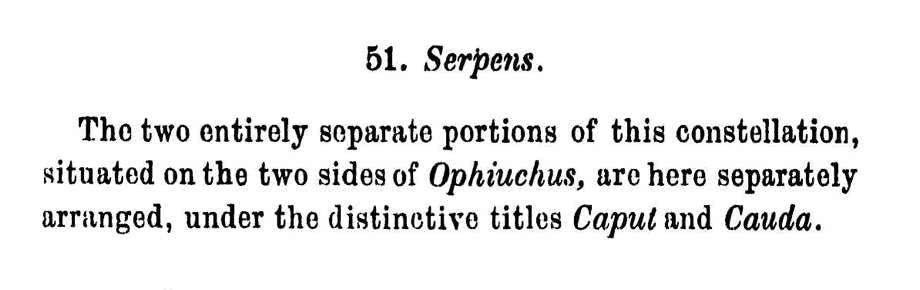
Benjamin Gould named the two halves of the constellation Serpens Caput and Serpens Cauda in his Uranometria Argentina catalogue of 1879.