

Genitive: Sagittae
Abbreviation: Sge
Size ranking: 86th
Origin: One of the 48 Greek constellations listed by Ptolemy in the Almagest
Greek name: Ὀϊστός (Oistos)
Sagitta, the third-smallest constellation in the sky, has no stars brighter than fourth magnitude, but it was well-known to the Greeks and was among the 48 constellations listed by Ptolemy in the Almagest. Aratus described it as ‘alone, without a bow’ since there is no sign of the archer who might have shot it.
Aratus and Ptolemy knew it by the Greek name Ὀϊστός (Oistos), but puzzlingly Eratosthenes called it Τόξον (Toxon) which means ‘bow’ rather than ‘arrow’. An alternative Latin name for the constellation widely used prior to the 18th century was Telum, meaning a dart or spear, as given on Dürer’s chart of 1515 and in Johannes Kepler’s Rudolphine Tables of 1627.
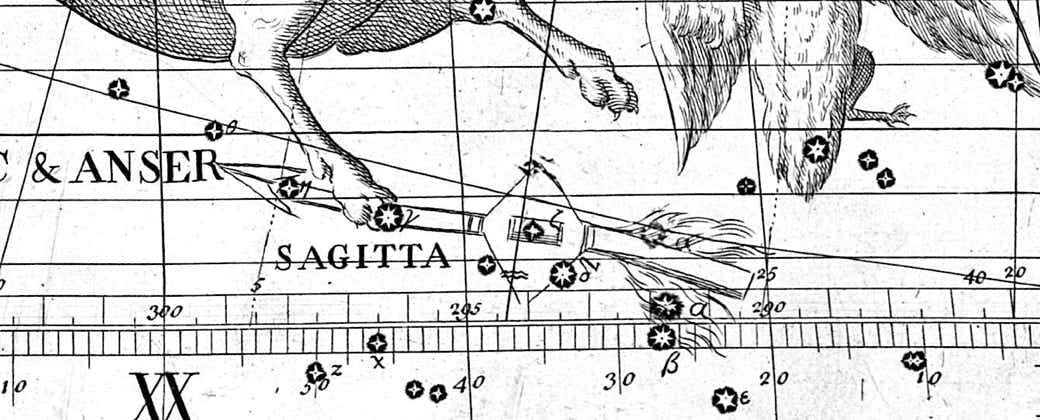
Sagitta flying near the feet of Vulpecula, from the Atlas Coelestis of John Flamsteed (1729).
The constellation’s brightest star, Gamma Sagittae, lies where the right forepaw of Vulpecula touches the arrow’s shaft. Note that the engraver made a mistake by placing Alpha to the north of the arrow’s shaft and then tried to erase it, although not altogether successfully. For Bode’s version of the arrow in his Uranographia see here.
Who shot the arrow?
There are at least three different stories to account for the arrow in the sky and its shooter. Eratosthenes said it was the projectile with which Apollo killed the Cyclopes because they made the thunderbolts of Zeus that struck down Apollo’s son, Asclepius. According to this story, Asclepius was a great healer with the power to raise the dead, but Zeus killed Asclepius when Hades, god of the Underworld, complained that he was losing business. Asclepius is commemorated in the constellation Ophiuchus.
Hyginus, on the other hand, said that Sagitta was one of the arrows with which Heracles killed the eagle that ate the liver of Prometheus. It was Prometheus who moulded men out of clay in the likeness of the gods, and gave them fire that he had stolen from Zeus. Prometheus carried the fire triumphantly in a vegetable stalk like a runner bearing the Olympic torch. Zeus cruelly punished him for this theft by chaining him to Mount Caucasus, where a long-winged eagle ate his liver during the day. But at night the liver grew again for the eagle to resume his feast in the morning. Heracles freed Prometheus from this eternal torture by shooting the eagle with an arrow.
Germanicus Caesar identified Sagitta as the arrow of Eros which kindled in Zeus his passion for the shepherd boy Ganymede, who is commemorated by the constellation Aquarius. Now, according to Germanicus, the arrow is guarded in the sky by the eagle of Zeus – and Sagitta does indeed lie next to the constellation of the eagle, Aquila.
Stars of Sagitta
Alpha Sagittae, magnitude 4.4, has the strange-sounding name Sham, which comes from the Arabic name for the constellation, al-sahm, meaning ‘the arrow’. The constellation’s brightest star is actually Gamma Sagittae, magnitude 3.5, which Ptolemy described as lying on the arrow-head; however, Bayer in his Uranometria extended the shaft to the stars he labelled Eta and Theta, which Ptolemy did not list. Flamsteed and Bode changed the angle of the arrow slightly so that Eta Sagittae lay at its tip and Alpha and Beta on the southern feather, as in the illustration above, whereas according to Ptolemy they should have been at the end of the shaft. In 2026 the IAU gave Gamma Sagittae the name Telum, in recognition of the old alternative name for the constellation.
Chinese associations
In China the stars of Sagitta plus Rho Aquilae were visualized as a flag or banner, Zuoqi, as used for signalling to troops on the battlefield. It flanked a drum, Hegu, formed by the bright star Altair (Alpha Aquilae) and its two neighbouring stars. Zuoqi was known as the left flag even though it lies to the north of Altair. Nine other stars to the south in present-day Aquila formed the right flag, Youqi.
© Ian Ridpath. All rights reserved
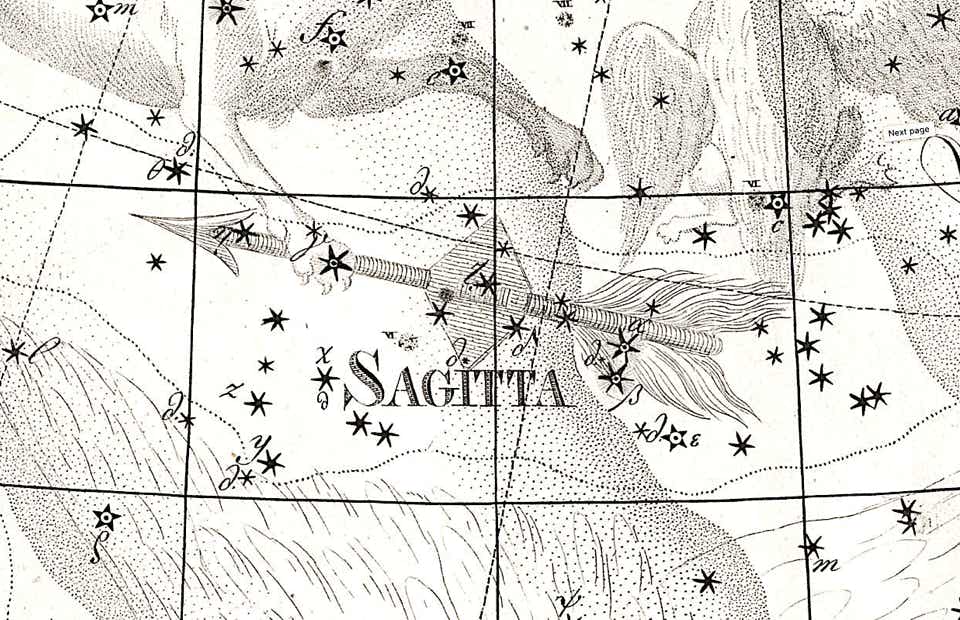
Johann Bode’s depiction of Sagitta on Plate VIII of his Uranographia.