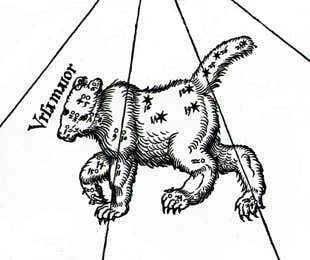


Genitive: Pyxidis
Abbreviation: Pyx
Size ranking: 65th
Origin: The 14 southern constellations of Nicolas Louis de Lacaille
A small southern constellation invented by the Frenchman Nicolas Louis de Lacaille during his survey of the southern skies in 1751–52. Pyxis represents a magnetic compass as used by seamen. It is located near the stern of the ship Argo in the same area as the ship’s mast. Lacaille’s original depiction of it was published in 1756 under the French name la Boussole, and in the notes accompanying the chart he described it as ‘le Compas de mer’. On the second edition of his chart in 1763 Lacaille Latinized its name to Pixis Nautica (sic), which was subsequently shortened, with amended spelling, to just Pyxis.
The four stars that Lacaille labelled Alpha, Beta, Gamma, and Delta Pyxidis had been catalogued by Ptolemy as lying in the mast of Argo, two in the middle and two at the tip. Johann Bayer did not assign Greek letters to them in his Uranometria of 1603 so Lacaille evidently felt free to appropriate them for his new constellation.
It is sometimes asserted that Pyxis is one of the parts into which Lacaille divided the former Argo Navis, but that is not the case. Lacaille split Argo into three: Carina (Corps), Puppis (Pouppe), and Vela (Voilure). Pyxis is an additional constellation invented by Lacaille, and he showed it separately from Argo on his map and in his catalogue.
The brightest stars in Pyxis are of only fourth magnitude and there are no legends associated with it – indeed, the magnetic compass was completely unknown to the ancient Greeks.
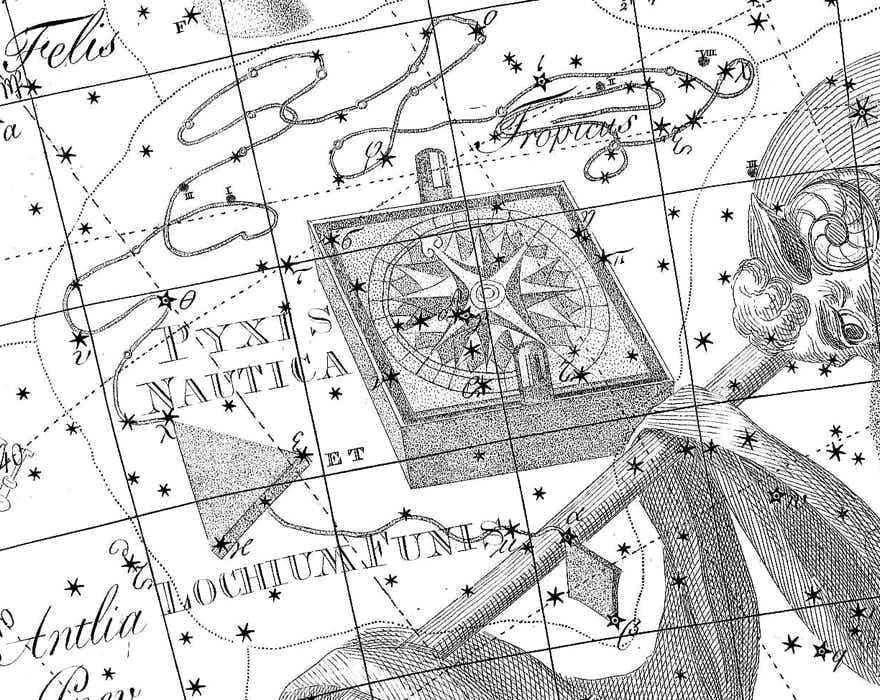
Pyxis hovers over the mast of Argo on Chart XVIII of the Uranographia of Johann Bode (1801). Curling around it is a Bode invention, the now-obsolete Lochium Funis, the log and line. For Lacaille’s original version of Pyxis, see here.
Malus, an attempted replacement for Pyxis
In 1844 the English astronomer John Herschel proposed returning Ptolemy’s four stars to Argo by replacing Pyxis with a fourth subdivision of the ship which he called Malus, the mast, in deference to Ptolemy’s original description of their location (see Herschel’s original proposal here). His countryman Francis Baily (of Baily’s beads fame) included Malus in his British Association Catalogue of 1845, but otherwise Malus was not widely adopted. The American astronomer Benjamin Apthorp Gould (1824–96) reverted the change in his Uranometria Argentina catalogue of 1879.
In this same area of sky the German astronomer Johann Bode introduced another constellation, Lochium Funis, the Log and Line, now obsolete but shown coiling around Pyxis on Bode’s Uranographia atlas of 1801, above.
Chinese associations
Tianmiao, ‘celestial temple’, was a Chinese constellation consisting of 14 stars describing an arch shape. Most of these were in present-day Pyxis, including the line Beta–Alpha–Gamma, with five stars in neighbouring Antlia. Tianmiao represented a temple dedicated to the Emperor’s ancestors.
© Ian Ridpath. All rights reserved


Lacaille’s brief description of Pyxis, which he termed La Boussole ‘ou le Compas de mer’, in the notes to his preliminary catalogue and chart published in the Histoire de l'Académie royale des sciences in 1756. He later Latinized the name to Pixis Nautica, which in turn was eventually shortened to just Pyxis.
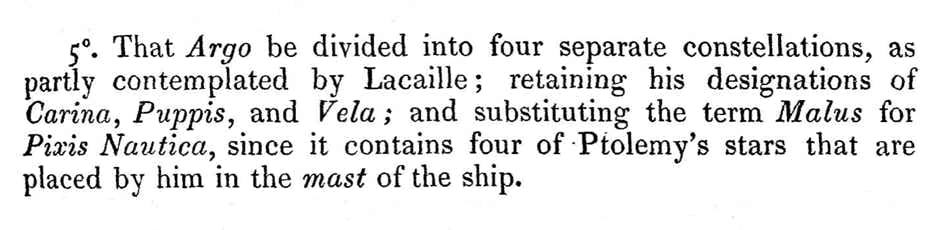
John Herschel’s proposal for replacing Lacaille’s constellation Pixis Nautica with Malus, as published in the Monthly Notices of the Royal Astronomical Society in 1844. His proposal was not adopted, but the name Pixis Nautica was shortened, with a change of spelling, to simply Pyxis.