Genitive: Pegasi
Abbreviation: Peg
Size ranking: 7th
Origin: One of the 48 Greek constellations listed by Ptolemy in the Almagest
Greek name: Ἵππος (Hippos)
Pegasus was the winged horse best known for his association with the Greek hero Bellerophon. The manner of the horse’s birth was unusual, to say the least. Its mother was Medusa, the Gorgon, who in her youth was famed for her beauty, particularly her flowing hair. Many suitors approached her, but the one who took her virginity was Poseidon, who is both god of the sea and god of horses. Unfortunately, the seduction happened in the temple of Athene. Outraged by having her temple defiled, the goddess Athene changed Medusa into a snake-haired monster whose gaze could turn men to stone.
When Perseus decapitated Medusa, both Pegasus and the warrior Chrysaor sprang from her body. The name Pegasus comes from the Greek word Πηγαί (pegai), meaning ‘springs’ or ‘waters’. Chrysaor’s name means ‘golden sword’, in description of the blade he carried when he was born. Chrysaor played no further part in the story of Pegasus; he later became father of Geryon, the three-bodied monster whom Heracles slew.
Pegasus stretched his wings and flew away from the body of his mother, eventually arriving at Mount Helicon in Boeotia, home of the Muses. There, he struck the ground with his hoof and, to the delight of the Muses, from the rock gushed a spring of water which was named Hippocrene, ‘horse’s fountain’. The goddess Athene later came to see it.
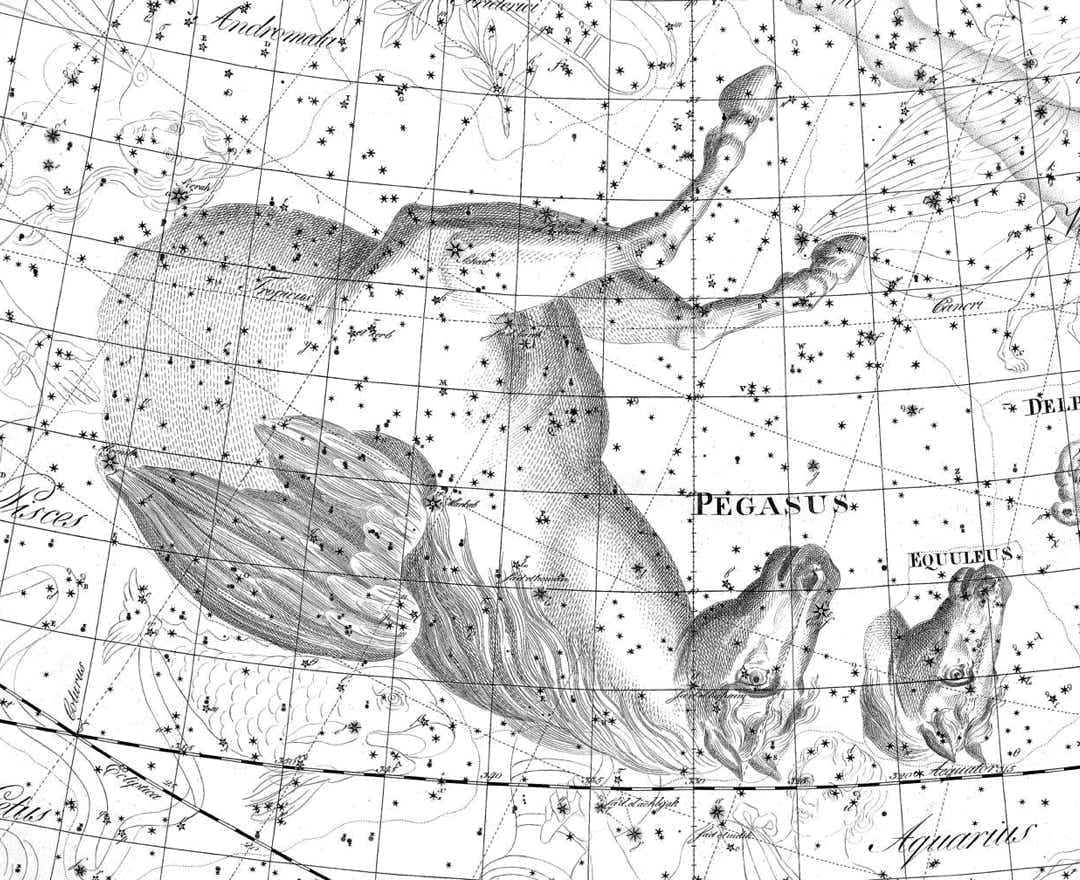
Only the front half of the flying horse is depicted in the sky, but enough to include his wings. His body is outlined by four stars that form the Square of Pegasus (although one of these is now assigned to Andromeda). In front of Pegasus is Equuleus, the foal, whose head alone is imagined among the stars. This illustration is from Chart X of the Uranographia of Johann Bode (1801).
The Greeks from Aratus to Ptolemy knew the constellation simply as Ἵππος (Hippos), the horse; the horse was usually understood to be Pegasus, but only later did it become commonly known by that specific name. Arab astronomers knew it as al-Faras al-A’ẓam, the larger horse, to distinguish it from Equuleus which they called Qiṭ’at al-Faras, meaning part of the horse.
Pegasus and Bellerophon
Pegasus is sometimes depicted as the steed of Perseus, but this is wrong. Pegasus was, in fact, ridden by another hero, Bellerophon, son of Glaucus. King Iobates of Lycia sent Bellerophon on a mission to kill the Chimaera, a fire-breathing monster that was devastating Lycia. According to Hesiod the Chimaera was the offspring of Typhon and Echidne, and had three heads, one like a lion, another like a goat and the third like a dragon. But Homer said in the Iliad that it had the front of a lion, the tail of a snake and a middle like a goat, the description that most other authors have followed.
Bellerophon found Pegasus drinking at the spring of Peirene in Corinth and tamed him with a golden bridle given by Athene. Ascending into the sky on the divine horse, Bellerophon swooped down on the Chimaera, killing it with arrows and a lance. After undertaking other tasks for King Iobates, Bellerophon seems to have got over-inflated ideas, for he attempted to fly up on Pegasus to join the gods on Olympus. Before he got there he fell back to Earth; but Pegasus completed the trip and Zeus used him for a while to carry his thunder and lightning, according to Hesiod. Zeus later put Pegasus among the constellations.
Eratosthenes doubted this story because, he said, the horse in the sky has no wings. It is true that Aratus does not mention wings on the celestial horse, but he identifies the constellation as Pegasus, and Ptolemy in his Almagest definitely mentions wings, so Eratosthenes must be mistaken. Germanicus Caesar is in no doubt. Pegasus, he writes, ‘beats his swift wings in the topmost circle of the sky and rejoices in his stellification’. Eratosthenes repeats the claim of the 5th century BC playwright Euripides that this constellation represents Melanippe, daughter of Chiron the centaur (see Equuleus).
The Great Square, and other stars of Pegasus
In the sky only the top half of the horse is shown, but even so it is still the seventh-largest constellation. Its body is represented by the famous Square of Pegasus whose corners are marked by four stars. In Greek times, one star was considered common with Andromeda, marking both the horse’s navel and the top of Andromeda’s head. When Johann Bayer came to assign Greek letters to the stars early in the 17th century he gave this a dual identity as both Alpha Andromedae and Delta Pegasi. Now it is allocated exclusively to Andromeda, as Alpha Andromedae; there is no longer a Delta Pegasi. Hence, strictly speaking, the Square of Pegasus now has only three corners.
Of the remaining three stars of the Square, Alpha Pegasi was said by Ptolemy to lie on the horse's shoulders at the base of the wing; its popular name, Markab, comes from the Arabic word mankib meaning ‘shoulder’. Beta Pegasi, according to Ptolemy, lay on the right shoulder where the horse's leg joined its body. However, its popular name, Scheat, comes from the Arabic sāq, meaning ‘shin’. According to the German star name expert Paul Kunitzsch, this name was mistakenly transferred to this star from Delta Aquarii as a result of confusion in a 15th-century star table. (Delta Aquarii is now known as Skat, from the same Arabic root.)
Gamma Pegasi lay at the wing-tip over the horse’s rump. Its popular name, Algenib, comes from the Arabic al-janb meaning side or flank. The brightest star in the constellation, albeit by a small margin, is Epsilon Pegasi, magnitude 2.4, on the horse’s muzzle; it is called Enif from the Arabic anf meaning ‘nose’. Germanicus Caesar said it lies ‘where the animal chews the bit, his mouth foaming’.
According to the Arabic star lore expert Danielle Adams of the University of Arizona, Arab astronomers visualized the Square of Pegasus as a leather well-bucket, al-dalw, with the stars of Andromeda as a rope attached to one corner.
Chinese associations
There was no Square of Pegasus in the Chinese sky. Instead, the west and east sides of the familiar (to us) square were separate constellations each consisting of two stars. Alpha and Beta Pegasi were linked to form Shi, representing one of the Emperor’s many palaces. Shi, which is usually translated as ‘encampment’, was also the name given to the 13th lunar mansion. Associated with Shi was a subsidiary constellation called Ligong, formed from three pairs of stars around Beta Pegasi – Eta and Omicron, Lambda and Mu, and Tau and Upsilon Pegasi. Ligong denoted the Emperor’s holiday resort, or perhaps resorts in plural given there are three different pairs of stars involved.
On the other side of the Square of Pegasus, the present-day Gamma Pegasi was joined with Alpha Andromedae to form Bi, the eastern wall of the Emperor’s palace grounds, also seen as the Emperor’s private reference library. The 14th lunar mansion was named Bi (‘wall’) after this constellation. (Confusingly, the 19th mansion, in Taurus, is also called Bi but has a different meaning.) Chinese astronomers did at least note the obvious fact that the four stars of Shi and Bi formed a great square, and likened it to the mouth of a fish.
Epsilon and Theta Pegasi were joined with Alpha Aquarii to form Wei, an angular-shaped constellation representing the roof of a house; Wei (‘rooftop’), the 12th Chinese lunar mansion, took its name from this group. Between Wei and the preceding mansion, Xu, were four pairs of stars representing judges or arbiters of various matters. Silu (governing honours, rank, and salaries) and Siming (governing punishment, life, and death) consisted of stars in southern Pegasus and northern Aquarius, identities uncertain. The other two, Siwei and Sifei, were over the border in adjoining Equuleus.
In the northern part of present-day Pegasus, Iota Pegasi and three other stars formed Jiu, a mortar, while Pi Pegasi and 1 Lacertae above it were part of Neichu (also known simply as Chu), a pestle, used for preparing food. Near the border with Vulpecula was Ren, ‘humans’, five stars in the shape of a stick figure; however, sources differ as to which stars were involved and probably different stars were used at different times.
Six stars to the south of Alpha Pegasi, including Rho and Sigma, were Leidian, thunder and lightning. Completing the stormy picture, two other Chinese constellations across the border in Pisces represented a thunderclap (Pili) and a rain cloud (Yunyu).
© Ian Ridpath. All rights reserved