

Genitive: Orionis
Abbreviation: Ori
Size ranking: 26th
Origin: One of the 48 Greek constellations listed by Ptolemy in the Almagest
Greek name: Ὠρίων
Orion (Ὠρίων in Greek) is the most splendid of constellations, befitting a character who was in legend the tallest and most handsome of men. His right shoulder and left foot are marked by the brilliant stars Betelgeuse and Rigel, with a distinctive line of three stars forming his belt. ‘No other constellation more accurately represents the figure of a man’, says Germanicus Caesar.
Manilius called it ‘golden Orion’ and ‘the mightiest of constellations’, and exaggerated its brilliance by saying that, when Orion rises, ‘night feigns the brightness of day and folds its dusky wings’. Manilius described Orion as ‘stretching his arms over a vast expanse of sky and rising to the stars with no less huge a stride’. In fact, Orion is not an exceptionally large constellation, ranking only 26th in size (smaller, for instance, than Perseus according to the modern constellation boundaries), but the brilliance of its stars gives it the illusion of being much larger.
Orion is also one of the most ancient constellations, being among the few star groups known to the earliest Greek writers such as Homer and Hesiod. Even in the space age, Orion remains one of the few star patterns that non-astronomers can recognize.
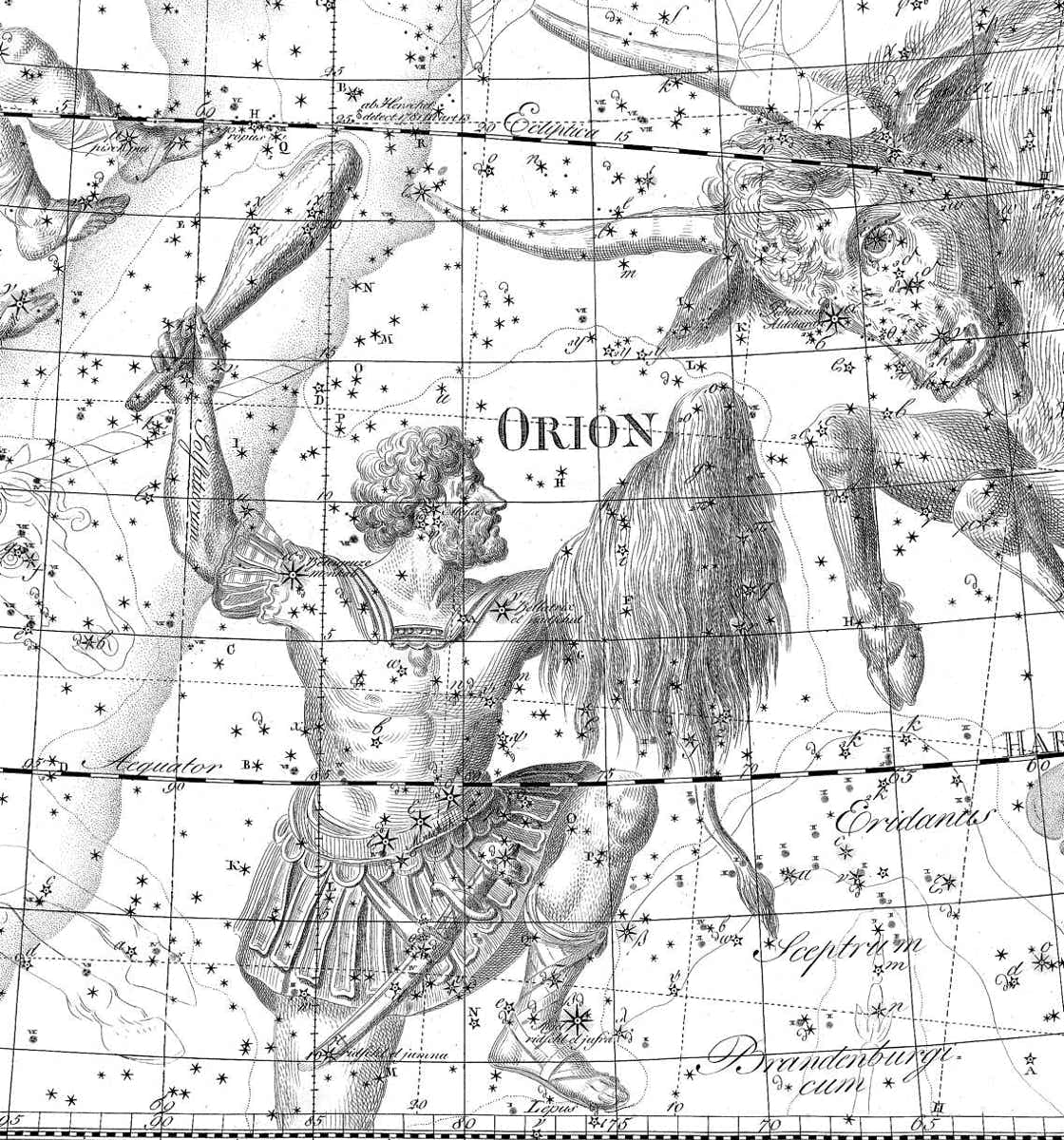
Orion raises his club and shield against the charging Taurus as illustrated on Chart XII in the Uranographia of Johann Bode (1801). Orion’s right shoulder is marked by the bright star Betelgeuse, and his left foot by Rigel. On this chart, Bode spelled Betelgeuse as Beteigeuze and gave it the alternative name Menkab, from the Arabic word for shoulder, mankib. For more on the origin of the name Betelgeuse see the next page.
In the sky, Orion is depicted facing the snorting charge of neighbouring Taurus the bull, yet the myth of Orion makes no reference to such a combat. However, the constellation originated with the Sumerians, who saw in it their great hero Gilgamesh fighting the Bull of Heaven. The Sumerian name for Orion was URU AN-NA, meaning light of heaven. Taurus was GUD AN-NA, bull of heaven.
Gilgamesh was the Sumerian equivalent of Heracles, which brings us to another puzzle. Being the greatest hero of Greek mythology, Heracles deserves a magnificent constellation such as this one, but in fact is consigned to a much more obscure area of sky. So is Orion really Heracles in another guise? It might seem so, for one of the labours of Heracles was to catch the Cretan bull, which would fit the Orion–Taurus conflict in the sky. Ptolemy described him with club and lion’s pelt, both familiar attributes of Heracles, and he is shown this way on old star maps. Yet despite these parallels, no mythologist hints at a connection between this constellation and Heracles.
Tales of Orion
According to myth, Orion was the son of Poseidon the sea god and Euryale, daughter of King Minos of Crete. Poseidon gave Orion the power to walk on water. Homer in the Odyssey describes Orion as a giant hunter, armed with an unbreakable club of solid bronze. In the sky, the hunter’s dogs (the constellations Canis Major and Canis Minor) follow at his heels, in pursuit of the hare (the constellation Lepus).
On the island of Chios, Orion wooed Merope, daughter of King Oenopion, apparently without much success, for one night while fortified with wine he tried to ravish her. In punishment, Oenopion put out Orion’s eyes and banished him from the island. Orion headed north to the island of Lemnos where Hephaestus had his forge. Hephaestus took pity on the blind Orion and offered one of his assistants, Cedalion, to act as his eyes. Hoisting the youth on his shoulders, Orion headed east towards the sunrise, which an oracle had told him would restore his sight. As the Sun’s healing rays fell on his sightless eyes at dawn, Orion’s vision was miraculously restored.
Orion is linked in a stellar myth with the Pleiades star cluster in Taurus. The Pleiades were seven sisters, daughters of Atlas and Pleione. As the story is usually told, Orion fell in love with the Pleiades and pursued them with amorous intent. But according to Hyginus, it was actually their mother Pleione he was after. Zeus snatched the group up and placed them among the stars, where Orion still pursues them across the sky each night.
There is a strange and persistent story about the birth of Orion, designed to account for the early version of his name, Urion (even closer to the Sumerian original URU AN-NA). According to this story, there lived in Thebes an old farmer named Hyrieus. One day he offered hospitality to three passing strangers, who happened to be the gods Zeus, Neptune, and Hermes. After they had eaten, the visitors asked Hyrieus if he had any wishes. The old man confessed that he would have liked a son, and the three gods promised to fulfil his wish. Standing together around the hide of the ox they had just consumed, the gods urinated on it and told Hyrieus to bury the hide. From it in due course was born a boy whom Hyrieus named Urion after the mode of his conception.
© Ian Ridpath. All rights reserved