
Genitive: Ophiuchi
Abbreviation: Oph
Size ranking: 11th
Origin: One of the 48 Greek constellations listed by Ptolemy in the Almagest
Greek name: Ὀφιοῦχος (Ophiouchos)
Ophiuchus (pronounced off-ee-YOO-cuss) represents a man grasping a huge snake with both hands, the head of the snake in his left hand and its tail in his right hand. The snake is represented by a separate constellation, Serpens, which is unique among the 88 constellations in being divided into two halves, the head on one side of Ophiuchus and the tail on the other. The mythologists such as Aratus and Hyginus described the snake as being coiled around the waist of Ophiuchus, and that is how it was shown on early illustrations, including Dürer’s hemisphere of 1515; but from Bayer’s chart of 1603 onwards it was usually shown passing either across his body or between his legs.
The Greek spelling of the name was Ὀφιοῦχος (Ophiouchos); Ophiuchus is the Latin version. The constellation was once also known by the alternative Latin name Serpentarius, which is found on some older atlases such as those of Johann Bayer and Johannes Hevelius. Both Flamsteed and Bode included this alternative name in their respective catalogues, although on their charts it was labelled Ophiuchus, as in the illustration from Flamsteed’s atlas here.
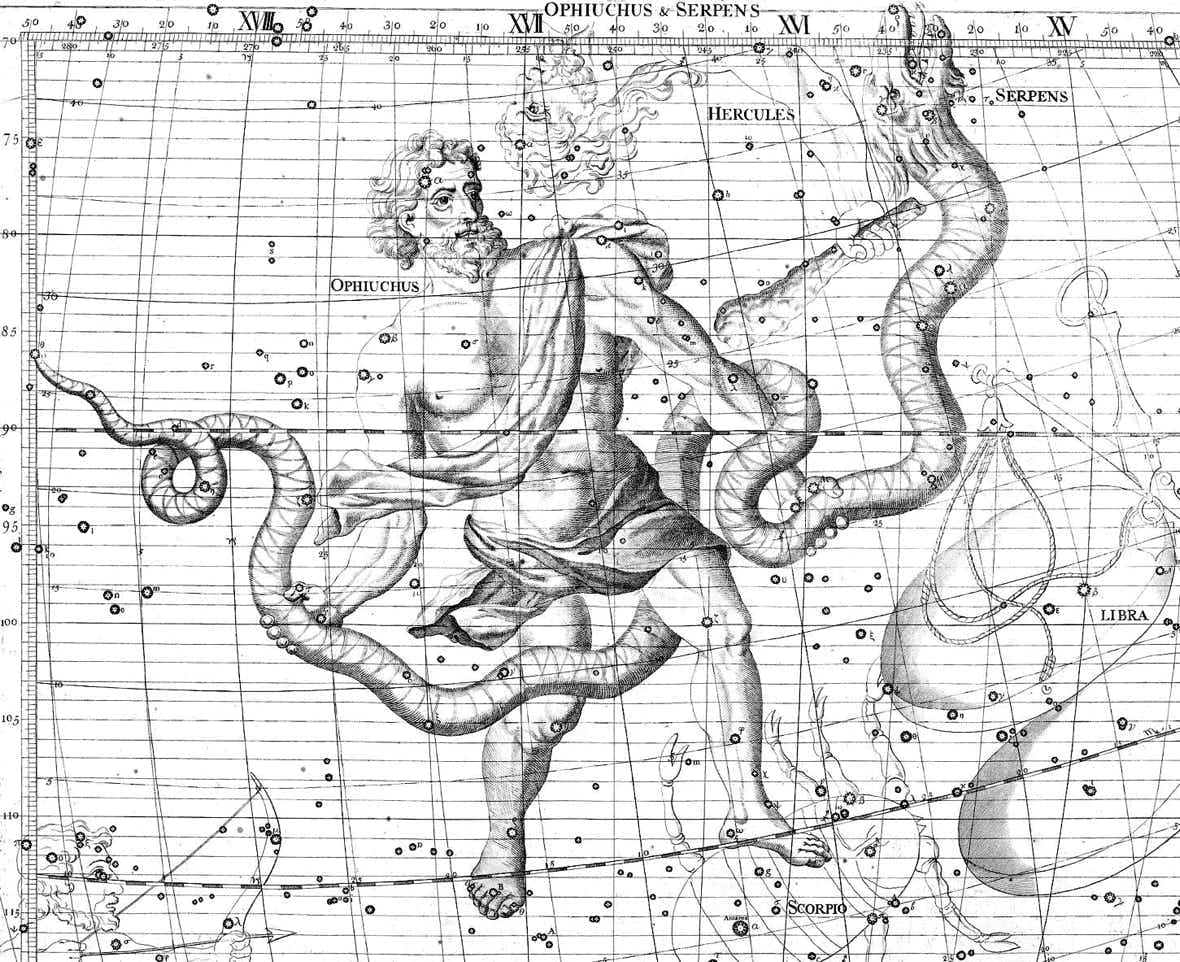
Ophiuchus holds a writhing snake, Serpens, in a double-handed grip as portrayed in the Atlas Coelestis of John Flamsteed (1729). Ophiuchus appears to stand on Scorpius, the scorpion, with his left foot, while his head lies next to that of Hercules. The V-shaped group of stars above the tail of the snake, next to the right shoulder of Ophiuchus, once formed part of the obsolete constellation Taurus Poniatovii. The dashed line crossing the feet of Ophiuchus is the Sun’s path, the ecliptic.
The Greeks identified him as Asclepius, the god of medicine (Aesculapius in Latin). Asclepius was the son of Apollo and Coronis (although some say that his mother was Arsinoë). The story goes that Coronis two-timed Apollo by sleeping with a mortal, Ischys, while she was pregnant by Apollo. A crow brought Apollo the unwelcome news, but instead of the expected reward the crow, which until then had been snow-white, was cursed by Apollo and turned black.
In a rage of jealousy, Apollo shot Coronis with an arrow. Rather than see his child perish with her, Apollo snatched the unborn baby from its mother’s womb as the flames of the funeral pyre engulfed her, and took the infant to Chiron, the wise centaur (represented in the sky by the constellation Centaurus).
Chiron raised Asclepius as his own son, teaching him the arts of healing and hunting. Asclepius became so skilled in medicine that not only could he save lives, he could also raise the dead.
Asclepius and the snake
On one occasion in Crete, Glaucus, the young son of King Minos, fell into jar of honey while playing and drowned. As Asclepius contemplated the body of Glaucus, a snake slithered towards it. He killed the snake with his staff; then another snake came along with a herb in its mouth and placed it on the body of the dead snake, which magically returned to life. Asclepius took the same herb and laid it on the body of Glaucus, who too was magically resurrected. (Robert Graves suggests that the herb was mistletoe, which the ancients thought had great regenerative properties, but perhaps it was actually willow bark, the source of salicylic acid, the active ingredient in aspirin.) Because of this incident, says Hyginus, Ophiuchus is shown in the sky holding a snake, which became the symbol of healing from the fact that snakes periodically shed their skin (a process known as ecdysis) and are thus seemingly reborn.
Others, though, say that Asclepius received from the goddess Athene the blood of Medusa the Gorgon. The blood that flowed from the veins on her left side was a poison, but the blood from the right side could raise the dead.
Someone else supposedly resurrected by Asclepius was Hippolytus, son of Theseus, who died when he was thrown from his chariot (some identify him with the constellation Auriga, the Charioteer). Reaching for his healing herbs, Asclepius touched the youth’s chest three times, uttering healing words, and Hippolytus raised his head.
Hades, god of the Underworld, began to realize that the flow of dead souls into his domain would soon dry up if this technique became widely known. He complained to his brother god Zeus who struck down Asclepius with a thunderbolt. Apollo was outraged at this harsh treatment of his son and retaliated by killing the three Cyclopes who forged Zeus’ thunderbolts. To mollify Apollo, Zeus made Asclepius immortal (in the circumstances he could hardly bring him back to life again) and set him among the stars as the constellation Ophiuchus.
Ophiuchus and the zodiac
Although Ophiuchus is not one of the official 12 constellations of the zodiac, the Sun passes through its southern regions in the first half of December. The Sun’s path, the ecliptic, is the black-and-white curved line crossing the feet of Ophiuchus in the star chart above. According to the modern constellation boundaries, the Sun spends more time in Ophiuchus than it does in neighbouring Scorpius. Hence Ophiuchus is sometimes referred to as the 13th sign of the zodiac.
Stars of Ophiuchus
The head of Ophiuchus is marked by its brightest star, second-magnitude Alpha Ophiuchi, called Rasalhague from the Arabic ra’s al-ḥawwā’ meaning ‘the head of the serpent holder’ (the Arabs called the constellation al-Ḥawwā’, the serpent holder). Beta Ophiuchi is called Cebalrai from the Arabic kalb al-rā’ī, ‘the shepherd’s dog’; the Arabs visualized a shepherd (the star Alpha Ophiuchi) along with his dog and some sheep in this area. Ptolemy in the Almagest located Beta Ophiuchi in the serpent holder’s right shoulder, along with Gamma; the left shoulder is marked by Iota and Kappa Ophiuchi. (Note that Bayer’s chart in his Uranometria showed Ophiuchus from behind, so left and right on that chart are reversed from the way they were described by Ptolemy.)
Delta and Epsilon Ophiuchi are called Yed Prior and Yed Posterior. These are compound names, formed from the Arabic al-yad, meaning ‘the hand’, with the Latin words Prior and Posterior added to give names meaning the ‘leading’ and ‘following’ parts of the hand, where Ptolemy had located them. The hand in question is the left one; the right hand, according to Ptolemy, was marked by the stars we now know as Nu and Tau Ophiuchi, but these have no proper names.
Zeta and Eta Ophiuchi are his left and right knees, while Rho and Theta Ophiuchi are in his feet. Scorpius, the scorpion, lies beneath his feet. Aratus said that Ophiuchus ‘tramples’ the scorpion with both feet, but in reality it is only the left foot that stands on the scorpion; the right foot remains well clear of it.
In the Almagest, Ptolemy listed a scattering of five stars between the right shoulder of Ophiuchus and the tail of the serpent which he regarded as being outside the main figure of Ophiuchus. These stars were later incorporated into the short-lived constellation Taurus Poniatovii. They are now officially part of Ophiuchus and are known as 66, 67, 68, 70, and 72 Ophiuchi. Barnard’s Star, the second-closest star to the Sun at a distance of 5.9 light years, lies in this same area, near 66 Ophiuchi, but is too faint to be seen with the naked eye.
Ophiuchus was the site of the last supernova seen in our Galaxy. This appeared in 1604 near Xi Ophiuchi in the right ankle of Ophiuchus and reached an estimated maximum magnitude of –3. It is known as Kepler’s Star after Johannes Kepler who described it in a book called De stella nova (1606).
Chinese associations
Ophiuchus, along with the southern part of Hercules and much of Serpens, was in an area of sky that the ancient Chinese visualized as a celestial market, Tianshi, bracketed on the east and west by walls. The left (east) wall of Tianshi started in Hercules and headed south via Serpens Cauda, ending in Ophiuchus at Eta Ophiuchi. The right (west) wall ran southwards from Hercules via Serpens Caput and ended with Delta, Epsilon, and Zeta Ophiuchi.
Alpha Ophiuchi (Rasalhague) was known to ancient Chinese astronomers as Hou, a senior assistant to the Emperor. The exact nature of Hou and his role is somewhat enigmatic; he is variously described as an overseer, an usher for receiving guests, or even an astrologer. The throne of the Emperor himself, called Dizuo, lay immediately to the north in Hercules, and was marked by Alpha Herculis.
Just to the south of Hou were three constellations with similar-sounding names: Zongzheng, Zongren, and Zong. Zongzheng, consisting of Beta and Gamma Ophiuchi, and Zongren (66, 67, 68, and 70 Ophiuchi) represented a governor and his aides for supervising the younger members of the royal family, while Zong (71 and 72 Oph) represented a revered ancestor of the royal family.
Mu, 47, 30, and a fainter star formed part of Shilou, a six-star loop representing a hall or tower housing the trading standards office; completing the shape were Omicron and Nu in Serpens Cauda. Closer to the right wall of the market, 20 Ophiuchi and another star were Chesi, interpreted variously as market stalls; a sales and service centre for wagons; or simply a group of customers, horses, and carts near the market entrance. Lambda Ophiuchi and Sigma Serpentis made Liesi, an arcade of jewellers’ shops. Iota and Kappa Ophiuchi were part of Hu, a measuring container for liquids that overlapped into Hercules.
In southern Ophiuchus, outside the walls of the market, Phi, Chi, Psi, and Omega Ophiuchi formed Dongxian, the western door to a stewards’ room for investigating trading infringements; the eastern door was Xixian, in Scorpius and Libra. Theta Ophiuchi and three other stars formed Tianjiang, ‘celestial river’, located in the Milky Way and said to govern waterways. Next to it was Tianyue, consisting of eight faint stars in Ophiuchus and Sagittarius and lying exactly on the ecliptic. Tianyue represented a lock or keyhole through which the Sun had to thread itself every year. It lay directly opposite in the sky from Tianguan, a gate on the ecliptic in Taurus.
© Ian Ridpath. All rights reserved
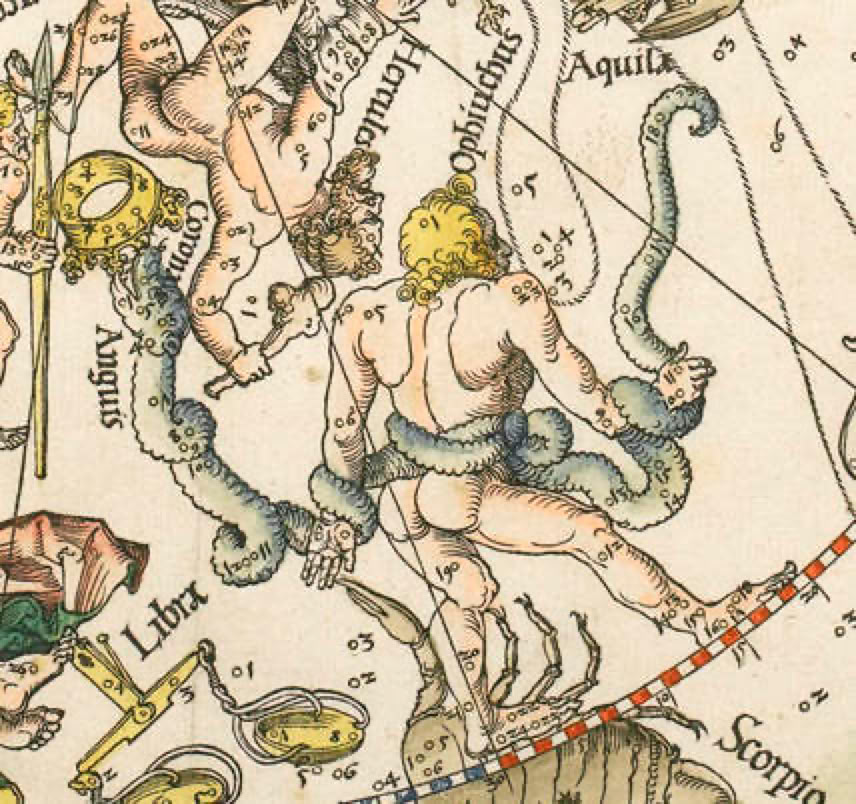
Ophiuchus with Serpens wrapped around his waist, as portrayed on Albrecht Dürer’s celestial hemisphere of 1515. The constellations are shown back to front, as they would appear on a globe. Here, Serpens is given the alternative name Anguis.
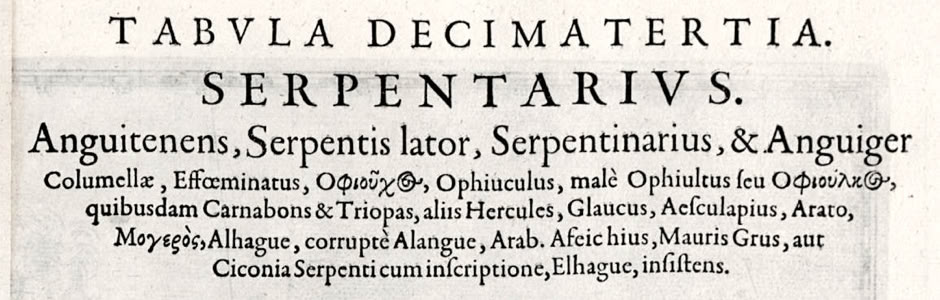
Johann Bayer called the constellation Serpentarius in the catalogue to his Uranometria atlas of 1603, followed by a long series of alternative names.
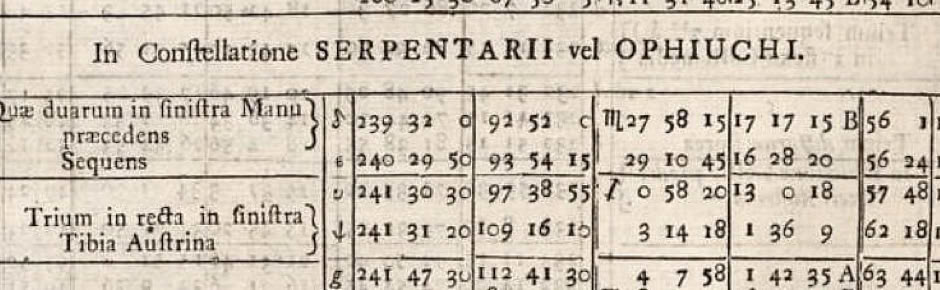
John Flamsteed put the name Serpentarius before Ophiuchus in his star catalogue, but on his chart he used only the name Ophiuchus.
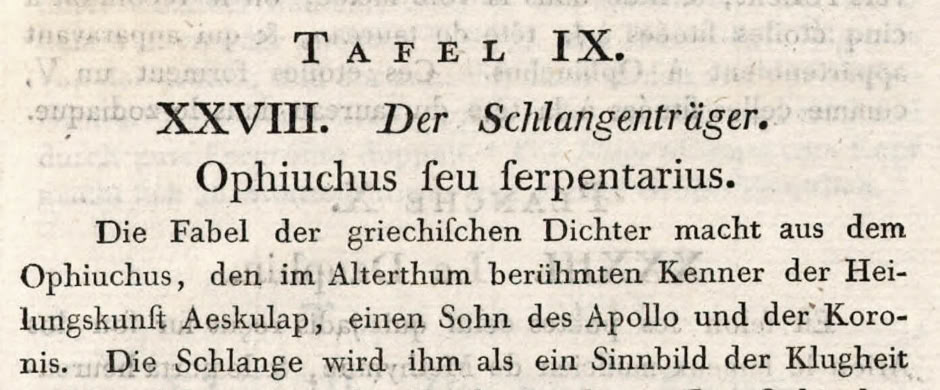
Johann Bode gave the name Serpentarius as an alternative to Ophiuchus in his star catalogue Allgemeine Beschreibung und Nachweisung der Gestirne (1801) that accompanied his great star atlas Uranographia.
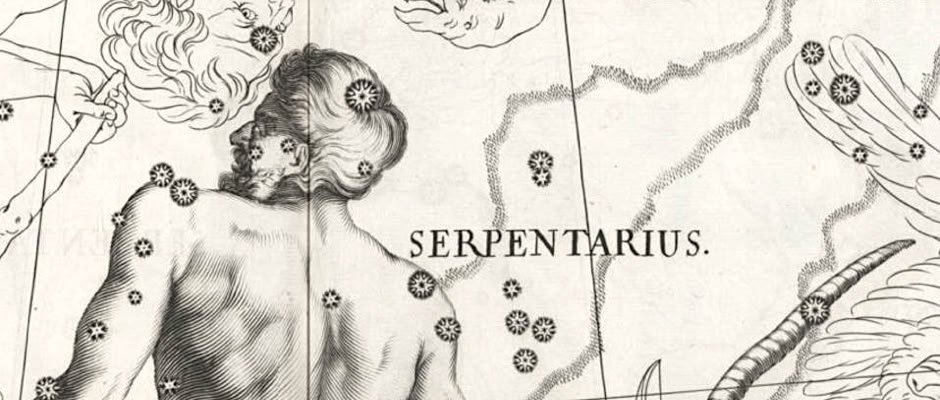
Serpentarius on Johannes Hevelius’s Firmamentum Sobiescianum atlas of 1690. Like all constellations in Hevelius’s atlas it is shown in mirror image, as on a celestial globe.
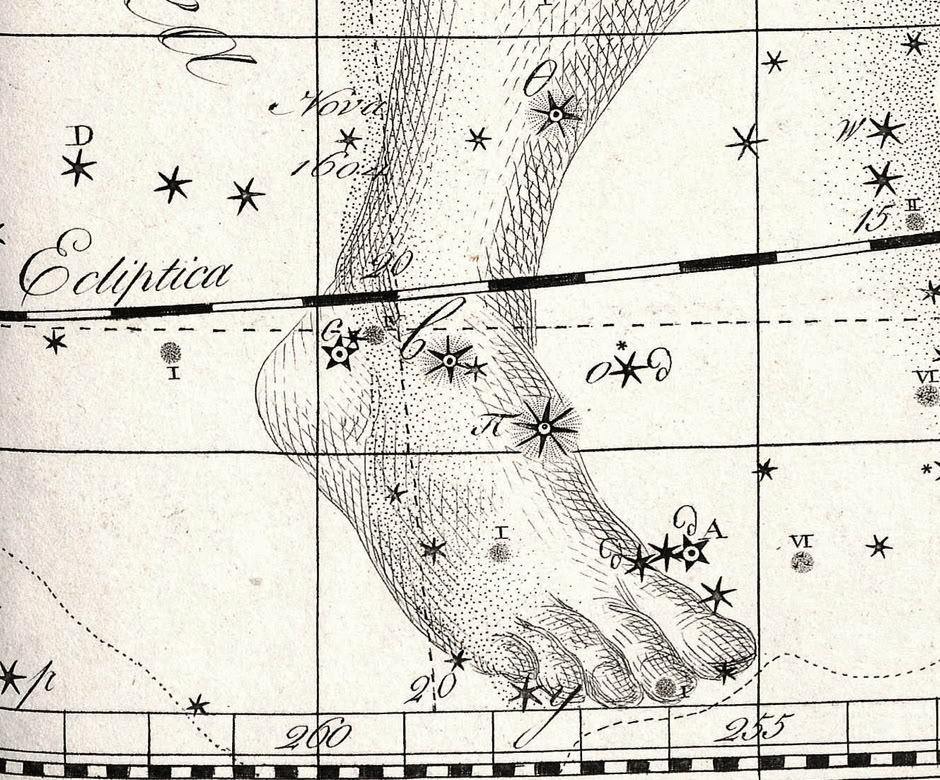
The last supernova in our Galaxy, labelled ‘Nova 1604’ on this chart from the Uranographia of Johann Bode, occurred in 1604 in Ophiuchus. The star labelled Theta (θ) at top centre is now known as Xi (ξ).