
Genitive: Leporis
Abbreviation: Lep
Size ranking: 51st
Origin: One of the 48 Greek constellations listed by Ptolemy in the Almagest
Greek name: Λαγωός (Lagoös)
This constellation was known to the Greeks as Λαγωός (Lagoös), the Greek word for hare; Lepus is the more recent Latin name. Eratosthenes tells us that Hermes placed the hare in the sky because of its swiftness. Both Eratosthenes and Hyginus referred to the remarkable fertility of hares, as attested to by Aristotle in his Historia Animalium (History of Animals): ‘Hares breed and bear at all seasons, superfoetate (i.e. conceive again) during pregnancy and bear young every month.’
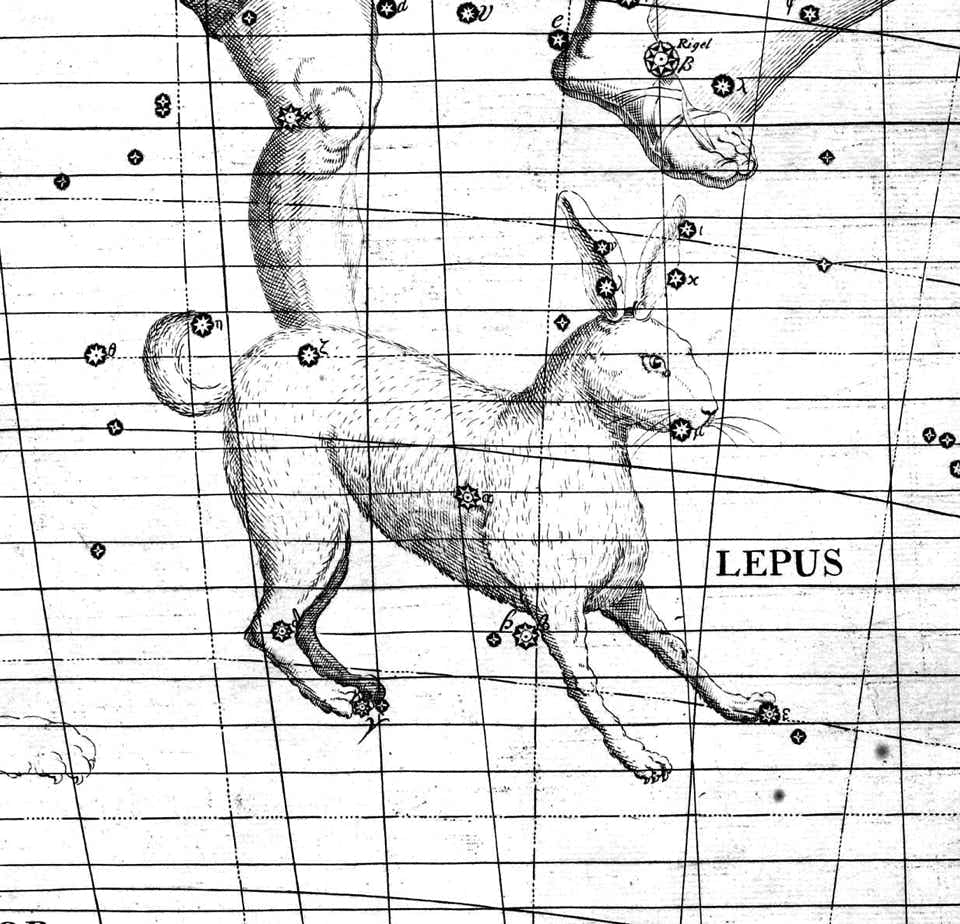
Lepus cowers under the feet of Orion, the hunter, as seen on the Atlas Coelestis
of John Flamsteed (1729).
The celestial hare makes an interesting tableau with Orion and his dogs. Aratus wrote that the Dog (Canis Major) pursues the hare in an unending race: ‘Close behind he rises and as he sets he eyes the setting hare.’ But judging by its position in the sky, the hare seems more to be crouched in hiding beneath the hunter’s feet.
Hyginus tells us the following moral tale about the hare. At one time there were no hares on the island of Leros, until one man brought in a pregnant female. Soon, everyone began to raise hares and before long the island was swarming with them. They overran the fields and destroyed the crops, reducing the population to starvation. By a concerted effort, the inhabitants drove the hares out of their island. They put the image of the hare among the stars as a reminder that one can easily end up with too much of a good thing.
The constellation’s brightest star, third-magnitude Alpha Leporis, is called Arneb, from the Arabic al-arnab meaning ‘the hare’, which was also the Arab name for the constellation as a whole. It lies in the middle of the animal’s body. The stars Kappa, Iota, Lambda, and Nu Leporis delineate the hare’s prominent ears.
Chinese associations
In the Chinese sky, four stars in the north of the modern Lepus, namely Iota, Kappa, Lambda, and Nu Leporis, formed Junjing, a well of drinking water for the army; noblemen had their own well, Yujing, on the border between Orion and Eridanus. Alpha, Beta, Gamma, and Delta Leporis formed Ce, a toilet, perhaps for use by those attending the annual hunt that was depicted in this part of the sky. A privacy screen, Ping, was formed by Mu and Epsilon Leporis. Droppings from the toilet were represented by a star to the south of Ce, in Columba.
© Ian Ridpath. All rights reserved