

Genitive: Herculis
Abbreviation: Her
Size ranking: 5th
Origin: One of the 48 Greek constellations listed by Ptolemy in the Almagest
Greek name: Ἐνγόνασι (Engonasi)
The origin of this constellation is so ancient that its true identity was lost even to the Greeks, who knew the figure as Ἐνγόνασι (Engonasi) or Ἐνγόνασιν (Engonasin), literally meaning ‘the kneeling one’. The Greek poet Aratus described him as being worn out with toil, his hands upraised, with one knee bent and a foot on the head of Draco, the dragon. ‘No one knows his name, nor what he labours at’, said Aratus. But Eratosthenes, a century after Aratus, identified the figure as Heracles (the Greek name for Hercules) triumphing over the dragon that guarded the golden apples of the Hesperides. The Greek playwright Aeschylus, quoted by Hyginus, offered a different explanation. He said that Heracles was kneeling, wounded and exhausted, during his battle with the Ligurians.
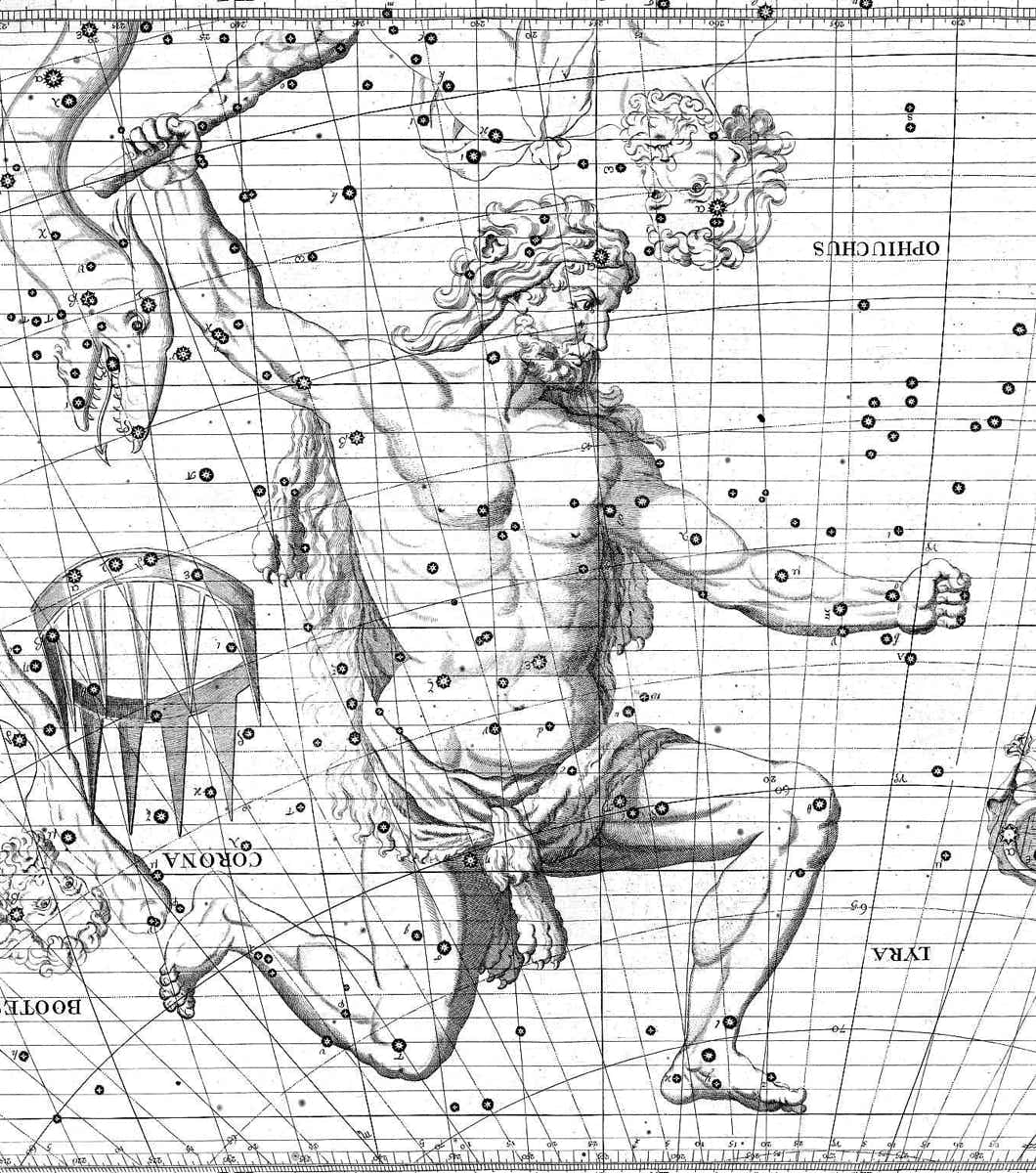
Hercules, the kneeling man, from the Atlas Coelestis of John Flamsteed (1729).
In the sky he is depicted with his feet towards the north celestial pole, his left foot
on the head of the dragon, Draco, and his own head next to that of Ophiuchus. Hercules wears a lion’s skin and in his right hand brandishes a club, his favourite weapon. Here his left hand is empty, but other illustrations show it grasping either the three-headed Cerberus or an apple branch.
Heracles is the greatest of Greek and Roman heroes, the equivalent of the Sumerian hero Gilgamesh. So it is surprising that the Greeks allotted him a constellation only as an afterthought. One reason may be that he was already sometimes personified as one of the heavenly twins represented by the constellation Gemini, the other twin being Apollo.
The full saga of Heracles is long and complex, as befits a legend that has grown in the telling. Heracles was the illicit son of the god Zeus and Alcmene, most beautiful and wise of mortal women, whom Zeus visited in the form of her husband, Amphitryon. The infant was christened Alcides, Alcaeus, or even Palaemon, according to different accounts; the name Heracles came later. Zeus’s real wife, Hera, was furious at her husband’s infidelity. Worse still, Zeus laid the infant Heracles at Hera’s breast while she slept, so that he suckled her milk. And having drunk the milk of a goddess, Heracles became immortal.
As Heracles grew up he surpassed all other men in size, strength and skills with weapons, but he was forever dogged by the jealousy of Hera. She could not kill him, since he was immortal, so instead she vowed to make his life as unpleasant as possible. Under Hera’s evil spell he killed his children in a fit of madness. When sanity returned, he went remorsefully to the Oracle at Delphi to ask how he might atone for his dreadful deed. The Oracle ordered him to serve Eurystheus, king of Mycenae, for 12 years. It was then that the Oracle gave him the name Heracles, meaning ‘glory of Hera’.
Labours of Heracles
Eurystheus set him a series of ten tasks that are called the Labours of Heracles. The first was to kill a lion that was terrorizing the land around the city of Nemea. This lion had a hide that was impervious to any weapon – so Heracles strangled it to death. He used its own claws to cut off the skin. Thereafter he wore the pelt of the lion as a cloak, with its gaping mouth as a helmet, which made him look even more formidable. The Nemean lion is identified with the constellation Leo.
The second labour was to destroy the multi-headed monster called the Hydra which lurked in the swamp near the town of Lerna, devouring incautious passers-by. Heracles grappled with the monster, but as soon as he cut off one of its heads, two grew to replace it. To make matters worse, a large crab came scuttling out of the swamp and nipped at the feet of Heracles. Angrily he stamped on the crab and called for help to Iolaus, his charioteer, who burned the stumps as each head was lopped to prevent more heads growing. Heracles gutted the Hydra and dipped his arrows in its poisonous blood – an action that would eventually be his undoing. Both the crab (Cancer) and the Hydra are commemorated as constellations.
For his next two labours, Heracles was ordered to catch elusive animals: a deer with golden horns, and a ferocious boar. Perhaps the most famous labour is his fifth, the cleaning of the dung-filled stables of King Augeias of Elis. Heracles struck a bargain with the king that he would clean out the stables in a single day in return for one-tenth of the king’s cattle. Heracles accomplished the task by diverting two rivers. But Augeias, claiming he had been tricked, renounced the bargain and banished Heracles from Elis.
The next task took him to the town of Stymphalus where he dispersed a flock of marauding birds with arrow-like feathers. The survivors flew to the Black Sea, where they subsequently attacked Jason and the Argonauts. Next, Heracles sailed to Crete to capture a fire-breathing bull that was ravaging the land. Some equate this bull with the constellation Taurus. For his eighth and ninth labours, Heracles brought to Eurystheus the flesh-eating horses of King Diomedes of Thrace and the belt of Hippolyte, queen of the Amazons.
Finally, Heracles was sent to steal the cattle of Geryon, a triple-bodied monster who ruled the island of Erytheia, far to the west. While sailing there, Heracles set up the columns at the straits of Gibraltar called the Pillars of Heracles. He killed Geryon with a single arrow that pierced all three bodies from the side, then drove the cattle back to Greece. On route through Liguria, in southern France, he was set upon by local forces who so outnumbered him that he ran out of arrows. Sinking to his knees, he prayed to his father, Zeus, who rained down rocks on the plain. Heracles hurled these rocks at his attackers and routed them. According to Aeschylus, this is the incident that is recorded by the constellation Engonasin, the kneeler.
Two more tasks – mission creep
When Heracles returned from the last of these exploits, the cowardly and deceitful Eurystheus refused to release him from his service because Heracles had received help in slaying the Hydra and had attempted to profit from the stable-cleaning. Hence Eurystheus set two additional tasks, even more difficult than those before. The first was to steal the golden apples from the garden of Hera on the slopes of Mount Atlas. The tree with the golden fruit had been a wedding present from Mother Earth (Gaia) when Hera married Zeus. Hera set the Hesperides, daughters of Atlas, to guard the tree, but they stole some of the precious produce. So now the dragon Ladon lay coiled around the tree to prevent any further pilfering.
After a heroic journey, during which he released Prometheus from his bonds, Heracles came to the garden where the golden apples grew. Nearby stood Atlas, supporting the heavens on his shoulders. Heracles dispatched Ladon with a well-aimed arrow, and Hera set the dragon in the sky as the constellation Draco. Heracles had been advised (by Prometheus, says Apollodorus) not to pick the apples himself, so he invited Atlas to fetch them for him while he temporarily supported the skies. Heracles hastily returned the burden of the skies to the shoulders of Atlas before making off with the golden treasure.
The twelfth labour, the most daunting of all, took him down to the gates of the Underworld to fetch Cerberus, the three-headed watchdog. Cerberus had the tail of a dragon and his back was covered with snakes. A more loathsome creature would be difficult to imagine but Heracles, protected from the tail and the snakes by the skin of the Nemean lion, wrestled Cerberus with his bare hands and dragged the slavering dog to Eurystheus. The startled king had never expected to see Heracles alive again. Now, with all the labours completed, Eurystheus had no option but to make Heracles a free man again.
© Ian Ridpath. All rights reserved