

Genitive: Equulei
Abbreviation: Equ
Size ranking: 87th
Origin: One of the 48 Greek constellations listed by Ptolemy in the Almagest
Greek name: Ἵππου Προτομή (Hippou Protome)
This insignificant constellation, second-smallest in the sky, was one of the 48 constellations listed by the Greek astronomer Ptolemy in the second century AD. It was unknown to Aratus 400 years earlier, and its invention is often attributed to Ptolemy. In the Almagest he called it Ἵππου Προτομή (Hippou Protome), the forepart of a horse; Equuleus is a later Latin name.
However, that is not the whole story. The Greek writer Geminus, who pre-dated Ptolemy by a century or two (his exact dates are unknown), tells us in his book Introduction to the Phenomena that Hipparchus introduced a constellation called Protome hippou (Προτομὴ Ἵππου) in the second century BC. We do not have Hipparchus’s original to check, but presumably it was the same constellation that Ptolemy adopted for his own catalogue. Hence the true inventor of Equuleus seems to have been Hipparchus rather than Ptolemy.
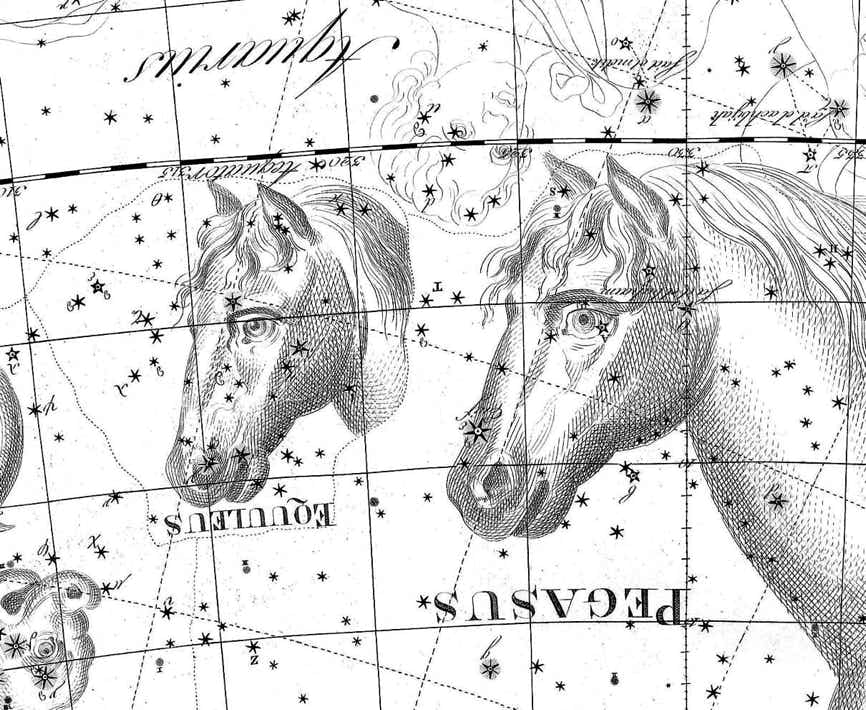
Equuleus, the little horse or foal, seen next to the head of Pegasus on
Chart X of the Uranographia of Johann Bode (1801).
Ptolemy assigned four stars to Equuleus, which we know today as Alpha, Beta, Gamma, and Delta Equulei, but gave no brightness estimates for them, describing them simply as ‘faint’; in fact they are of 4th and 5th magnitudes. Equuleus was visualized as the head of a horse, next to the head of the much better-known horse Pegasus. Bayer in his Uranometria atlas termed it Equus Minor, and showed its head emerging from clouds.
The early mythologists such as Eratosthenes and Hyginus never mentioned this little horse, but perhaps Ptolemy (or Hipparchus) had in mind the story of Hippe and her daughter Melanippe, sometimes told for Pegasus but which seems more appropriate for Equuleus. Hippe, daughter of Chiron the centaur, one day was seduced by Aeolus, grandson of Deucalion. To hide the secret of her pregnancy from Chiron she fled into the mountains, where she gave birth to Melanippe. When her father came looking for her, Hippe appealed to the gods who changed her into a mare. Artemis placed the image of Hippe among the stars, where she still hides from Chiron (represented by the constellation Centaurus), with only her head showing.
The constellation’s brightest star, fourth-magnitude Alpha Equulei, is called Kitalpha from the Arabic qiṭ’at al-faras meaning ‘part of the horse’, their name for the constellation as a whole. In 2026 the IAU gave the name Protome to the 6th-magnitude star 6 Equulei, on the foal’s nose, after the original Greek name of the constellation.
Chinese associations
In the Chinese constellation system Alpha Equulei was joined with Beta Aquarii to form Xu (‘emptiness’), a place connected with death and mourning, after which the 11th Chinese lunar mansion was named. Between Xu and the 12th mansion, Wei, were four pairs of stars representing deities who acted as judges or arbiters on various matters. Delta and Gamma Equulei were Sifei (a deity governing matters of right and wrong), while Beta and 9 Equulei were Siwei (governing disaster and good fortune). The other two, Silu and Siming, judges of rank and life, were over the border in adjoining Pegasus and Aquarius.
© Ian Ridpath. All rights reserved