

Genitive: Delphini
Abbreviation: Del
Size ranking: 69th
Origin: One of the 48 Greek constellations listed by Ptolemy in the Almagest
Greek name: Δελφίν (Delphin)
Dolphins were a familiar sight to Greek sailors, so it is not surprising to find one of these friendly and intelligent creatures depicted in the sky. Two stories account for the presence of the celestial dolphin. According to Eratosthenes, this jaunty dolphin represents the messenger of the sea god Poseidon.
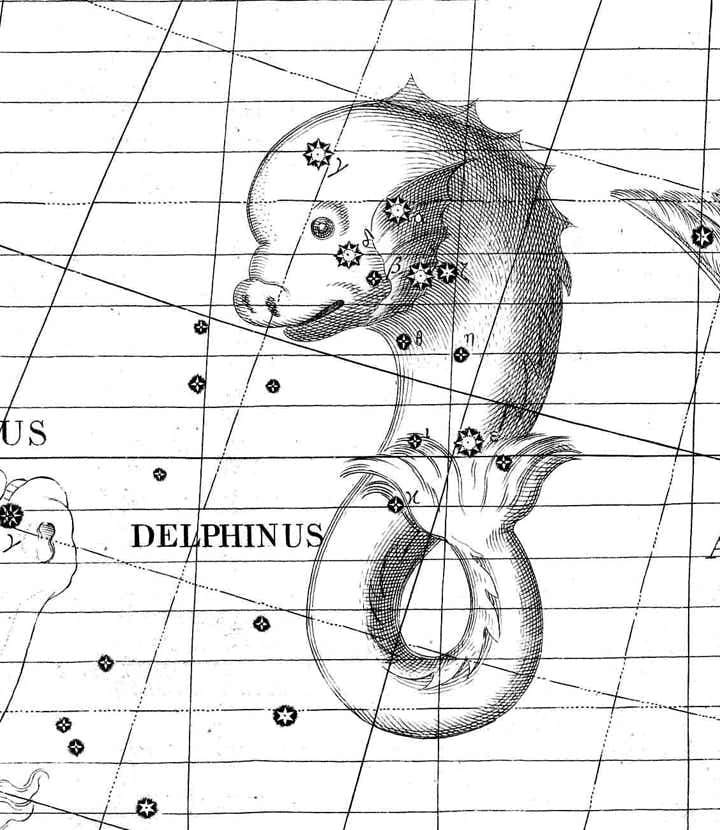
A playful-looking Delphinus leaps among the stars in the
Atlas Coelestis of John Flamsteed (1729).
After Zeus, Poseidon, and Hades had overthrown their father Cronus, they divided up the sky, the sea, and the underworld between them, with Poseidon inheriting the sea. He built himself a magnificent underwater palace off the island of Euboea. For all its opulence, the palace felt empty without a wife, so Poseidon set out in search of one. He courted Amphitrite, one of the group of sea nymphs called Nereids, but she fled from his rough advances and took refuge among the other Nereids. Poseidon sent messengers after her, including a dolphin, which found her and with soothing gestures brought her back to the sea god, whom she subsequently married. In gratitude, Poseidon placed the image of the dolphin among the stars.
Saving Arion
Another story, given by Hyginus and Ovid, says that this is the dolphin that saved the life of Arion, a real-life poet and musician of the seventh century BC. Arion was born on the island of Lesbos, but his reputation spread throughout Greece for he was said to be unequalled in his skill with the lyre. While Arion was returning to Greece by ship from a concert tour of Sicily and southern Italy, the sailors plotted to kill him and steal the small fortune that he had earned.
When the sailors surrounded him with swords drawn, Arion asked to be allowed to sing one last song. His music attracted a school of dolphins which swam alongside the ship, leaping playfully. Placing his faith in the gods, Arion leaped overboard – and one of the dolphins carried him on its back to Greece, where Arion later confronted his attackers and had them sentenced to death. Apollo, god of music and poetry, placed the dolphin among the constellations, along with the lyre of Arion which is represented by the constellation Lyra. Delphinus was known in Greek as Δελφίν (Delphin) or Δελφίς (Delphis).
Stars of Delphinus
Two stars in Delphinus bear the peculiar names Sualocin and Rotanev, which first appeared in the Palermo Catalogue of 1814 compiled by the Italian astronomer Giuseppe Piazzi (1746–1826). Read backwards, these names spell out Nicolaus Venator, the Latinized form of Niccolò Cacciatore (1770–1841), who was Piazzi’s assistant and eventual successor at Palermo Observatory. It is usually said that Cacciatore was responsible for the naming, which would make him the only person to have named a star after himself and got away with it. However, it is equally possible that the names were applied by Piazzi to honour his heir apparent, or ‘dauphin’ (dolphin).
The constellation was once popularly called Job’s Coffin, presumably from its elongated box-like shape, although sometimes this name is restricted to the diamond formed by the four stars Alpha, Beta, Gamma, and Delta Delphini. Who originated the name Job’s Coffin, or when, is not known.
Chinese associations
The stars of Job’s Coffin (i.e. Alpha, Beta, Gamma, and Delta Delphini) plus Zeta Delphini formed the Chinese constellation Hugua, while Epsilon, Eta, Theta, Iota, and Kappa Delphini were Baigua. These two Chinese constellations represented a pair of gourds, probably from the calabash vine, also known as the bottle-gourd plant. Calabash are a kind of melon, grown for food and for use as containers. Hugua was said to be a hard, dried gourd, presumably intended as a container or scoop, whereas Baigua was described as an over-ripe or rotten gourd, evidently having gone off.
© Ian Ridpath. All rights reserved



The star names Sualocin and Rotanev first appeared in Giuseppe Piazzi’s Palermo Catalogue of 1814.