

Genitive: Cygni
Abbreviation: Cyg
Size ranking: 16th
Origin: One of the 48 Greek constellations listed by Ptolemy in the Almagest
Greek name: Ὄρνις (Ornis)
A popular name for Cygnus is the Northern Cross, and indeed its shape is far larger and more distinctive than the famous Southern Cross. In its cruciform shape the Greeks visualized the long neck, outstretched wings, and stubby tail of a swan flying along the Milky Way, in which it is embedded. Aratus’s description of it as being hazy or misty in parts is no doubt a reference to the Milky Way running through it. The mythographers tell us that the swan is Zeus in disguise, on his way to one of his innumerable love affairs, but his exact quarry is a subject of some disagreement.
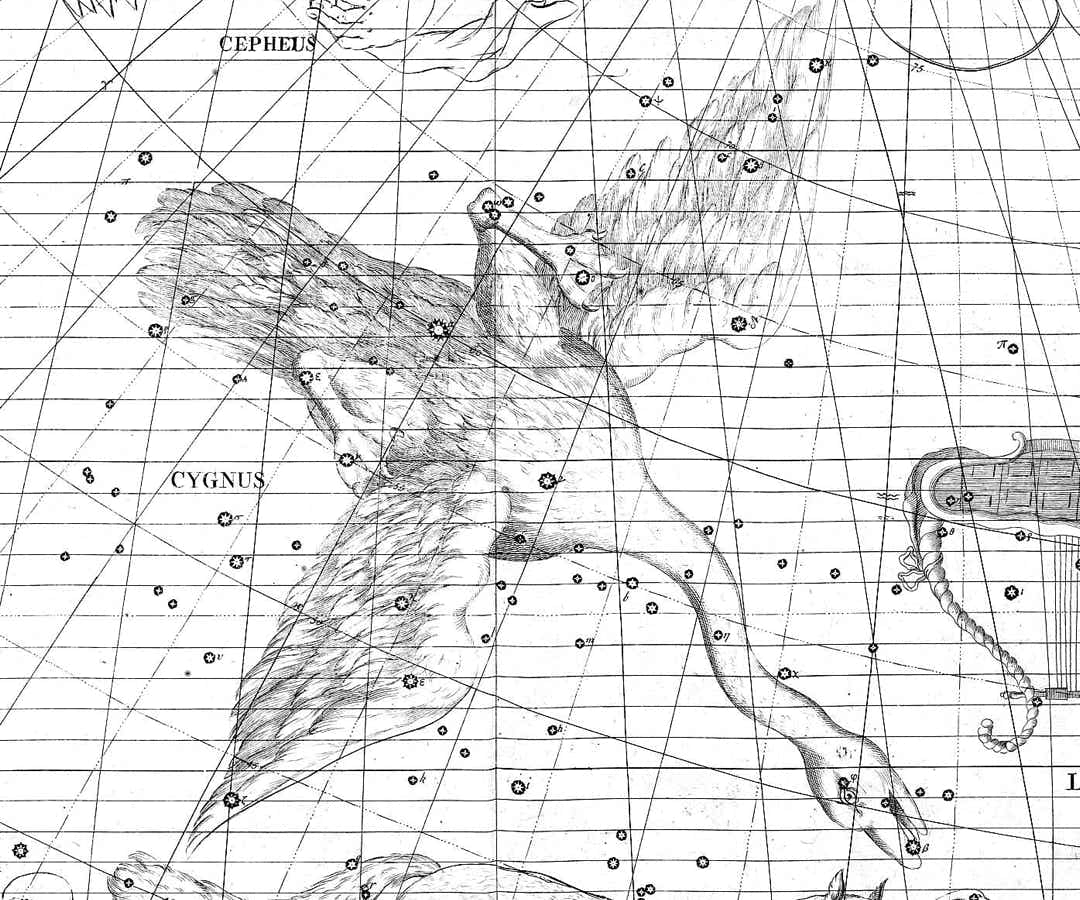
Cygnus flying down the Milky Way in a chart from the Atlas Coelestis of John Flamsteed (1729). The bird is seen from below, with its legs and claws visible. At the root of its tail lies the bright star Deneb, here labelled simply with the Greek letter Alpha.
The version of the tale that goes back to Eratosthenes in the third century BC says that Zeus one day took a fancy to the nymph Nemesis, who lived at Rhamnus, some way north-east of Athens. To escape his unwelcome advances she assumed the form of various animals, first jumping into a river, then fleeing across land, before finally taking flight as a goose. Not to be outdone, Zeus pursued her through all these transformations, at each step turning himself into a larger and swifter animal, until he finally became a swan in which form he caught and raped her. Hyginus tells a similar story, but does not mention the metamorphoses of Nemesis. Rather, he says that Zeus pretended to be a swan escaping from an eagle and that Nemesis gave the swan sanctuary. Only after she had gone to sleep with the swan in her lap did she discover her mistake.
In both versions the outcome was that Nemesis produced an egg which was then given to Queen Leda of Sparta, some say by Hermes and others say by a passing shepherd who found the egg in a wood. Out of the egg hatched the beautiful Helen, later to become famous as Helen of Troy.
Leda and the swan
A simpler alternative says that Zeus seduced Leda in the form of a swan by the banks of the river Eurotas; with this story in mind, Germanicus Caesar refers to the swan as the ‘winged adulterer’. Leda was the wife of King Tyndareus of Sparta, which considerably complicated the outcome because she also slept with her husband later the same night.
According to one interpretation, she gave birth to a single egg from which hatched the twins Castor and Polydeuces as well as Helen. The shell of this egg was said to have been put on display at a temple in Sparta, hanging by ribbons from the ceiling. A rival account says that Leda produced two eggs, from one of which emerged Castor and Polydeuces while from the other came Helen and her sister Clytemnestra. To add to the confusion, Polydeuces and Helen were reputedly the children of Zeus, while Castor and Clytemnestra were fathered by Tyndareus. Castor and Polydeuces are commemorated by the constellation Gemini, where Polydeuces is better known by his Latin name, Pollux.
Aratus called the constellation simply Ὄρνις (Ornis), the bird. Its identification with a swan (Κύκνος, i.e. Kyknos, or Cygnus in Latin transliteration) was introduced half a century later by Eratosthenes. Despite Eratosthenes’s identification of the constellation with a swan, Ptolemy followed Aratus by referring to it as an anonymous Bird in his Almagest some 350 years later.
Deneb and Albireo – plus an unusual variable
Cygnus’s brightest star, Deneb, marks the tail of the swan; its name comes from dhanab, the Arabic word for ‘tail’. Bode’s atlas called it Deneb Edegige, corrupted from the Arabic dhanab al-dajāja, meaning tail of the hen. Surprisingly, the Greeks had no name for this prominent star. Deneb is a highly luminous supergiant about 1,400 light years away, the most distant of all first-magnitude stars. It forms one corner of the so-called Summer Triangle of stars completed by Vega in the constellation Lyra and Altair in Aquila.
The beak of the swan is marked by a star named Albireo, revealed by small telescopes to be a beautiful coloured double star of green and amber, like a celestial traffic light. The German historian Paul Kunitzsch has traced the tortuous history of the name Albireo. It started with an Arabic translation of the Greek word for ‘bird’, Ὄρνις (ornis), the name which Aratus and Ptolemy gave for the constellation. In the Middle Ages this Arabic name was mistranslated back into Latin, where it was described as ‘ab ireo’, meaning that it was thought to come from the name of a certain herb. This phrase was itself mistaken for an Arabic name and was rewritten as albireo. Hence the name Albireo, although it looks Arabic, is completely meaningless.
The four main stars in the wings of the swan, i.e. Zeta, Epsilon, Gamma, and Delta Cygni, were known by Arab astronomers as al-fawāris, the horsemen (sometimes Kappa Cygni was included as well). In commemoration of this Arabic asterism, third-magnitude Delta Cygni is officially named Fawaris. On this Arabic visualization Deneb was al-ridf, the rear rider, from which came its alternative name Arided.
Johann Bayer’s chart of Cygnus includes a third-magnitude star in the neck of the swan that he labelled P. This star was not known to Ptolemy or Tycho but was first spotted in August 1600 by the Dutch cartographer and astronomer Willem Janszoon Blaeu (1571–1638). P Cygni was only the second variable star to be discovered, the first being Mira in Cetus, although it was originally classified as a nova. It is now known to be a rare type of hot, massive star termed a luminous blue variable (LBV). Since Bayer’s time it has fluctuated between 3rd and 6th magnitude and currently sits at magnitude 4.8.
Chinese associations
In Chinese astronomy, the Milky Way was visualized as a celestial river, Tianhe. Deneb and eight stars in the wings of Cygnus, including Gamma, Delta, and Epsilon Cygni, were known as Tianjin, a ford or bridge across the river. The river appeared to be shallower in this region because, as we now know, a dark cloud of dust called the Cygnus Rift obscures light from the stars behind.
Four stars in northern Cygnus centred on Iota Cygni formed Xizhong, named after a legendary charioteer said to be the inventor of the horse-drawn carriage – perhaps the Chinese equivalent of Auriga.
Seven stars in Cygnus and Lacerta formed Chefu, a marshalling yard for chariots, but there is no consistency between sources as to which stars were involved; in fact, Sun and Kistemaker restrict Chefu to Cygnus alone. Crossing the opposite border from Lyra into Cygnus was a line of five stars ending with 4 and 8 Cygni that formed Niandao, a route between royal palaces.
Surprisingly, Beta Cygni (Albireo) and the other stars in the neck of Cygnus were not incorporated into any Chinese constellations.
© Ian Ridpath. All rights reserved
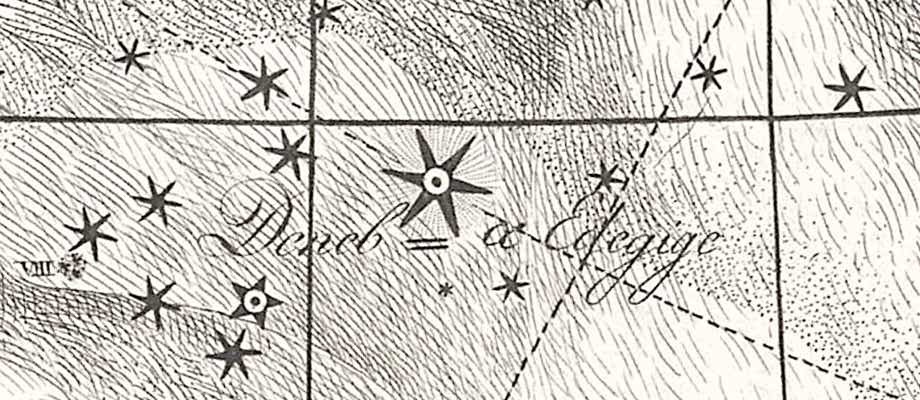
Deneb (Alpha Cygni) was named Deneb Edegige on Chart VIII of Johann Bode’s Uranographia star atlas of 1801.
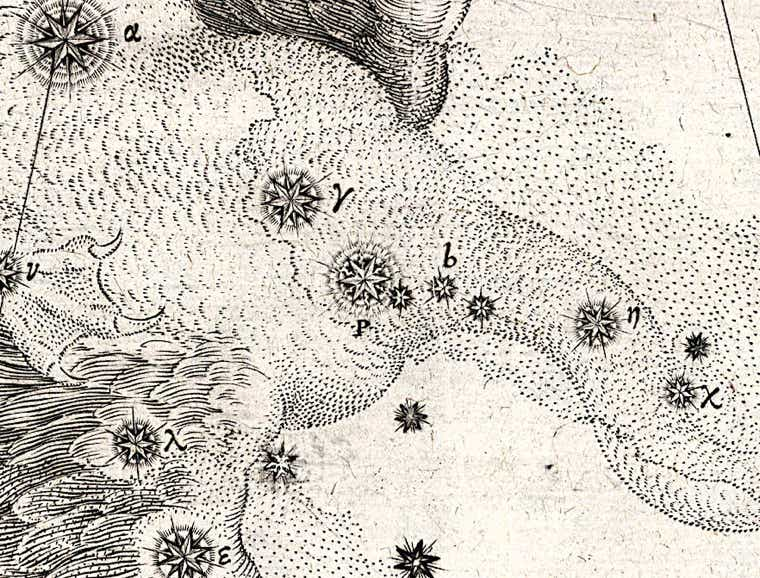
The variable star P Cygni (centre) labelled on Johann Bayer’s chart of Cygnus. The star was first noticed by astronomers when it brightened to 3rd magnitude in 1600, only three years before Bayer’s atlas was published.