


Genitive: Coronae Borealis
Abbreviation: CrB
Size ranking: 73rd
Origin: One of the 48 Greek constellations listed by Ptolemy in the Almagest
Greek name: Στέφανος (Stephanos)
A semicircle of stars between Boötes and Hercules marks the golden crown worn by Princess Ariadne of Crete when she married the god Dionysus (known to the Romans as Bacchus). The crown is said to have been made by Hephaestus, the god of fire, and was studded with jewels from India.
Ariadne, daughter of King Minos of Crete, is famous in mythology for her part in helping Theseus to slay the Minotaur, the gruesome creature with the head of a bull on a human body. Ariadne was actually half-sister to the Minotaur, for her mother Pasiphae had given birth to the creature after copulating with a bull owned by King Minos. To hide the family’s shame, Minos imprisoned the Minotaur in a labyrinth designed by the master craftsman Daedalus. So complex was the maze of the labyrinth that neither the Minotaur nor anyone else who ventured in could ever find their way out.
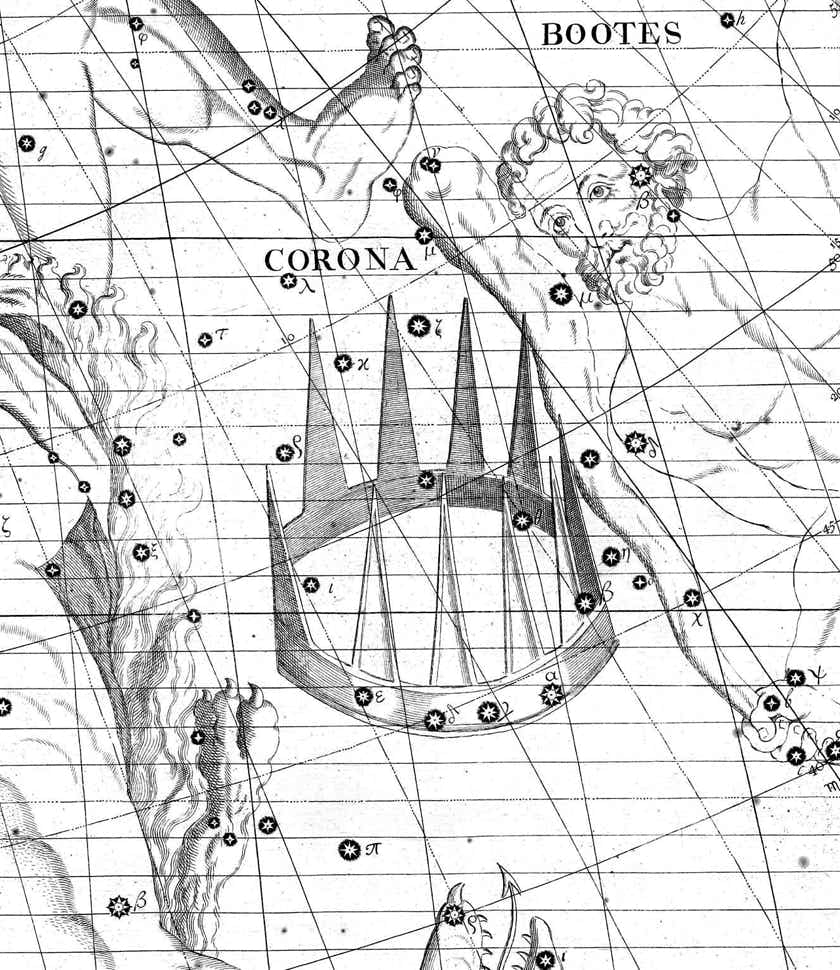
Corona Borealis, the jewelled crown of Princess Ariadne, shown in the Atlas Coelestis of John Flamsteed (1729). Johann Bayer, though, imagined it as a floral wedding wreath in his Uranometria atlas of 1603.
One day the hero Theseus, son of King Aegeus of Athens, came to Crete. Theseus was a strong, handsome man with many of the qualities of Heracles and was unsurpassed as a wrestler. Ariadne fell in love with him on sight. When Theseus offered to kill the Minotaur she consulted Daedalus, who gave her a ball of thread and advised Theseus to tie one end to the door of the labyrinth and pay out the thread as he went along. After killing the Minotaur with his bare hands, Theseus emerged by following the trail of thread back to the door.
He sailed off with Ariadne, but no sooner had they reached the island of Naxos than he abandoned her. As she sat there, cursing Theseus for his ingratitude, she was seen by Dionysus. The god’s heart melted at the sight of the forlorn girl and he married her on the spot.
Accounts differ about where Ariadne’s crown came from. One story says that it was given to her by Aphrodite as a wedding present. Others say that Theseus obtained it from the sea nymph Thetis, and that its sparkling light helped Theseus find his way through the labyrinth. Whatever the case, after their wedding Dionysus joyfully tossed the crown into the sky where its jewels transformed into stars. The scene was imagined in a famous painting by the 16th-century Venetian artist Titian titled Bacchus and Ariadne, although Titian’s depiction of the starry crown is not astronomically accurate.
The Greeks knew Corona as Στέφανος (Stephanos), meaning ‘crown’ or ‘wreath’. In the Almagest, Ptolemy listed eight stars in the arc of the crown from the modern Pi (π) to Iota (ι) CrB. Its brightest star, second-magnitude Alpha, is officially called Alphecca from the Arabic name for the constellation, al-fakka, although it was once also known as Gemma, the Latin for ‘jewel’. In 2026 the IAU gave the name Stephanos to Pi CrB, commemorating the ancient Greek name for the constellation as a whole.
The Blaze Star
In 1866 the Irish astronomer John Birmingham discovered a ‘new’ star of magnitude 2 in the southern part of Corona Borealis, near Epsilon CrB, which faded below naked-eye visibility over the following week. This object was in fact a nova, the first to be identified with an existing star, the 10th-magnitude BD +26°2765, and now has the variable star designation T Coronae Borealis (T CrB). It turned out to be a recurrent nova, having flared up again in 1946, suggesting that it has a cycle of 80 years or so.
The British spectroscopist William Allen Miller referred to it as the Blaze Star in a lecture in 1869. This name was popularized by the British astronomy writer R. A. Proctor (1872) and later by his daughter Mary Proctor (1897) and it was adopted as an official name for T CrB by the IAU in 2025.
Chinese associations
Corona Borealis is one of the few constellations that ancient Chinese astronomers drew in much the same way as we do, namely as an arc or loop. Hence it is relatively easy to pick out on Chinese star charts. Chinese astronomers charted nine stars in the loop, from Pi to Rho Coronae Borealis, which they called Guansuo, the prison for working-class miscreants; the prison for the upper classes, Tianlao, was more auspiciously placed farther north, in Ursa Major.
Xi Coronae Borealis was one end of the constellation Tianji, which extended over the border from neighbouring Hercules.
© Ian Ridpath. All rights reserved