

Genitive: Ceti
Abbreviation: Cet
Size ranking: 4th
Origin: One of the 48 Greek constellations listed by Ptolemy in the Almagest
Greek name: Κῆτος (Ketos)
When Cassiopeia, wife of King Cepheus of Ethiopia, boasted that she was more beautiful than the sea nymphs called the Nereids she set in motion one of the most celebrated stories in mythology, the main characters of which are commemorated among the constellations. In retribution for the insult to the Nereids, the sea god Poseidon sent a fearsome monster to ravage the coast of Cepheus’s territory. That monster, a dragon of the sea, is represented by the constellation Cetus.
To rid himself of the monster, Cepheus was instructed by the Oracle of Ammon to offer up his daughter Andromeda as a sacrifice to the monster. Andromeda was chained to the cliffs at Joppa (the modern Tel-Aviv) to await her terrible fate.
Cetus was visualized by the mythologists as a hybrid creature, with enormous gaping jaws and the forefeet of a land animal, attached to a scaly body with huge coils like a sea serpent. Hence Cetus is drawn on star maps as a most unlikely looking creature, more comical than frightening. It is sometimes identified as a whale because the Latin word Cetus means whale. However the original Greek name, Ketos, referred to any large aquatic creature or sea monster, and in most depictions it looks nothing like a whale.
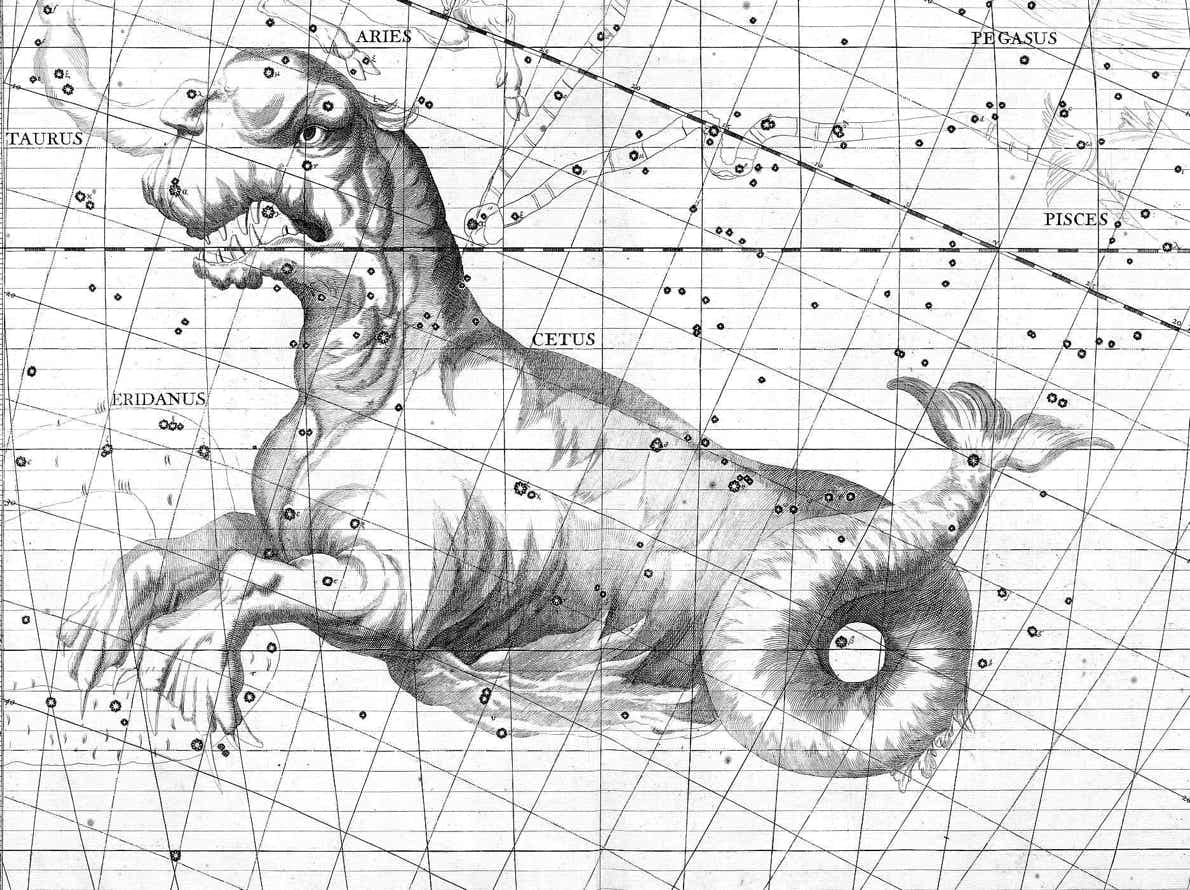
The bizarre-looking sea monster Cetus emerging from the ocean of the
southern skies, illustrated in the Atlas Coelestis of John Flamsteed (1729).
Bode in his Uranographia gave it the alternative title Monstrum Marinum.
Andromeda trembled as the B-movie monster made towards her, cleaving through the waves like a huge ship. Fortunately, at this moment the hero Perseus happened by and sized up the situation. Swooping down like an eagle onto the creature’s back, Perseus drove his diamond-hard sword deep into its right shoulder. Agonized and enraged, the wounded monster reared up on its coils and twisted around, its cruel jaws snapping at its attacker. Again and again Perseus plunged his sword into the beast – through its ribs, its barnacle-encrusted back, and at the root of its tail. Spouting blood, the monster finally collapsed into the sea and lay there like a waterlogged hulk. Its corpse was hauled on shore by the appreciative locals who skinned it and put its bones on display.
Amazing Mira and the stars of Cetus
Cetus (Κῆτος in Greek) is the fourth-largest constellation, as befits such a monster, but none of its stars is particularly prominent. The brightest of them is second-magnitude Beta Ceti, officially named Diphda by the IAU from the Arabic al-ḍifdi’ referring to the second of a pair of frogs; the first frog was Fomalhaut. It was once also known as Deneb Kaitos from the Arabic meaning sea monster’s tail. Ptolemy in the Almagest described this star as lying on the end of the southern tail fin; the northern fin was marked by the star we now know as Iota Ceti. Albrecht Dürer imagined Cetus as a large fish with a forked tail on his celestial chart of 1515, but from Bayer’s Uranometria of 1603 onwards it was depicted as a monster with a looping tail, with Beta lying on the coil and Iota on the tail fin. Alpha Ceti is called Menkar from the Arabic al-minkhar meaning ‘nostrils’, a misnomer since this star lies on the beast’s jaw – according to Ptolemy, the star on the nostrils was actually the one to the north we know as Lambda Ceti.
The most celebrated star in Cetus is Omicron Ceti, popularly known as Mira, which lies at the base of the monster’s neck. Its name means ‘wonderful’ or ‘amazing’, given on account of its variability in brightness. Mira is a red giant star whose brightness variations are caused by changes in size. At times it can easily be seen with the naked eye, but for most of the time it is so faint that it is invisible without binoculars or a telescope; hence it went unnoticed by Ptolemy and Tycho.
The star was first recorded in 1596 by the German astronomer David Fabricius (1564–1617), but the cyclic nature of the changes was not recognized until 1638 by the Dutch astronomer Johannes Phocylides Holwarda (1618–51). The name Mira was given to the star by the Polish astronomer Johannes Hevelius in his report titled Historiola mirae stellae of 1662, when it was the only variable star known. Hevelius reported his own observations of its brightness and gave a chart of the star’s position, labelling it ‘Nova’. Bode in his Uranographia labelled it ‘variabilis 1596’.
Chinese associations
When the Chinese constellation system was first established some 2,000 years ago this area of sky was rising in the early evening in the autumn, and so became associated with agriculture and harvesting, particularly the storage of cereals. Two granaries can be found in Cetus: Tianjun, a circular one, formed by thirteen stars in what we visualize as the head and neck of the sea monster, including Alpha, Gamma, Delta, and Xi Ceti; and Tiancang, a square one, formed by six stars in the monster’s body (Iota, Eta, Theta, Zeta, Tau, and Upsilon). Despite their names, the shapes formed by the stars of Tianjun and Tiancang are not circular or square. A third granary, Tianlin, was just over the border in present-day Taurus.
South of Tianjun was Chuhao or Chugao, a group of six stars near the border with Eridanus that included Epsilon and Rho Ceti; this constellation represented a supply of animal feed or, in another interpretation, medicinal herbs. A loop of seven stars near Eta Ceti formed Tianhun, a manure pit or pigsty on a farm, although the stars’ identities are uncertain. The single star Beta Ceti was Tusikong, a controller of land and minister of works.
Some maps show Bakui, a net for catching birds, in the region of 2, 6, and 7 Ceti. However, older maps place this constellation farther south, in Sculptor and Phoenix, which suggests that Chinese astronomers moved it northwards over time as precession took this part of the sky below their horizon.
© Ian Ridpath. All rights reserved
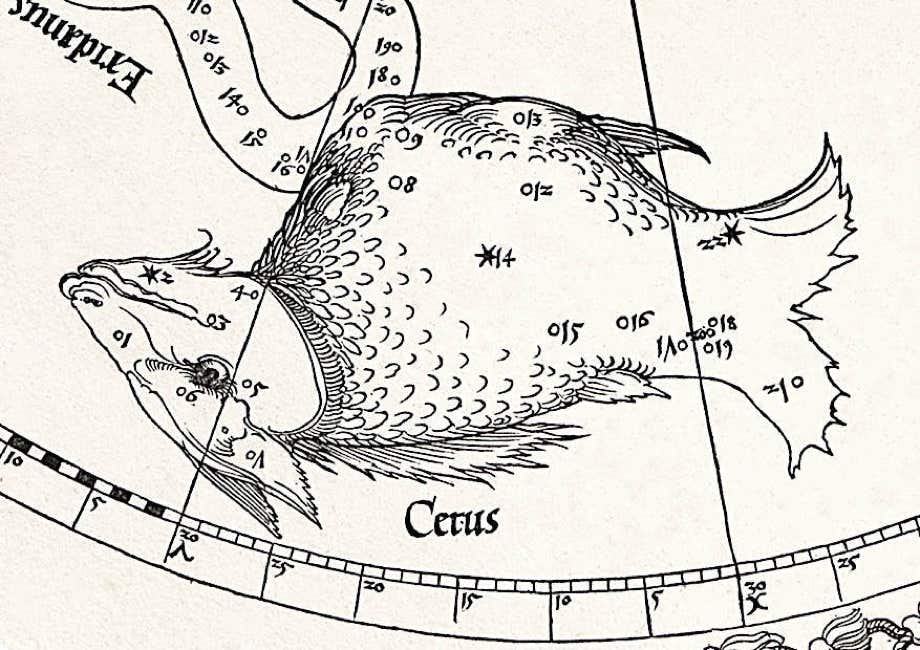
Albrecht Dürer’s illustration of Cetus on his celestial chart of 1515. The numbers against each star are the order in which they are listed in Ptolemy’s Almagest; numbers 21 and 22 on the northern and southern fin are the modern Iota and Beta Ceti. On this illustration south is up.
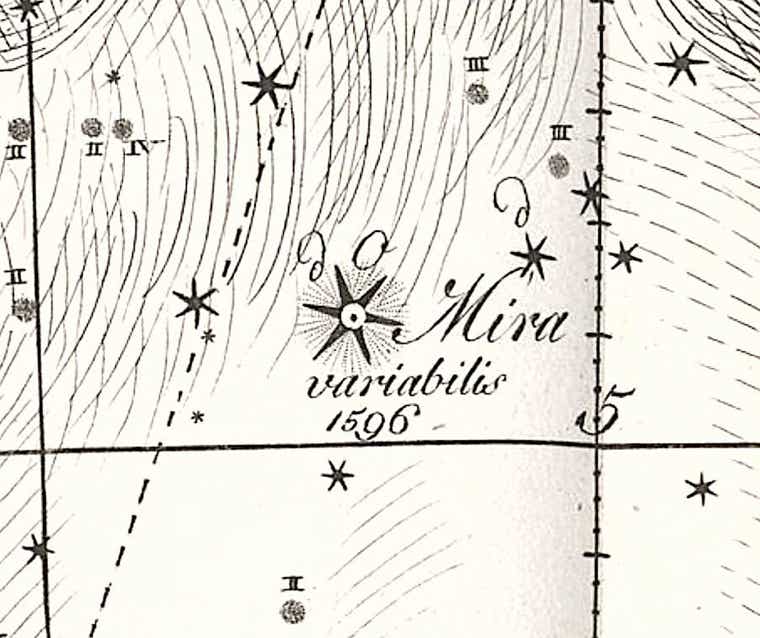
Johann Bode labelled the star Mira as ‘variabilis 1596’ on Chart XVII of his Uranographia atlas of 1801.