

Genitive: Cephei
Abbreviation: Cep
Size ranking: 27th
Origin: One of the 48 Greek constellations listed by Ptolemy in the Almagest
Greek name: Κηφεύς (Kepheus)
Cepheus was the mythological king of Ethiopia. He was deemed worthy of a place in the sky because he was fourth in descent from the nymph Io, one of the loves of Zeus – and having Zeus as a relative was always an advantage when it came to being commemorated among the constellations. The kingdom of Cepheus was not the Ethiopia we know today, but stretched from the south-eastern shore of the Mediterranean southwards to the Red Sea, an area that contains parts of the modern Israel, Jordan, and Egypt. Ptolemy described him as wearing the tiara-like head-dress of a Persian king, as he is shown on John Flamsteed’s star atlas, below.
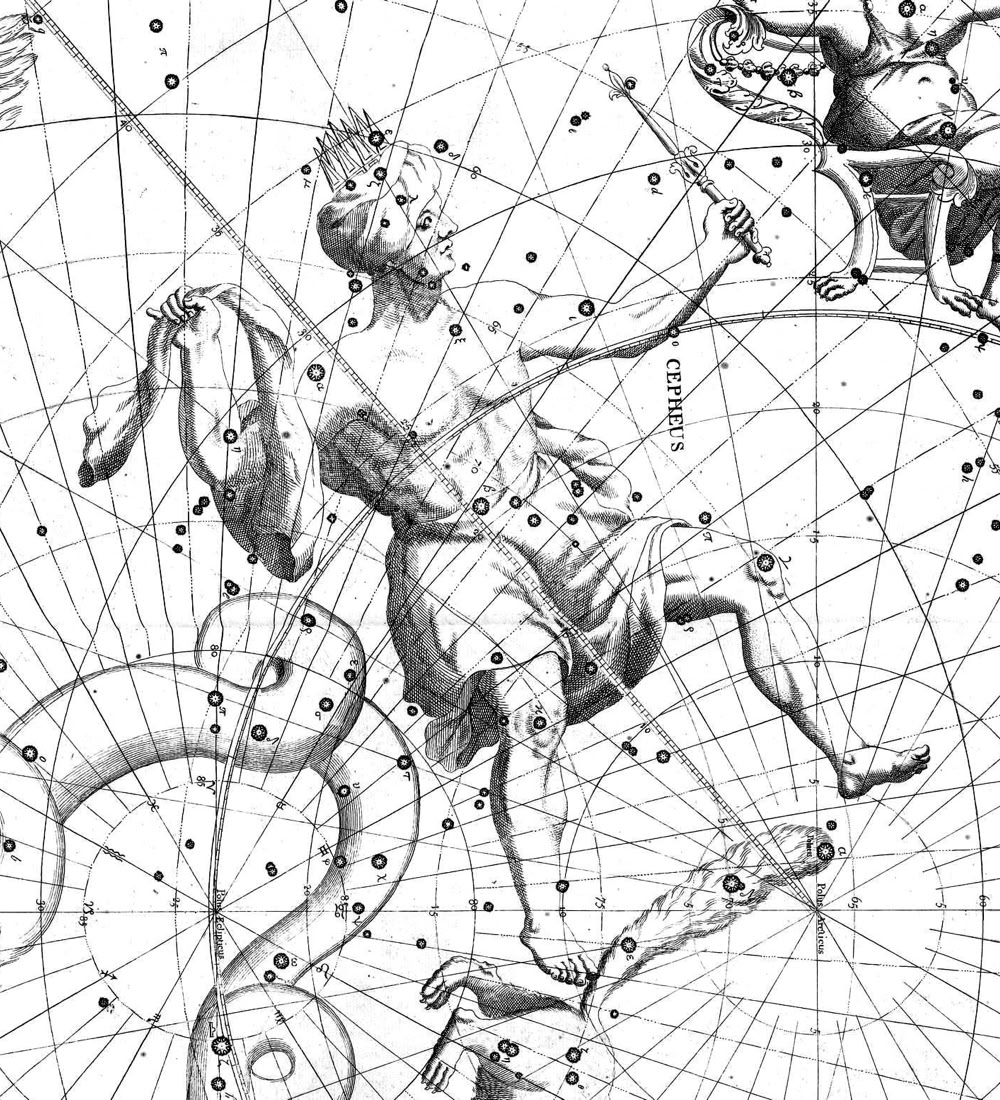
Cepheus in the robes and crown of a Persian king and with a regal sceptre
in his left hand, depicted in the Atlas Coelestis of John Flamsteed (1729).
Cepheus (Κηφεύς in Greek) was married to Cassiopeia, an unbearably vain woman whose boastfulness caused Poseidon to send a sea monster, Cetus, to ravage the shores of Cepheus’s kingdom. Cepheus was instructed by the Oracle of Ammon to chain his daughter Andromeda to a rock in sacrifice to the monster. She was saved by the hero Perseus, who killed the monster and claimed Andromeda for his bride.
King Cepheus laid on a sumptuous banquet at his palace to celebrate the wedding. But Andromeda had already been promised to Phineus, brother of Cepheus. While the celebrations were in progress, Phineus and his followers burst in, demanding that Andromeda be handed over, which Cepheus refused to do. The dreadful battle that ensued is described in gory detail by Ovid in Book V of his Metamorphoses. Cepheus retired from the scene, muttering that he had done his best, and left Perseus to defend himself. Perseus cut down many of his attackers, turning the remainder to stone by showing them the Gorgon’s head.
In the sky, the long-suffering Cepheus stands next to Cassiopeia, his feet extending almost to the north celestial pole. Each night he circles the pole, and as seen from Greek latitudes would have plunged head first into the sea at the lowest point, suffering the same unceremonious dunking as his vainglorious wife.
Stars of Cepheus
The constellation’s brightest star is Alpha Cephei, named Alderamin, magnitude 2.5, which marks the king’s right shoulder; according to the Arabic star name expert Paul Kunitzsch its name comes from the Arabic word al-dhirā’ain referring to a forearm, which was wrongly applied to it by European astronomers in medieval times. But its most celebrated star is Delta Cephei, a pulsating supergiant that varies in brightness every 5.4 days; it is the prototype of the Cepheid variable stars that astronomers use for estimating distances in space. The variation of Delta Cephei was discovered in 1784 by the English amateur astronomer John Goodricke (1764–86).
Ptolemy described the star as lying ‘to the rear of the tiara’; in this case ‘rear’ means it is on the following side as the sky turns, rather than at the back of his head. Johann Bayer, who first labelled the star Delta on his Uranometria atlas of 1603, placed it on the king’s forehead. Flamsteed (above) and Bode both followed Ptolemy’s description; knowing of Goodricke’s recent discovery, Bode labelled it ‘variabilis’.
On the opposite side of the king’s head (‘the one in advance of the tiara’, as Ptolemy put it) is another famous star, Mu Cephei. William Herschel remarked on its ‘fine deep garnet colour’ in 1783. Giuseppe Piazzi called it Garnet Sidus in his Palermo catalogue of 1803, also commenting on its dark red colour (‘rubei subobscuri coloris’). The IAU officially named it the Garnet Star in 2024. Its variability was first noted by the English astronomer John Russell Hind in 1848 and it is now known to vary between mags. 3.4 and 5.1.
Arabic astronomers visualized the stars of Cepheus as a shepherd (Gamma Cephei) and his dog (Rho Cephei) keeping watch over a small flock of sheep. Our name Errai for the star Gamma Cephei comes from the Arabic al-rā’ī meaning ‘the shepherd’.
Chinese associations
In the Chinese sky, Alpha, Eta, Theta, Xi, Iota, and Omicron Cephei were members of a nine-star group called Tiangou, the celestial hook (also known as Gouxing, ‘hook star’); the stars in this group were associated with omens regarding earthquakes. To the south of Tiangou, the stars Delta, Epsilon, Zeta, Mu, and Nu Cephei formed Zaofu (also spelled Zhaofu), named after the legendary charioteer of the emperor Mu Wang.
In northern Cepheus, near the borders with Cassiopeia and Camelopardalis, were five stars that formed Wudineizuo, the seats of five celestial emperors. These emperors are thought to be the deified rulers of the five directions in the sky, i.e. north, south, east, west, and central. There is no certainty as to which five stars represented them, though.
Part of the eastern wall of the Purple Palace Enclosure, aka the Central Palace, passed through Cepheus on its way from Draco to Cassiopeia, but there is no agreement between sources as to which stars were involved. For more on this Central Palace, see Ursa Minor.
© Ian Ridpath. All rights reserved

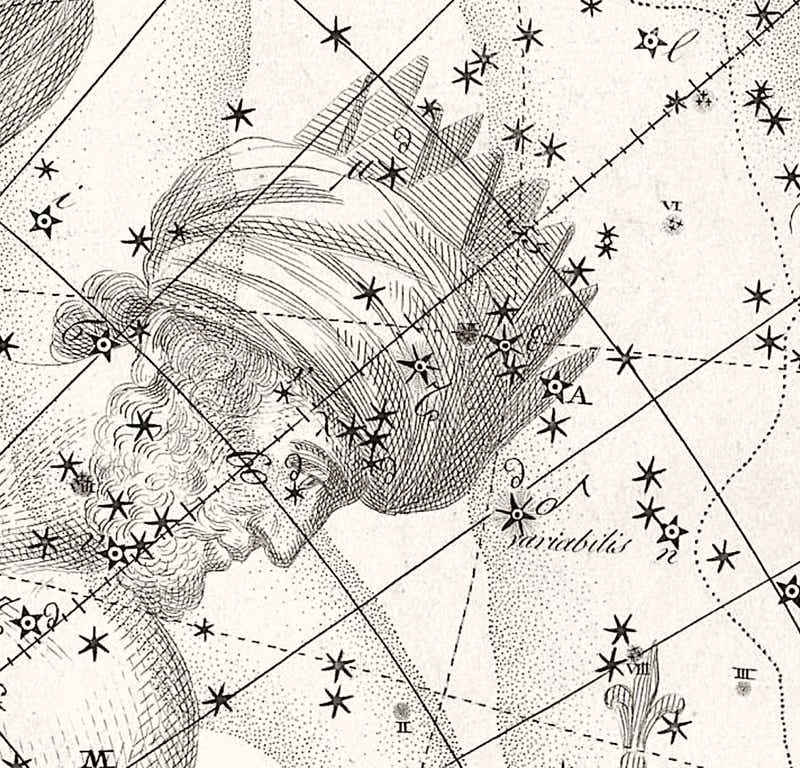
In his Uranographia atlas of 1801 Johann Bode placed Delta Cephei to one side of the king’s tiara, as described by Ptolemy, and labelled it ‘variabilis’. He also labelled it with a lowercase script ‘d’, to indicate that it is a double star.
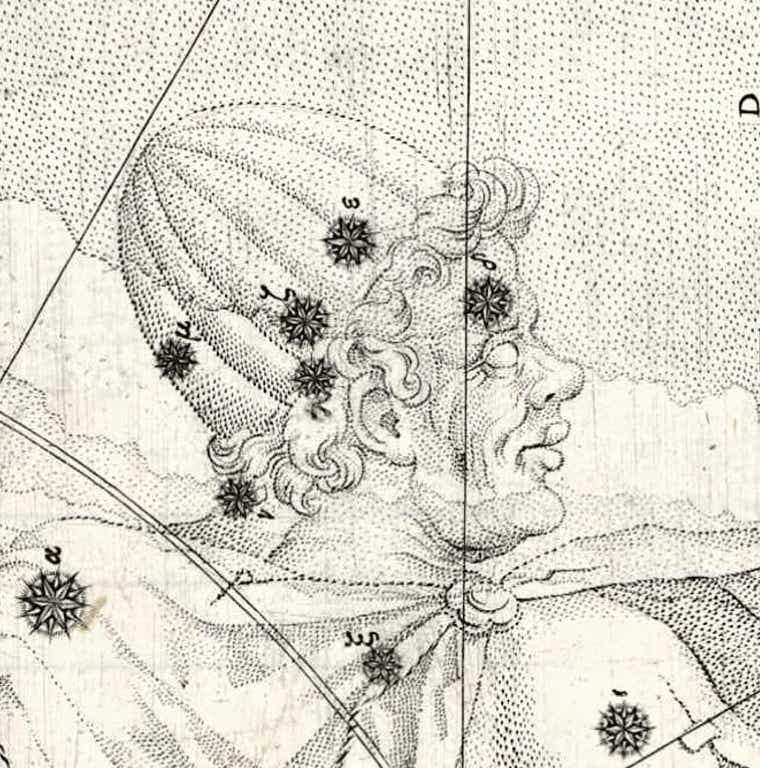
Johann Bayer positioned Delta Cephei on the king’s forehead in his Uranometria atlas of 1603, whereas Ptolemy had described the star as lying on the following side of his tiara (the right on this illustration). Bayer further diverged from Ptolemy’s description by outfitting Cepheus not with a regal headdress but a beanie-type cap.