

Genitive: Cassiopeiae
Abbreviation: Cas
Size ranking: 25th
Origin: One of the 48 Greek constellations listed by Ptolemy in the Almagest
Greek name: Κασσιέπεια (Kassiepeia)
Cassiopeia was the vain and boastful wife of King Cepheus of Ethiopia, who stands next to her in the sky. They are the only husband-and-wife couple among the constellations. Classical authors spell her name Cassiepeia, from the original Greek Κασσιέπεια, but Cassiopeia is the form used by astronomers.
While combing her long locks one day, Cassiopeia dared to claim that she was more beautiful than the sea nymphs called the Nereids. Such hubris by a mortal could not go unpunished so the Nereids went in search of retribution. There were 50 Nereids, all daughters of Nereus, the so-called Old Man of the Sea, and one of them, Amphitrite, was married to Poseidon, the sea god. Amphitrite and her sisters appealed to Poseidon to punish Cassiopeia for her vanity.
Bowing to their request, the sea god sent a monster to ravage the coast of King Cepheus’s country. This monster is commemorated in the constellation Cetus. To appease the monster, Cepheus and Cassiopeia chained their daughter Andromeda to a rock as a sacrifice, but Andromeda was saved from the monster’s jaws by the hero Perseus in one of the most famous rescue stories in history.
Cassiopeia the vainglorious queen seated on her throne and fussing with her hair, depicted in the Atlas Coelestis of John Flamsteed (1729).
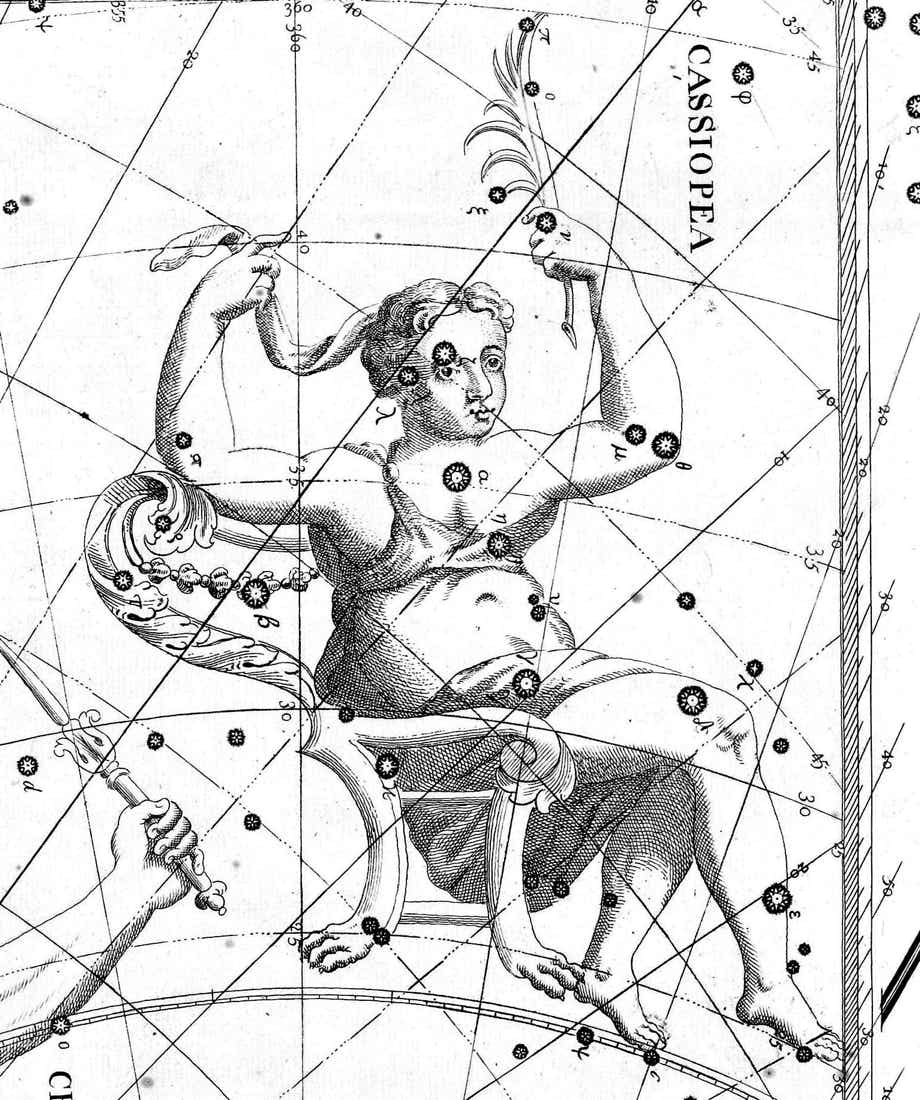
In the sky, Cassiopeia is depicted sitting on her throne. Each night she circles the celestial pole, sometimes upright, sometimes hanging upside down in apparent danger of falling out. The mythologists interpreted the indignity of this celestial fairground ride as part of her punishment from the gods, who made her a figure of fun. Aratus wrote that she plunged headlong into the sea like a diver (some translate it as ‘tumbler’), her feet waving in the air, because as seen from Greek latitudes she would have received a ducking at the lowest point on each circuit. Her long-suffering husband Cepheus alongside her endured the same fate.
Germanicus Caesar described Cassiopeia thus: ‘Her face contorted in agony, she stretches out her hands as if bewailing abandoned Andromeda, unjustly atoning for the sin of her mother,’ and this is how she is drawn in early manuscripts illustrating the works of Aratus and Hyginus. In some cases, her wrists are shown bound to the throne in which she sits. However, from Dürer’s chart of 1515 onwards she was portrayed not with her arms outstretched but holding aloft a palm frond in one hand. With her other hand she is either holding a robe or fussing with her hair, as in the illustration here. In al-Ṣūfī's Book of the Fixed Stars (c. AD 964), an Arabic version of the Almagest, the constellation was called Dhāt al-Kursīy, the woman with the throne.
Stars of Cassiopeia
The five brightest stars of Cassiopeia are arranged in a distinctive W-shape which writers such as Aratus likened to a key or a folding door. Alpha Cassiopeiae, magnitude 2.2, is called Schedar, from the Arabic al-sadr meaning ‘the breast’, where Ptolemy said it lay. Beta Cassiopeiae, magnitude 2.3, is known as Caph from the Arabic al-kaff al-khaḍīb meaning ‘stained hand’, because the stars of Cassiopeia were thought by the Arabs to represent a hand tattooed with henna. Delta Cassiopeiae, magnitude 2.7, is named Ruchbah, from the Arabic for ‘knee’, rukbat, again following Ptolemy's description of its location in the constellation figure. The central star of the W, Gamma Cassiopeiae, is an erratic variable, given to occasional outbursts in brightness; it has no official name.
Tycho’s Star
In November 1572 the familiar W-shape of Cassiopeia was disturbed by the intrusion of a bright interloper, now called Tycho’s Star after the Danish astronomer Tycho Brahe who first spotted it. Tycho published a treatise about the ‘new’ star the following year, De nova et nullius ævi memoria prius visa stella, which included the chart of the star’s position reproduced below.
Supernova 1572 in Cassiopeia from Tycho Brahe’s De nova et nullius ævi memoria prius visa stella (1573). The ‘new star’ is the large symbol at the top, labelled I. The fainter star beneath it, labelled H, is 4th-magnitude Kappa Cassiopeiae. The five main stars making up the familiar W of Cassiopeia are here labelled F, E, D, B, G.
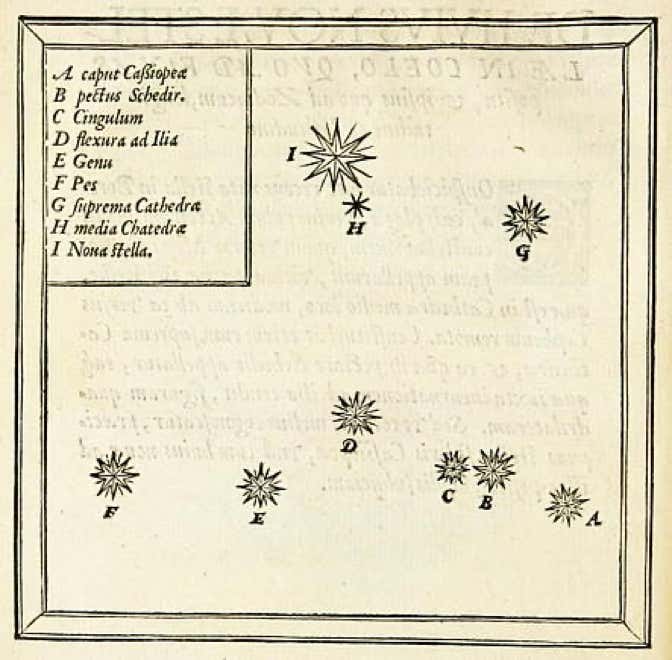
We now know that the interloper was actually a supernova, the explosion of a massive star at the end of its life. At its brightest, Supernova 1572 reached magnitude –4, comparable to Venus. It remained visible to the naked eye for over a year.
Johann Bayer in his Uranometria atlas of 1603 showed the new star as a huge starburst on the side of Cassiopeia’s throne, even though by then it had long since faded from view. On Hevelius’s Firmamentum Sobiescianum atlas of 1690 it appeared both on Cassiopeia’s throne and at the end of the left hand of Cepheus.
Chinese associations
Although the W shape of Cassiopeia seems obvious to us, Chinese star charts showed no sign of it. Instead, three stars of the W formed part of a group called Wangliang, commemorating a legendary Chinese charioteer of that name. Older Chinese charts depicted this as a fan-shaped group: a line of four stars (Gamma, Eta, Alpha, and Zeta Cassiopeiae) represented the team of horses and a fifth, Beta, was Wangliang himself. Another star nearby represented his whip, Ce, which was Kappa Cassiopeiae. However, on later depictions the constellation consisted of Beta, Kappa, Eta, Alpha, and Lambda Cassiopeiae, with Gamma Cassiopeiae as the whip.
Wangliang is the subject of a Chinese moral story. Wangliang was asked to drive a carriage for a hunter called Hsi. But they failed to snare a single bird all day. Hsi returned from the hunt, complaining that Wangliang was the worst charioteer in the world. Stung by this criticism, Wangliang asked to try again. This time, they bagged ten birds in just one morning. Impressed, Hsi asked Wangliang to be his full-time charioteer. Wangliang refused, explaining that on the first occasion he had driven according to the rules; the second time, he had cheated by driving into the birds to make it easier for Hsi to catch them. He declined to drive for a hunter who was not honourable. He said: ‘A man cannot straighten others by bending himself’.
The other two stars of the W (Delta and Epsilon Cassiopeiae) were part of a chain of six stars called Gedao running from Iota Cassiopeiae in the north via Theta and Nu to Omicron Cassiopeiae in the south. Gedao represented a pathway into the Central Palace, as the Chinese termed the circumpolar region (for more on the Central Palace, see Ursa Minor); Gedao was also seen as the flag or banner of Wangliang. Next to it, a single star called Fulu (Zeta Cassiopeiae) represented an alternative route or side road.
Crossing northern Cassiopeia from present-day Cepheus into Camelopardalis was a chain of nine stars called Chuanshe, representing guest rooms for visitors. These apartments lay just outside the walls of the Central Palace. As is so often the case with Chinese constellations, the identities of the stars are obscure.
Farther north, at the very entrance to the Central Palace, were Huagai and Gang, two related groups of stars that represented the Emperor’s gilded canopy for processions and its support. Huagai consisted of seven stars and Gang nine, the brightest of them being 4th-magnitude 50 Cassiopeiae, officially named Gang by the IAU in 2025.
The eastern boundary wall of the Central Palace is generally thought to have ended in Cassiopeia with the close pair of stars 21 and 23 Cassiopeiae, although some sources place its end in Cepheus.
© Ian Ridpath. All rights reserved
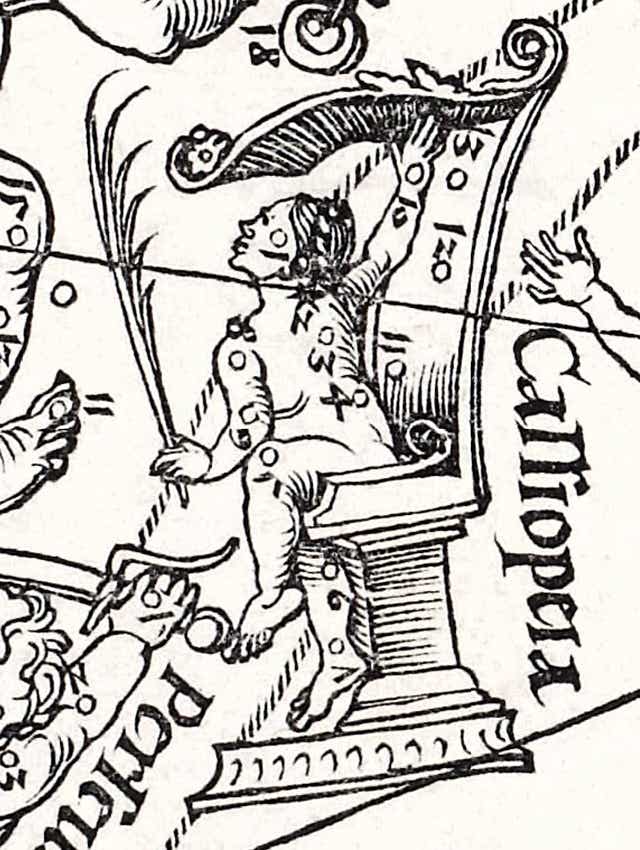
Cassiopeia shown sitting on her canopied throne holding a palm frond on Albrecht Dürer’s northern celestial hemisphere chart of 1515. Dürer’s constellation figures were drawn as they appear on a globe, so are back to front by comparison with the way they appear in the sky.
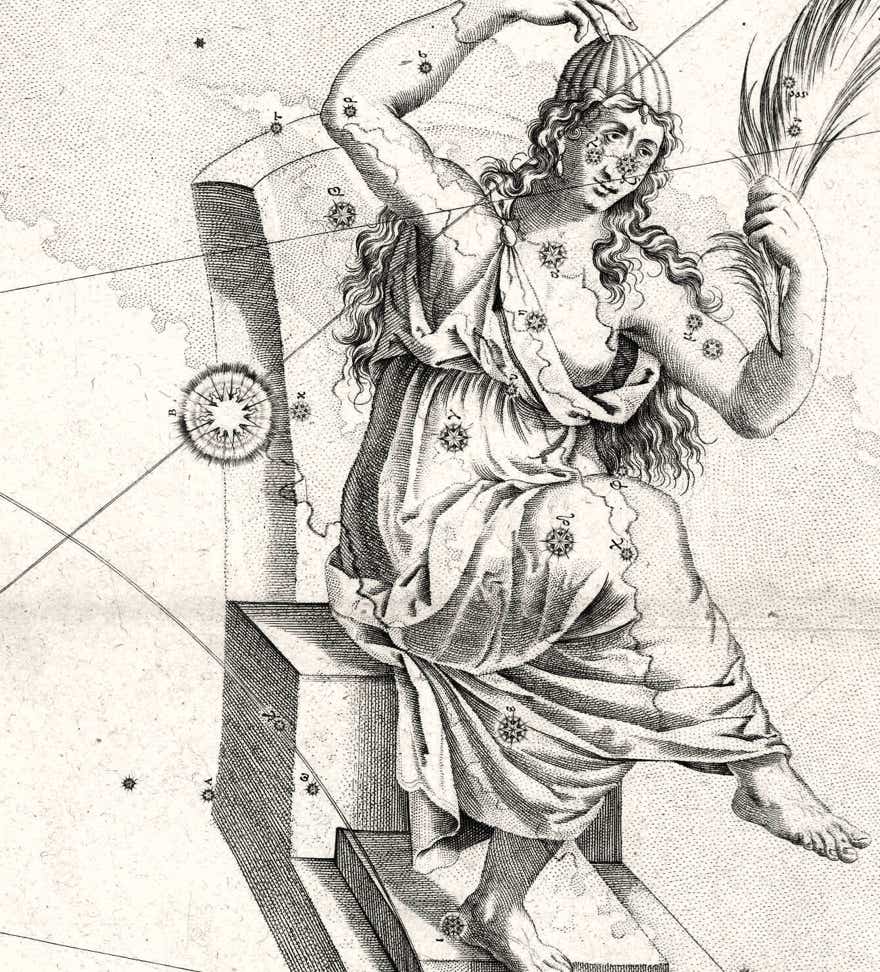
Tycho’s supernova was drawn as a huge starburst on the side of Cassiopeia’s throne on this chart from Johann Bayer’s Uranometria.
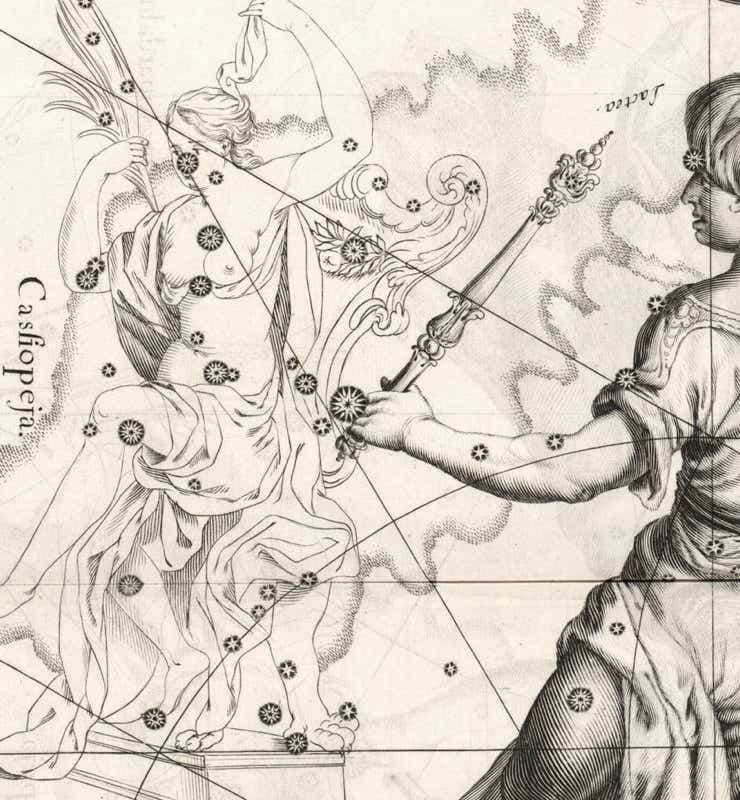
Johannes Hevelius marked Tycho’s supernova both on his chart of Cassiopeia, where it appeared on the side of her throne, and also on his chart of Cepheus, where it was placed at the end of Cepheus’s outstretched hand. Hevelius’s charts showed the constellations as they would appear on a celestial globe, so they appear back to front from the way we see them in the sky.