

Genitive: Canis Minoris
Abbreviation: CMi
Size ranking: 71st
Origin: One of the 48 Greek constellations listed by Ptolemy in the Almagest
Greek name: Προκύων (Prokyon)
Representing the smaller of the two dogs of Orion, Canis Minor originally consisted of just the bright star Procyon, known in Greek as Προκύων (Prokyon), meaning ‘before the dog’ or ‘foredog’. This name, used by the Greeks for both the star and the constellation, comes from the fact that it rises earlier than its more prominent kennel-mate Canis Major which Ptolemy called simply Κύων (Kyon), the Dog.
An alternative Latin name for the constellation was Antecanis or Anticanis, also meaning ‘before the dog’. The Roman writer and politician Marcus Tullius Cicero called it this in his translation of Aratus in the 1st century BC; in this illustrated edition of his manuscript the shape of the dog is cleverly filled with text from Hyginus’s Poetic Astronomy.
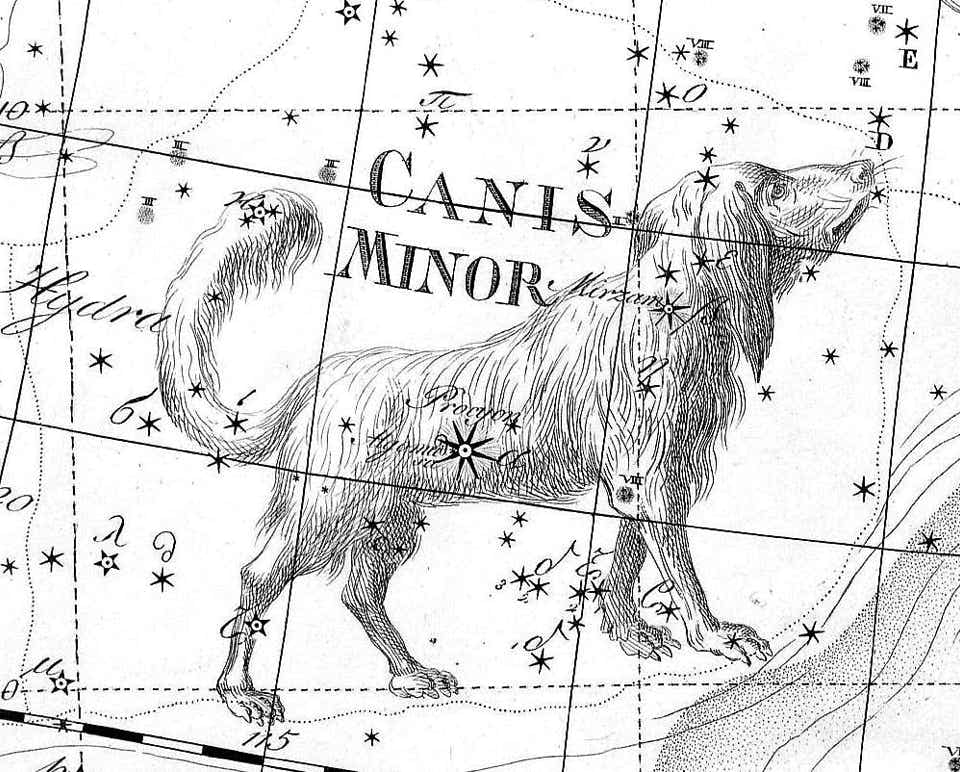
Canis Minor seen on Chart XII of the Uranographia of Johann Bode (1801). In its body lies the bright star Procyon. On this chart Bode labels Beta Canis Minoris as Mirzam, an Arabic title now applied to Beta Canis Majoris.
Canis Minor is small and contains little of interest other than Procyon itself, the eighth-brightest star in the heavens, 11.5 light years away. Ptolemy in the Almagest catalogued just two stars in Canis Minor: Procyon in the dog’s body, and the star in the dog’s neck now known as Beta Canis Minoris. Procyon is of particular interest to astronomers because it has a small, hot companion star called a white dwarf that orbits it every 41 years. Coincidentally the other dog star, Sirius, also has one of these small, highly dense white dwarfs as a companion.
On his chart of the constellation (above), Bode gave Procyon a second name, Algomeisa, from the Arabic al-ghumaiṣā’ meaning the one with bleary or teary eyes. This name comes from a story in which Procyon and Sirius were sisters and Canopus (which the Arabs called Suhail) was their brother. Sirius crossed the Milky Way to join her brother in the southern sky, but Procyon was left behind on the northern bank of the Milky Way, crying and dimmed by the tears in her eyes. Confusingly, the name Gomeisa has now been given to Beta Canis Minoris, the second-brightest star in the constellation, which was not part of the legend.
A tragic misunderstanding
Canis Minor is usually identified as one of the dogs of Orion, following him across the sky as the Earth turns. But in a famous legend from Attica (the area around Athens), recounted by the mythographer Hyginus, the constellation represents Maera, dog of Icarius, the man whom the god Dionysus first taught to make wine. When Icarius gave his wine to some shepherds for tasting, they rapidly became drunk. Suspecting that Icarius had poisoned them, they killed him. Maera the dog ran howling to Icarius’s daughter Erigone, caught hold of her dress with his teeth and led her to her father’s body. Both Erigone and the dog took their own lives where Icarius lay.
Zeus placed their images among the stars as a reminder of the unfortunate affair. To atone for their tragic mistake, the people of Athens instituted a yearly celebration in honour of Icarius and Erigone. In this story, Icarius is identified with the constellation Boötes, Erigone is Virgo, and Maera is Canis Minor.
According to Hyginus, the murderers of Icarius fled to the island of Ceos off the coast of Attica, but their wrongdoing followed them. The island was plagued with famine and sickness, attributed in the legend to the scorching effect of the Dog Star (here, Procyon seems to become confused with the greater dog star, Sirius in Canis Major). King Aristaeus of Ceos, son of the god Apollo, asked his father for advice and was told to pray to Zeus for relief. Zeus sent the Etesian winds, which every year blow for 40 days from the rising of the Dog Star to cool all of Greece and its islands in the summer heat. After this, the priests of Ceos instituted the practice of making yearly sacrifices before the rising of the Dog Star.
Chinese associations
In Chinese astronomy, Procyon along with Beta and Epsilon Canis Minoris formed Nanhe, the southern river; the northern river, Beihe, included Castor and Pollux in Gemini. Lying either side of the ecliptic, Nanhe and Beihe were also interpreted as gates or sentries.
Shuiwei, ‘water level’, consisted of a curved line of four stars representing a water level marker or, according to one interpretation, a drainage manager who releases water at times of flooding. The stars are usually identified as 6 and 11 Canis Minoris, and 8 and Zeta Cancri. However, a different and apparently older interpretation places all the stars of Shuiwei farther north, in Gemini.
© Ian Ridpath. All rights reserved
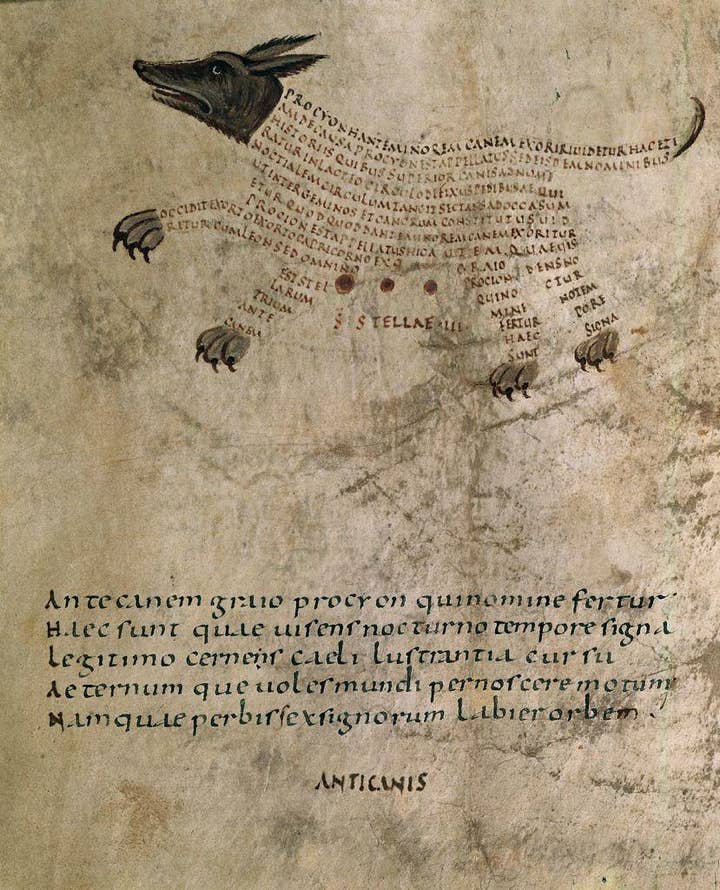
Canis Minor, here given the name Anticanis, from a 9th-century illustrated manuscript of Marcus Tullius Cicero’s Latin translation of Aratus’s Phaenomena. The figure of the dog, which is shown in reverse as on a globe, contains extracts from Hyginus’s Poetic Astronomy. British Library manuscript Harley 647.