

Genitive: Canis Majoris
Abbreviation: CMa
Size ranking: 43rd
Origin: One of the 48 Greek constellations listed by Ptolemy in the Almagest
Greek name: Κύων (Kyon)
Four dogs are to be found among the constellations: Canis Major, Canis Minor, and the two hunting dogs of Canes Venatici, but Canis Major is undoubtedly the top dog. Indeed, Ptolemy in the Almagest called it simply Κύων (Kyon), the Dog. Canis Major is dominated by Sirius, popularly termed the Dog Star, the most brilliant star in the entire night sky; almost certainly the constellation originated with this star alone.
Aratus referred to Canis Major as the guard-dog of Orion, following on the heels of its master and standing on its hind legs with Sirius carried in its jaws. Manilius called it ‘the dog with the blazing face’ while Germanicus Caesar said that ‘it belches forth fire from its mouth’. Canis Major seems to cross the sky in pursuit of the hare, represented by the constellation Lepus under Orion’s feet. To the north of it scampers Canis Minor, the smaller dog, either having lost the scent or sniffing out different prey.
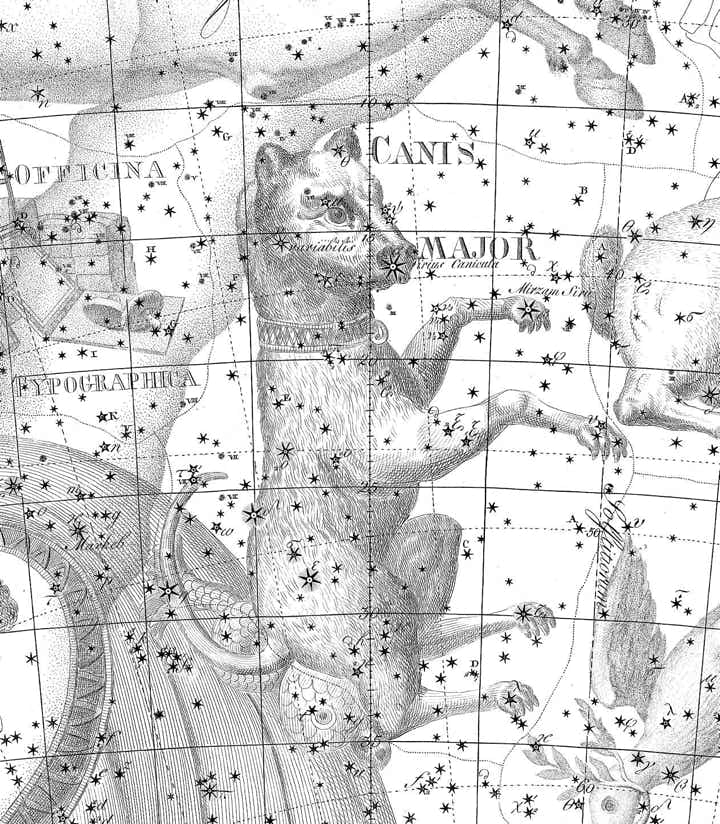
Canis Major on Chart XVIII of Johann Bode’s Uranographia (1801). Bode depicted the dog with Sirius marking its snout. Classical Greek descriptions, though, placed Sirius in the dog’s jaws. This image also contains a mystery: what is that scaly sea creature lurking behind the dog’s hind quarters?
Mythologists such as Eratosthenes and Hyginus said that the constellation represented Laelaps, a dog so swift that no prey could outrun it. This dog had a long list of owners, one of them being Procris, daughter of King Erechtheus of Athens and wife of Cephalus, but accounts differ about how she came by it. In one version the dog was given to her by Artemis, goddess of hunting; but a more likely account says that it is the dog given by Zeus to Europa, whose son Minos, King of Crete, passed it on to Procris. The dog was presented to her along with a javelin that could never miss; this turned out to be an unlucky gift, for her husband Cephalus accidentally killed her with it while out hunting.
Cephalus inherited the dog, and took it with him to Thebes (not Thebes in Egypt but a town in Boeotia, north of Athens) where a vicious fox was ravaging the countryside. The fox was so swift of foot that it was destined never to be caught – yet Laelaps the hound was destined to catch whatever it pursued. Off they went, almost faster than the eye could follow, the inescapable dog in pursuit of the uncatchable fox. At one moment the dog would seem to have its prey within grasp, but could only close its jaws on thin air as the fox raced ahead of it again. There could be no resolution of such a paradox, so Zeus turned them both to stone, and the dog he placed in the sky as Canis Major, without the fox.
Sirius, the dazzling dog star
The name of the star Sirius comes from the Greek word Σείριος (Seirios) meaning ‘searing’ or ‘scorching’, highly appropriate for something so brilliant. Even though the name Sirius was known as far back as the time of Hesiod (c.700 BC), Ptolemy in the Almagest called it Κύων (Kyon), ‘the Dog’, the same name as for the whole constellation. He described it as ‘the star in the mouth’. However, Johann Bayer in his Uranometria star atlas placed Sirius not in the mouth but on the dog’s snout. Bayer was followed in this by Bode in Uranographia, although not by Hevelius or the classically correct Flamsteed who both showed it in the mouth or jaws. Bode labelled Sirius with the alternative Latin name Canicula, which was sometimes used for the constellation of Canis Major as a whole.
In Greek times the rising of Sirius at dawn just before the Sun marked the start of the hottest part of the summer, a time that hence became known as the Dog Days. ‘It barks forth flame and doubles the burning heat of the Sun’, said Manilius, expressing a belief held by the Greeks and Romans that the star had a heating effect. The ancient Greek writer Hesiod wrote of ‘heads and limbs drained dry by Sirius’, and Virgil in the Georgics said that ‘the torrid Dog Star cracks the fields’. Germanicus Caesar claimed that when it rose with the Sun it strengthened healthy crops but killed those with shrivelled foliage or feeble roots. ‘There is no star the farmer likes more or hates more’, according to Germanicus.
‘Hardly is it inferior to the Sun, save that its abode is far away’, wrote Manilius, anticipating the modern view that stars are bodies like the Sun only vastly more distant. Yet, in contradiction of the supposed heating effects of Sirius, Manilius continued: ‘The beams it launches from its sky-blue face are cold’. That description of the colour of Sirius is in contrast to Ptolemy’s surprising reference to it as reddish, which has caused all manner of arguments. In fact, Manilius was nearly correct, for Sirius is a blue-white star, even larger and brighter than the Sun. It lies 8.6 light years away, making it one of the Sun’s closest neighbours. It has a white dwarf companion star, visible only through telescopes, that orbits it every 50 years.
In 14th-century Europe, Sirius was also known as Alhabor or Alabor, from the Arabic al-’abūr, a name commonly found on astrolabes of the time, meaning ‘the one who crossed over’. It refers to an Arabic folk tale in which Sirius and Procyon were sisters and Canopus (which the Arabs called Suhail) was their brother. Sirius, it was said, crossed the Milky Way to join her brother in the southern sky, leaving Procyon behind, crying and dimmed by her tears, making her the faintest of the three stars. Geoffrey Chaucer used the name Alhabor for Sirius in his celebrated Treatise on the Astrolabe written in or around 1391. He based his description on astrolabes such as this English example which had a dog’s head to indicate the position of the star. However, astronomers eventually settled on the original Greek name in preference to the Arabic alternative.
Other stars of Canis Major
Beta Canis Majoris, which precedes Sirius across the sky, is known as Mirzam, from the Arabic al-mirzam. R. H. Allen in his classic book Star Names said the name meant ‘the announcer’, while the Arabic star lore expert Danielle Adams translates it as ‘bringer-forth’. According to the Arabic astronomer al-Ṣūfī the Arabs applied the name mirzam to any star that preceded a bright star. Hence it was also applied to Beta Canis Minoris, which precedes Procyon, and Gamma Orionis, which precedes Betelgeuse, but it is the attribution to Beta Canis Majoris that has stuck.
Ptolemy listed 11 stars as lying around the constellation but not forming part of it. Of these, nine were later used by Petrus Plancius to create a new constellation, Columba, the dove; one was transferred to Monoceros (22 Mon); and one was eventually incorporated in Canis Major (λ CMa).
Chinese associations
Chinese astronomers knew Sirius as Tianlang, ’celestial wolf’, or simply Lang, ‘wolf’; it was said to symbolize invasion and plunder. Other stars of Canis Major provide a good illustration of how Chinese constellations could be remodelled by different astrologer/astronomers. Take Junshi, for example, representing a market for soldiers to buy provisions and barter goods. In one version, this was a ring of 13 stars, including Nu and Xi Canis Majoris, extending into present-day Lepus. At its centre was Yeji, a pheasant, represented by Beta Canis Majoris (Mirzam). But an alternative interpretation identified the pheasant as Nu-2 Canis Majoris, with Beta one of a ring of 6 stars (rather than 13) making up Junshi.
Similar malleability can be seen in the case of Hushi, the bow and arrow. In one depiction the bow, Hu, was represented by the arc of stars from Kappa via Epsilon, Sigma, Delta, and Tau Canis Majoris to Xi Puppis. A line from Eta via Delta to Omicron-2 Canis Majoris was Shi, an arrow, pointing at Lang in a show of defiance against thieves and raiders. But another version sees the bow as an altogether larger figure, extending well into Puppis and with Delta Canis Majoris as the tip of the arrow. The whole bow-and-arrow figure was sometimes known simply as Hu.
© Ian Ridpath. All rights reserved

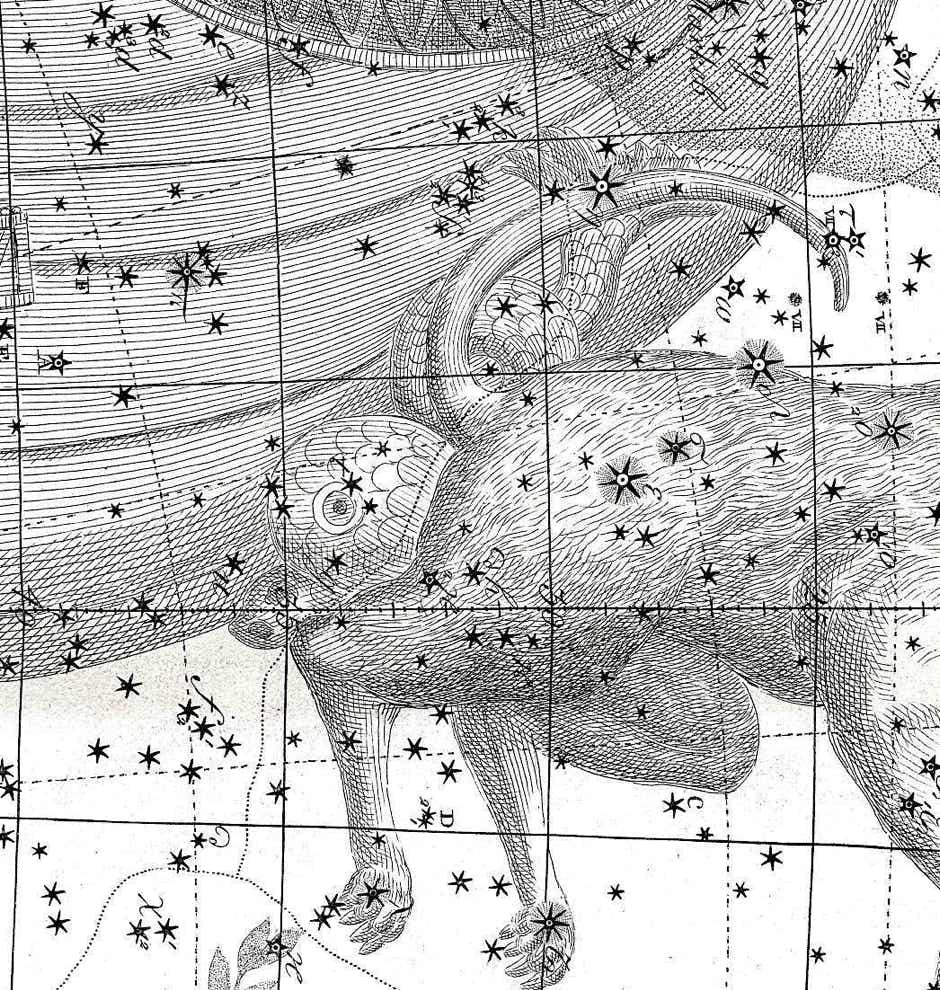
Bode’s Easter egg
This scaly sea creature with a looping tail lurks against the hull of Argo Navis, partly obscured by Canis Major, on Johann Bode’s Uranographia. It can be found on Chart 18, as here, and also at lower right on Chart 2. There seems to be no scientific or mythological explanation for its presence. Could it be Bode’s version of what in modern software jargon is termed an ‘Easter egg’, i.e. an undocumented surprise he put in to amuse those who look closely, like Cassini’s Moon maiden?
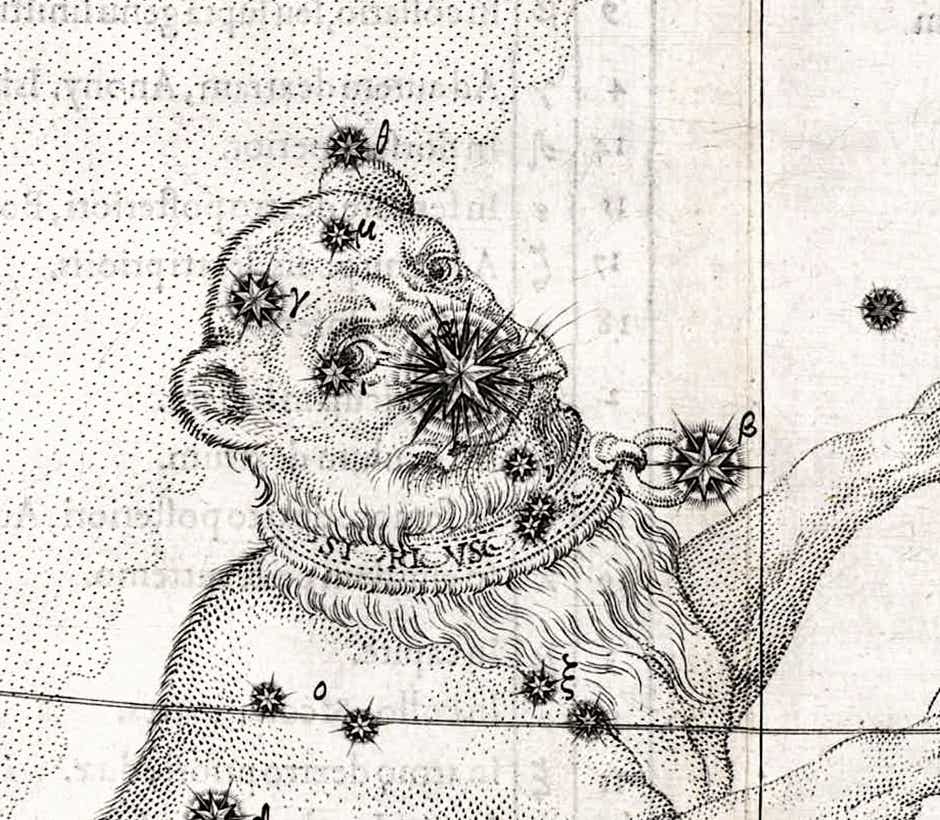
Johann Bayer placed Sirius on the snout of Canis Major, rather than in its jaws, on his Uranometria atlas of 1603. The name Sirius is engraved on the dog’s collar.
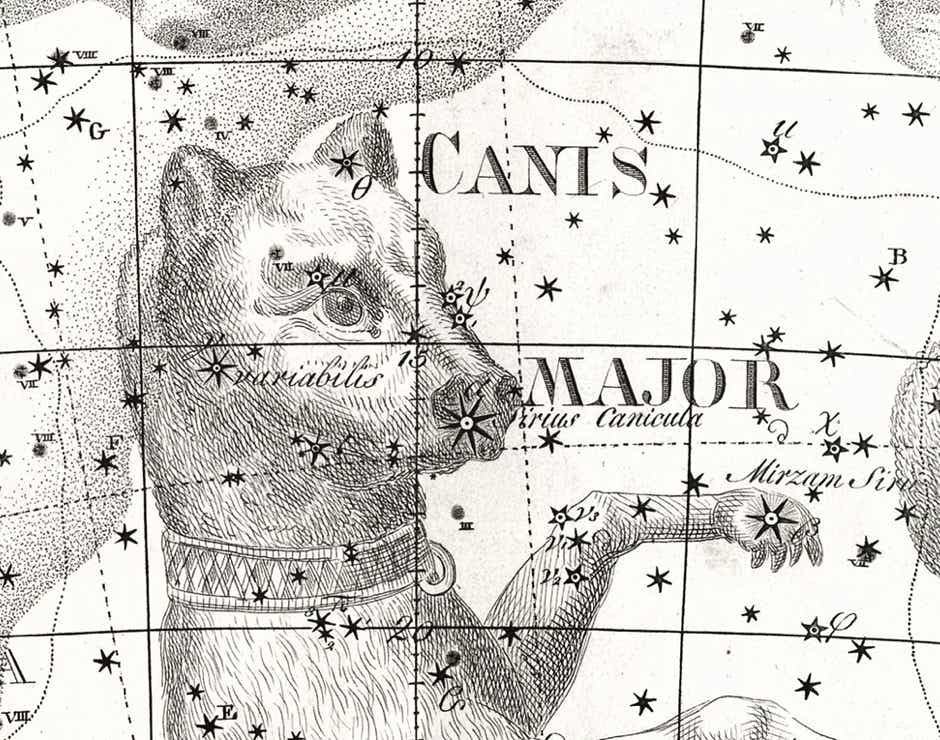
Bode showed Sirius on the side of the dog’s snout on his Uranographia atlas of 1801. He labelled it with the alternative name Canicula. At right Beta Canis Majoris is labelled Mirzam Sirii, the herald of Sirius.
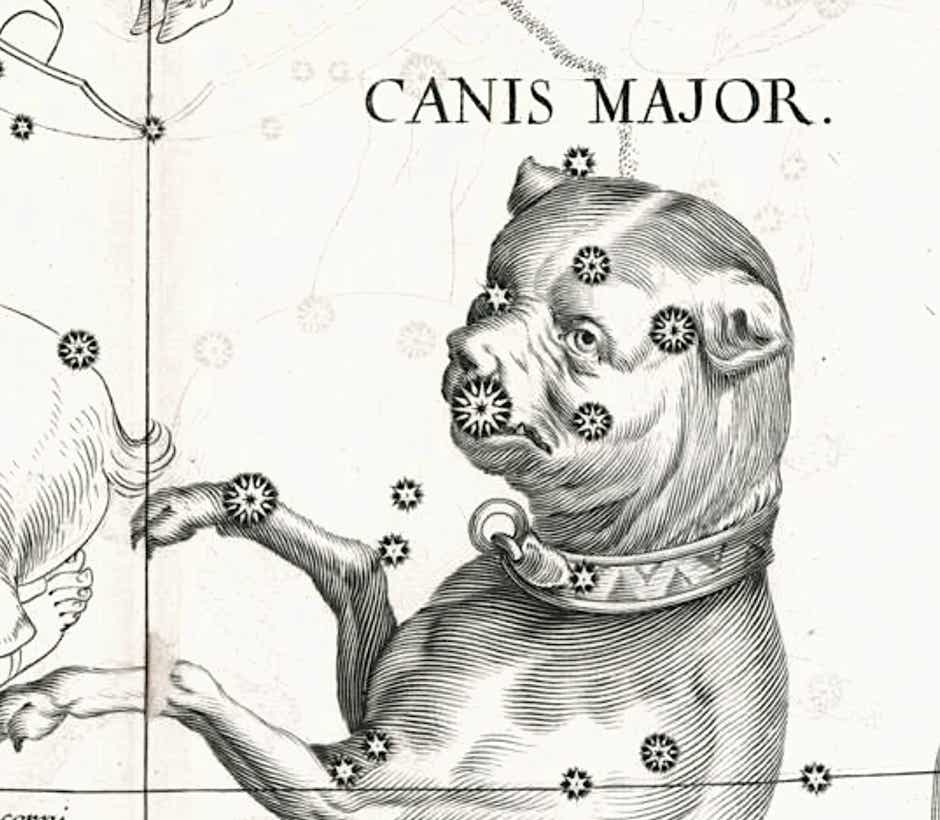
Johannes Hevelius in his star atlas Firmamentum Sobiescianum (1690) placed Sirius on the mouth of Canis Major, in keeping with Ptolemy’s description of it. Hevelius’s constellations were drawn as seen on a globe, and so appear back to front by comparison with the sky.
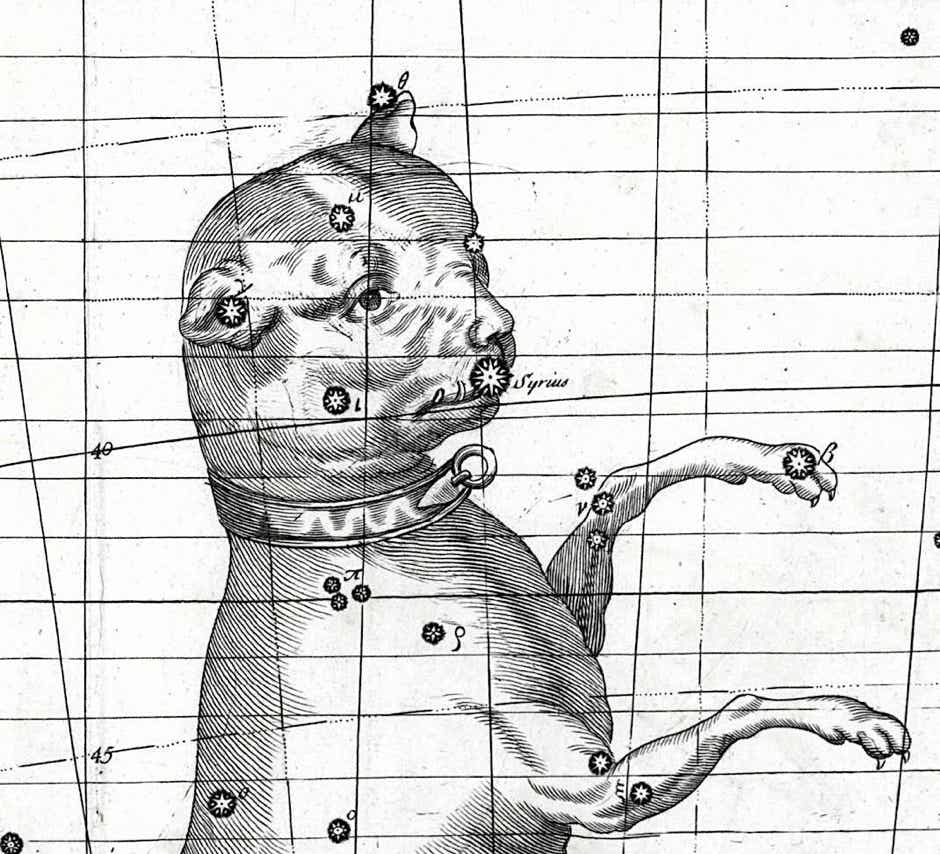
John Flamsteed followed Ptolemy’s description by placing Sirius on the mouth of Canis Major on his Atlas Coelestis published in 1729. He spelled the star’s name Syrius. Flamsteed’s dog seems to have been copied almost exactly from that of Hevelius.