
Genitive: Arae
Abbreviation: Ara
Size ranking: 63rd
Origin: One of the 48 Greek constellations listed by Ptolemy in the Almagest
Greek name: θυμιατήριον (Thymiaterion)
Altars feature frequently in Greek legend, for heroes were always making sacrifices to the gods, so it is not surprising to find an altar among the stars. But this altar is a special one, for it was used by the gods themselves to swear a vow of allegiance before their fight against the Titans, according to Eratosthenes and Manilius. That clash, known as the Titanomachy, was one of the most significant events in Greek myth.
At that time the ruler of the Universe was Cronus, one of the 12 Titans. Cronus had overthrown his father, Uranus, but it was prophesied that he would in turn be deposed by one of his own sons. In a desperate attempt to forestall the prophesy, Cronus swallowed his children as they were born: Hestia, Demeter, Hera, Hades, and Poseidon, all ultimately destined to become gods and goddesses. Eventually his wife, Rhea, could not bear to see any more children swallowed. She smuggled the next child, Zeus, to the cave of Dicte in Crete and gave Cronus a stone to swallow instead, telling him it was the infant Zeus.
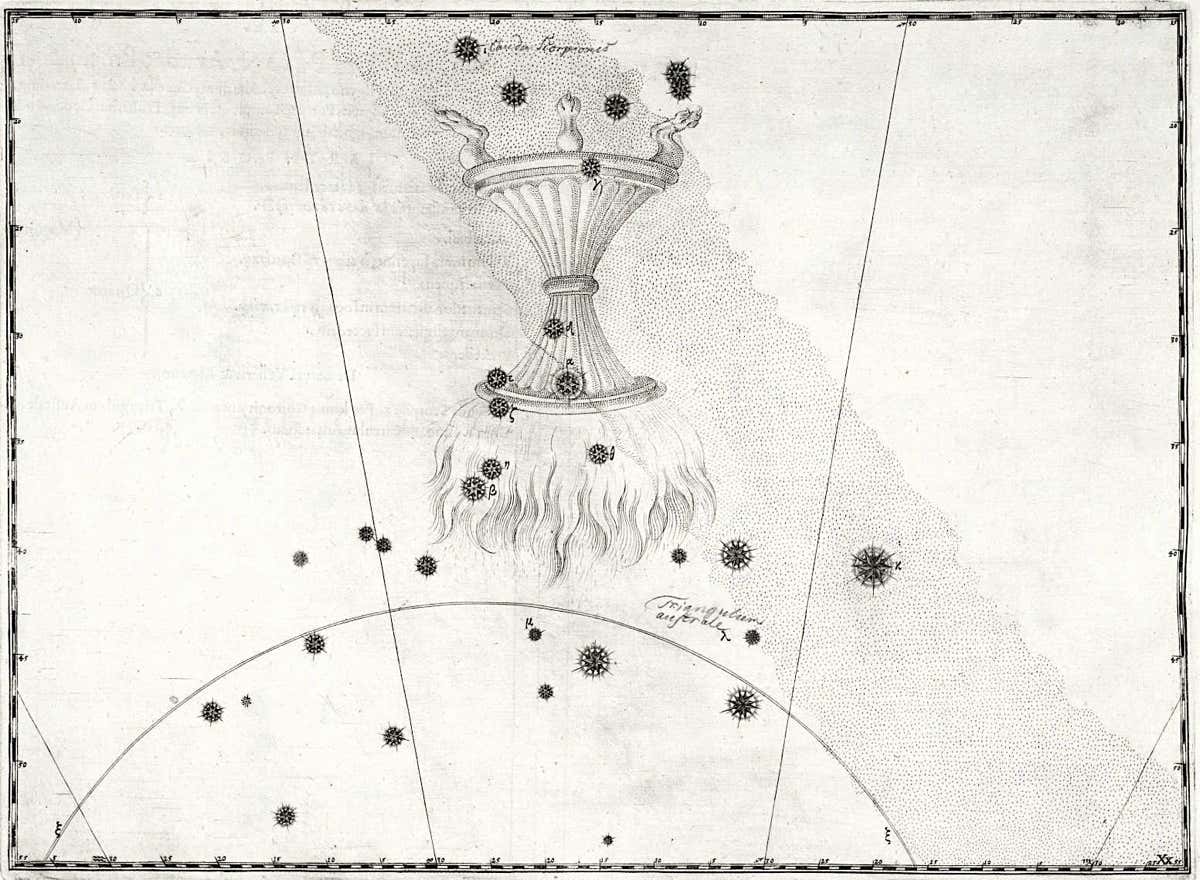
Ara, the altar, depicted as an elegant censer with its flames rising southwards in the Uranometria of Johann Bayer (1603). Ara was shown both as a censer and a conventional altar on old star charts. Click here for Bode’s later version.
On Crete, Zeus grew up safely. When he reached maturity he returned to his father’s palace and forced Cronus to vomit up the children he had swallowed, who emerged as fully grown gods and goddesses. Zeus and his brother gods then set up an altar and vowed on it to overthrow the callous rule of Cronus and the other Titans.
Titanomachy: battle between the Titans and the gods of Olympus
The battle raged ten years between the Titans, led by Atlas, on Mount Othrys, and the gods led by Zeus on Mount Olympus. To break the deadlock Mother Earth (Gaia) instructed Zeus to release the ugly brothers of the Titans, whom Cronus had imprisoned in the sunless caves of Tartarus, the lowermost region of the Underworld. There were two sets of brothers, the Hecatoncheires (hundred-handed giants) and the one-eyed Cyclopes, and they wanted revenge against Cronus.
Zeus stole down to Tartarus, released the monstrous creatures and asked them to join him in the battle raging above. Delighted by their unexpected freedom, the Cyclopes set to work to help the gods. They fashioned a helmet of darkness for Hades, a trident for Poseidon and, above all, thunderbolts for Zeus. With these new weapons and their monstrous allies, the gods routed the Titans.
After their victory, the gods cast lots to divide up the Universe. Poseidon became lord of the sea, Hades won the Underworld and Zeus was allotted the sky. Zeus then placed the altar of the gods in the sky as the constellation Ara in lasting gratitude for their victory over the Titans.
Depictions of Ara
The Greek name for the constellation was θυμιατήριον (Thymiaterion), referring to an incense burner or censer. Aratus shortened this to θυτήριον (Thyterion). An alternative Latin name widely encountered prior to the 18th century was Thuribulum, with the same meaning. Manilius described the altar as ‘bearing incense-flame’, i.e. topped with burning incense.
The altar is usually depicted with its base to the north and its flames rising southwards, as described by Ptolemy in the Almagest and shown, for example, by Dürer in 1515 (R. H. Allen in his book Star Names wrongly states that this orientation did not become established until Bayer’s atlas in 1603, illustrated above, but even the Farnese globe of the second century has Ara facing south, albeit without flames). Other atlases depict Ara as the altar on which Centaurus is about to sacrifice Lupus, the wolf.
Bayer allocated Greek letters to eight stars in Ara on his Uranometria atlas of 1603 (Ptolemy had listed only seven), but there were huge positional errors on Bayer’s chart and the eighth star is entirely spurious. Lacaille reobserved the constellation and relabelled its stars in his Coelum Australe Stelliferum catalogue of 1763 and it is Lacaille’s Greek letters that we use today.
Chinese associations
In China, five stars of Ara formed the constellation Gui, representing an edible tortoise living in the river of the Milky Way. The stars concerned were probably Epsilon, Gamma, Delta, Eta, and Zeta Arae. Tortoises are actually land animals, so Gui is better thought of as a turtle; turtles were prized as a delicacy in China. There was another turtle in the Chinese sky, Bie, not far away on the banks of the Milky Way in Corona Australis.
A line of three stars formed Chu, a pestle for pounding rice to remove the husks, a procedure known as hulling. The rice was separated from the chaff in the winnowing basket, Ji, to the north in Sagittarius. The three stars of Chu were most likely Sigma, Alpha, and Beta Arae, although some depictions place Chu next door in Telescopium, incorporating Alpha and Zeta Telescopii.
© Ian Ridpath. All rights reserved