

Genitive: Aquilae
Abbreviation: Aql
Size ranking: 22nd
Origin: One of the 48 Greek constellations listed by Ptolemy in the Almagest
Greek name: Ἀετός (Aetos)
Aquila represents an eagle, the thunderbird of the Greeks. The constellation’s name in Greek was Ἀετός, i.e. Aetos, meaning eagle. There are several explanations for the presence of this eagle in the sky. In Greek and Roman mythology, the eagle was the bird of Zeus, carrying (and retrieving) the thunderbolts which the wrathful god hurled at his enemies. But the eagle was involved in love as well as war.
According to one story, Aquila is the eagle that snatched up the beautiful Trojan boy Ganymede, son of King Tros, to become the cup-bearer of the gods on Olympus. Authorities such as the Roman poet Ovid say that Zeus turned himself into an eagle, whereas others say that the eagle was simply sent by Zeus. Ganymede himself is represented by the neighbouring constellation of Aquarius, and star charts show Aquila swooping down towards Aquarius. Germanicus Caesar says that the eagle is guarding the arrow of Eros (neighbouring Sagitta) which made Zeus lovestruck.
The constellations of the eagle and the swan are linked in an account by Hyginus. Zeus fell in love with the goddess Nemesis but, when she resisted his advances, he turned himself into a swan and had Aphrodite pretend to pursue him in the form of an eagle. Nemesis gave refuge to the escaping swan, only to find herself in the embrace of Zeus. To commemorate this successful trick, Zeus placed the images of swan and eagle in the sky as the constellations Cygnus and Aquila.
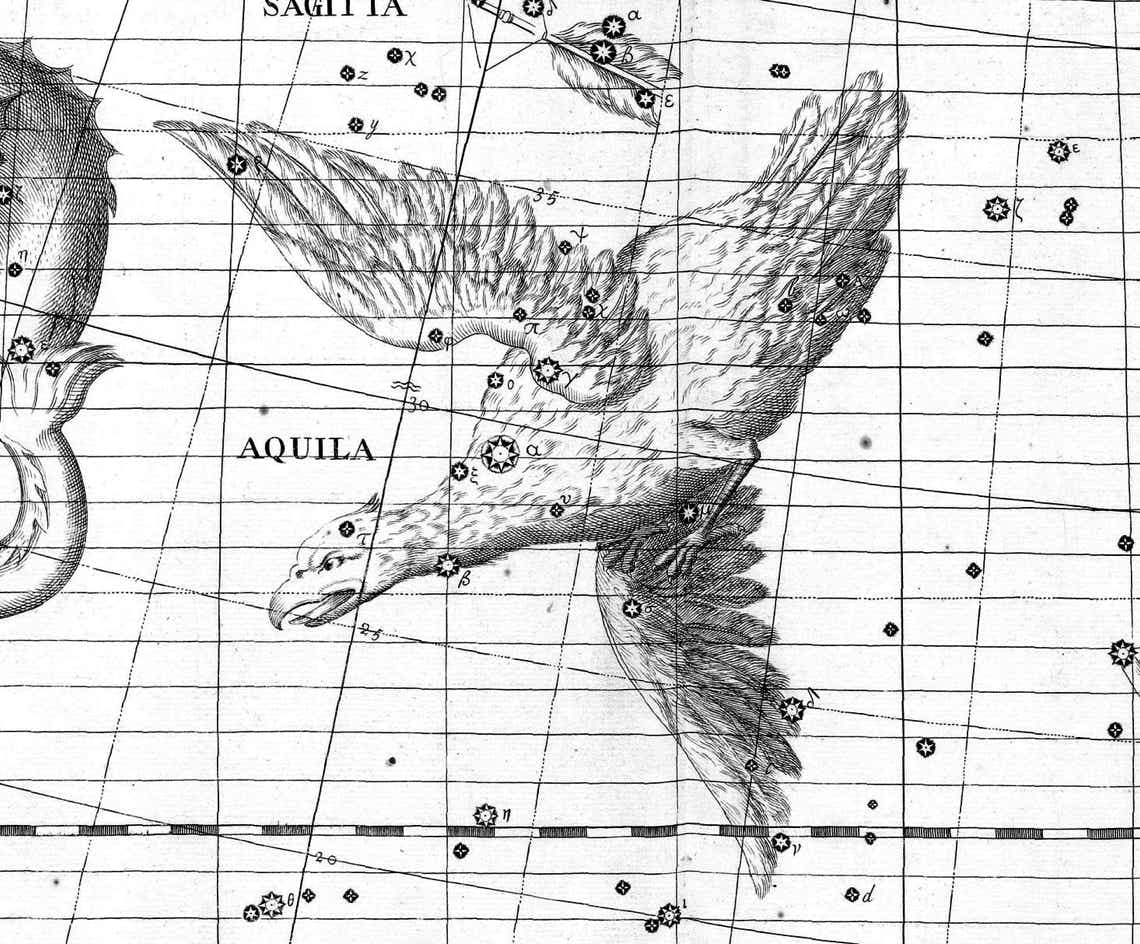
Aquila soaring across the pages of John Flamsteed’s Atlas Coelestis (1729). Its brightest star, Altair, lies at the base of its neck and is labelled Alpha. Some depictions of Aquila, such as by Johann Bode and Johannes Hevelius, show the eagle as seen from above, but Ptolemy’s description in the Almagest makes it clear that the eagle should be imagined as though seen from below, as it appears on Flamsteed’s chart here.
Altair and the stars of Aquila
The name of the constellation’s brightest star, Altair, comes from the Arabic al-nasr al-tā’ir, meaning ‘flying eagle’ or ‘flying vulture’ (the Arabic word nasr can mean either eagle or vulture). This name arises because Altair and its flanking stars Beta and Gamma Aquilae were visualized by the Arabs as an eagle (or vulture) with wings outstretched, soaring on high. Vega in Lyra and its two attendant stars were seen as a similar bird of prey but with wings folded in a dive; see, for example, their depictions on this 13th-century Persian astrolabe. The German star-name expert Paul Kunitzsch notes that the Babylonians and Sumerians referred to Altair as the eagle star, testimony to an even more ancient origin of the name.
The Greeks, including Aratus and Ptolemy, called the star Ἀετός (Aetos), the eagle, the same as the whole constellation. According to Ptolemy’s description, Altair’s neighbouring stars Beta and Gamma Aquilae lie in the eagle’s neck and left shoulder respectively. These two stars have their own names, Alshain and Tarazed, which come from shāhīn-i tarāzū, a Persian translation of an old Arabic word meaning ‘the balance’ since in conjunction with Altair they gave the impression of a weighing beam. Altair forms one corner of the so-called Summer Triangle with the stars Vega and Deneb, found in the constellations Lyra and Cygnus respectively.
Incidentally, the star that Bayer labelled Rho Aquilae, on the leading edge of the eagle’s northern wing, was carried across the border into neighbouring Delphinus by its own proper motion in 1992, an early example of how the present-day constellation figures will eventually disperse due to the individual motions of their component stars.
An obsolete subdivision
The southern part of Aquila was subdivided by Ptolemy into a now-obsolete constellation called Antinous consisting of six stars from 3rd to 5th magnitude, visualized on some maps, such as that of Bayer, as a young man being held in the eagle’s claws. These stars are all now considered part of Aquila; we know them as Eta, Theta, Delta, Iota, Kappa, and Lambda Aquilae. Eta Aquilae is one of the brightest Cepheid variable stars; its variability was discovered in 1784 by the English amateur astronomer Edward Pigott (1753–1825), who referred to it as Eta (η) Antinoi. Ptolemy had simply said that this star lay south of the head of Aquila; Bode placed it in the right shoulder of Antinous and, knowing of Pigott’s observations, labelled it ‘variabilis’. Flamsteed did not show Antinous on his chart of Aquila (see illustration above), but in his catalogue he listed their stars together under the title ‘Aquilæ cum Antinoo’. In commemoration of this former constellation, the star Theta Aquilae was given the official name Antinous by the IAU in 2024.
Chinese associations
In China, Altair and its two flanking stars, Beta and Gamma Aquilae, were known as Hegu, a large battle drum – beating the drum was a signal for the army to attack. The line to the south formed by Theta, 62, 58, and Eta Aquilae was Tianfu, the drumstick. Delta Aquilae and surrounding stars including Mu, Sigma, and Iota were Youqi, a banner flying on the right side of the drum, while Rho Aquilae and the stars of Sagitta to the north were another banner, Zuoqi, on the opposite side of the drum.
Altair and its attendant stars also had two other identifications. In one they were known as the Three Generals, the commanding officer in the centre flanked by two subordinates. In a popular Chinese folk tale, Altair represents a cowherd flanked by his two sons. The cowherd was separated by the Milky Way from his wife the weaving girl (the star Vega) and the two were allowed to meet only once a year, when magpies formed a bridge for them over the Milky Way. For the full story see Lyra.
Lambda and 12 Aquilae were grouped with stars of Scutum to make Tianbian, a team of trade officials or trading standards officers overseeing the organization of markets. (A large adjoining area of sky including much of Hercules, Ophiuchus, and Serpens was visualized as a marketplace, called Tianshan, and these trade officials were positioned just outside its wall. The star Zeta Aquilae was part of the wall.) The L-shaped figure formed by 69, 70, and 71 Aquilae plus 1 Aquarii was known as Lizhu, representing four pearls as worn by the Empress. These stars were astrologically linked with the Emperor’s harem.
© Ian Ridpath. All rights reserved
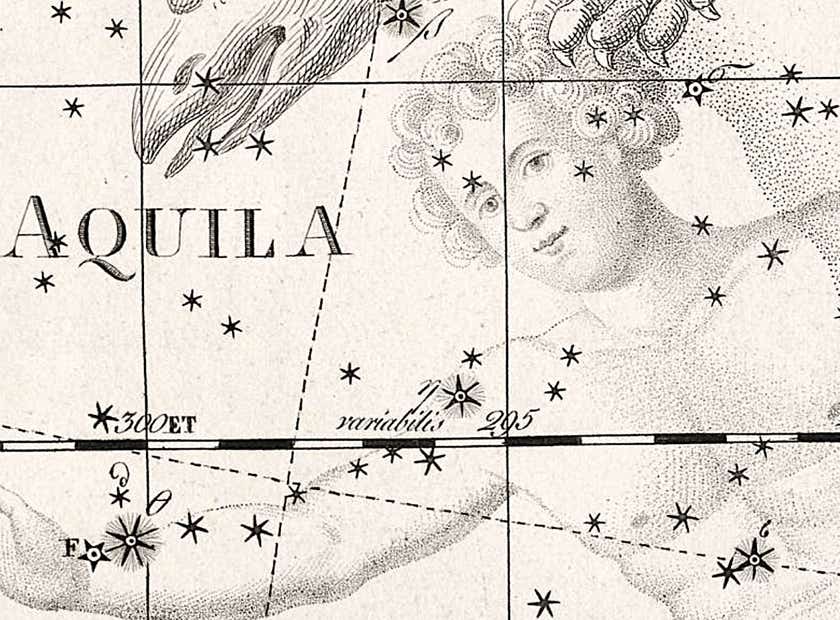
Johann Bode placed Eta Aquilae on the right shoulder of the now-obsolete sub-constellation Antinous and labelled it ‘variabilis’ on Chart IX of his Uranographia atlas of 1801.
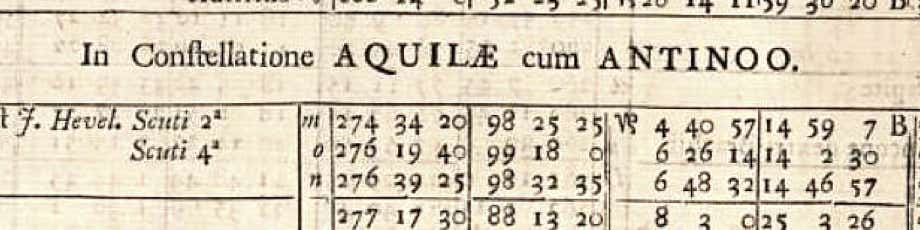
In his catalogue John Flamsteed listed the stars of Aquila and Antinous together under the title Aquilæ cum Antinoo.