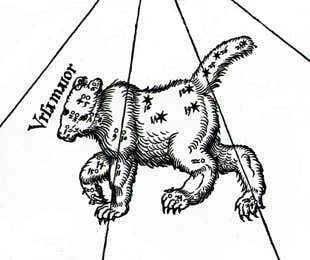


Genitive: Apodis
Abbreviation: Aps
Size ranking: 67th
Origin: The 12 southern constellations of Keyser and de Houtman
One of the dozen new constellations introduced at the end of the 16th century from observations of the southern sky by the Dutch navigators Pieter Dirkszoon Keyser and Frederick de Houtman. Apus represents a fabulous bird of paradise, as found in New Guinea, but it is a disappointing tribute to such an exotic creature, its brightest stars being of only 4th magnitude.
The name Apus is a Latinization of the Greek apous, meaning ‘footless’, since the birds were originally known to westerners only from dead specimens without feet or wings; these appendages had been removed by the locals, who prized the plumage for ornamental dress and traded the birds’ skins with neighbouring islands. The first examples were brought back to Europe by the survivors of Ferdinand Magellan’s round-the-world voyage in 1522, creating immense interest. For a while it was speculated that these gaudy birds were the mythical phoenix (and belief in the existence of the phoenix may be why the Dutch explorers also invented a southern constellation called Phoenix).
In 1598 the Dutch explorer Jan van Linschoten gave the birds the Latin name Avis paradiseus. They are now divided into six species in the genus Paradisaea, of which the greater bird of paradise (Paradisaea apoda) is the largest and is the one that is depicted in the sky.
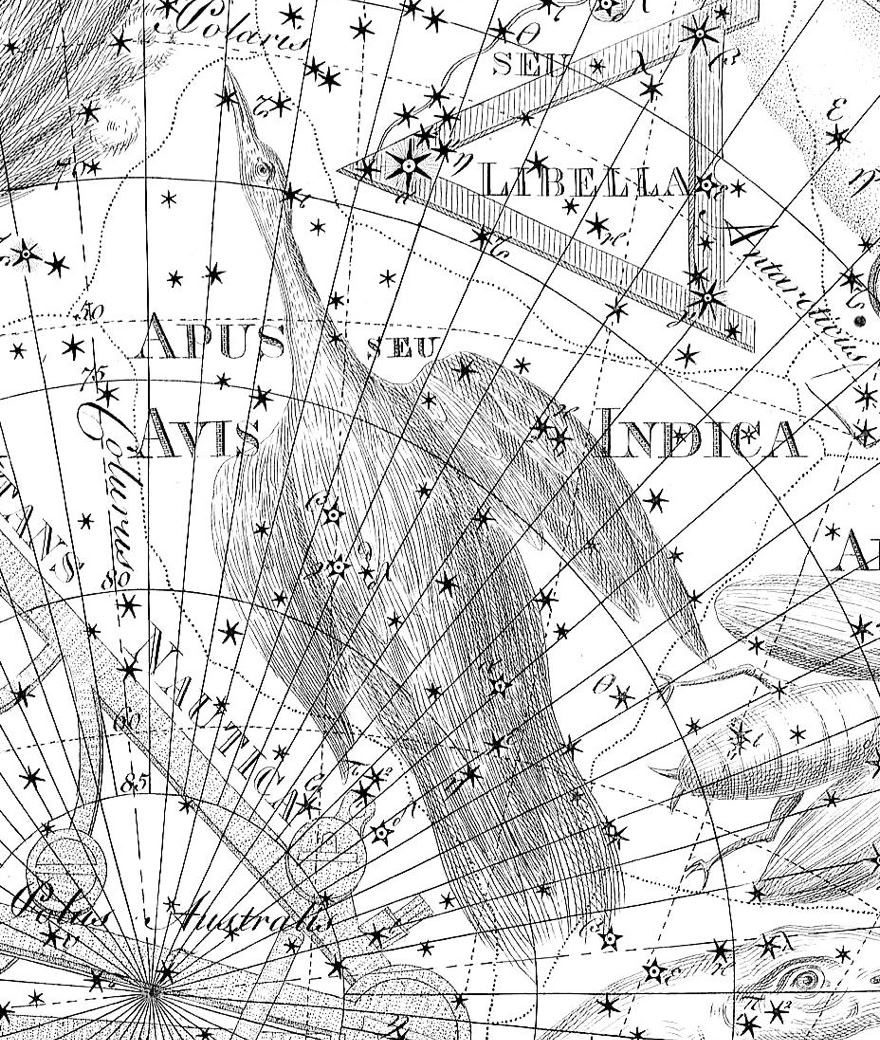
Apus seen on Chart XX of the Uranographia of Johann Bode (1801), where it was given the alternative title of Avis Indica, the Indian bird, referring to its habitat of the East Indies. The bird’s tail originally extended closer to the south celestial pole at lower left, as shown on Johann Bayer’s southern star chart of 1603, but was clipped by Lacaille in the 1750s to make room for Octans. The quartet of stars now known as Rho, Omega, Pi, and Delta Octantis were originally in the tail of Apus.
An early misprint
The constellation was first shown on the 1598 celestial globe of Petrus Plancius as ‘Paradys-vogel Apis Indica’. It seems that the word ‘apis’, Latin for bee, was a misprint for ‘avis’, meaning bird. Johann Bayer followed Plancius by calling the constellation Apis Indica on his Uranometria atlas of 1603. All early globes and charts depicted the bird without wings or feet, indicating they were modelled on dead specimens.
The Dutch historian and geographer Paulus Merula, who provided the first written description of the new southern constellations in his Cosmographiae generalis of 1605, called it Avis Paradisi, correcting Plancius’s misprint. The Dutch cartographer Willem Janszoon Blaeu also seems to have spotted Plancius’s error and changed the name to Apous Indica on his celestial globe of 1603. Johannes Kepler in the influential Rudolphine Tables of 1627 called it ‘Apus, Avis Indica’ (Apus, bird of India), establishing the modern version of the name. Halley and Hevelius both called it simply Apus, but the alternative name of Avis Indica continued to Bode’s day (see illustration).
Part of the celestial bird’s tail was docked by Nicolas Louis de Lacaille in the 1750s to make way for his south polar constellation Octans, an unfortunate truncation given that in real life the long, colourful tail feathers are the main attraction.
In 2025 the IAU gave the name Paradys to the constellation’s brightest star, Alpha Apodis, mag. 3.8, in commemoration of the original Dutch name.
© Ian Ridpath. All rights reserved

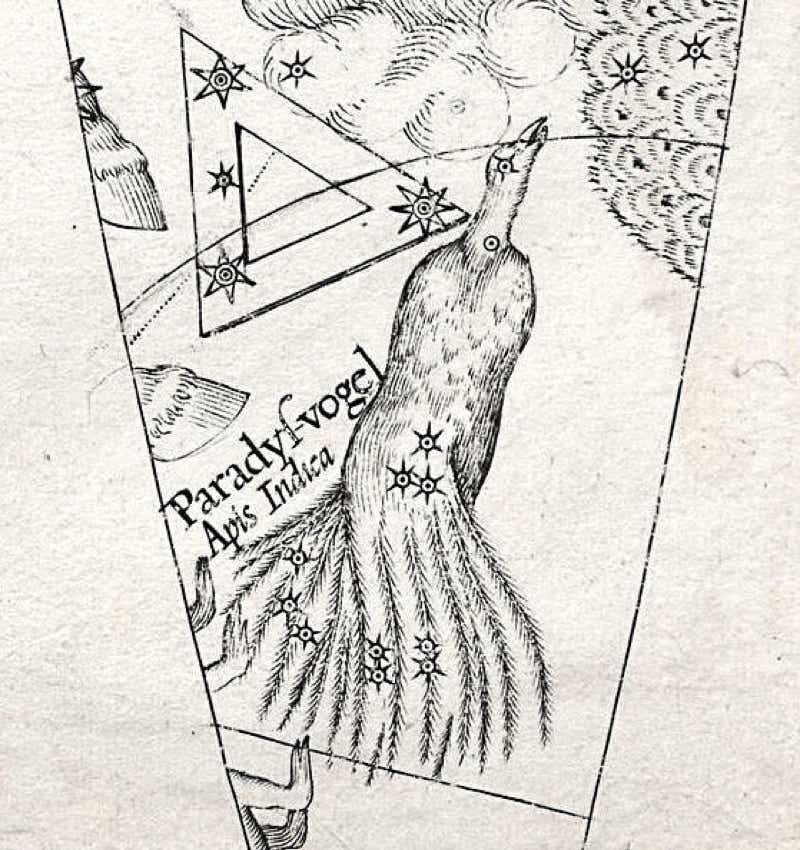
Apus depicted on a gore from Petrus Plancius’s celestial globe of 1598 under the name Paradys-vogel, Apis Indica. The example shown is probably the Greater Bird of Paradise, the largest of the six species now recognized. Above left of it lies Triangulum Australe, unlabelled. (Nicolai Collection of the State Library of Württemberg, Stuttgart)
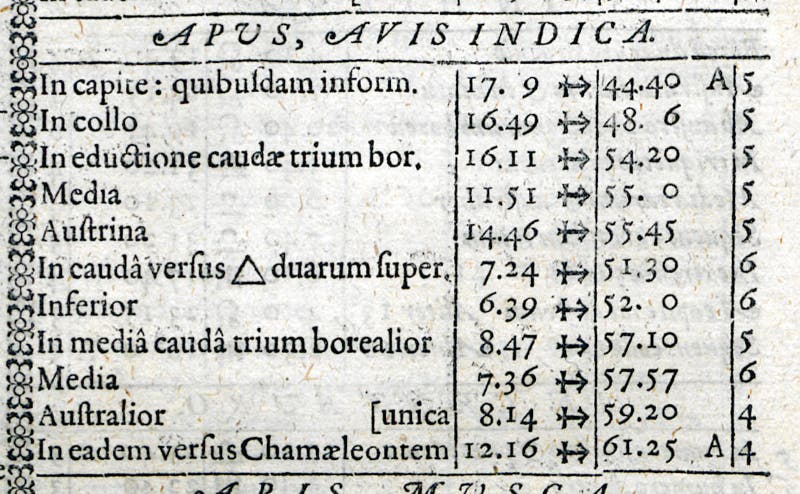
Johannes Kepler called the constellation ‘Apus, Avis Indica’
(Apus, bird of India) in the Rudolphine Tables of 1627.
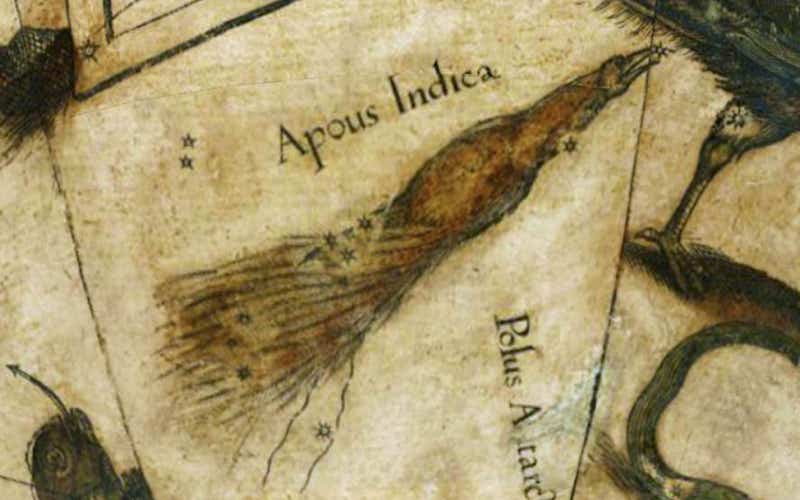
The Dutch cartographer Willem Janszoon Blaeu used the Greek form of the name, Apous, rather than the Latin Apus on his celestial globe of 1603.