
ON OTHER PAGES
Constellation boundaries
How the modern constellation outlines came to be
ONE of the tasks undertaken by the International Astronomical Union (IAU) at its first General Assembly in 1922 was to agree a definitive list of 88 constellations with standardized names and three-letter abbreviations. But these 88 constellations still had no properly defined boundaries.
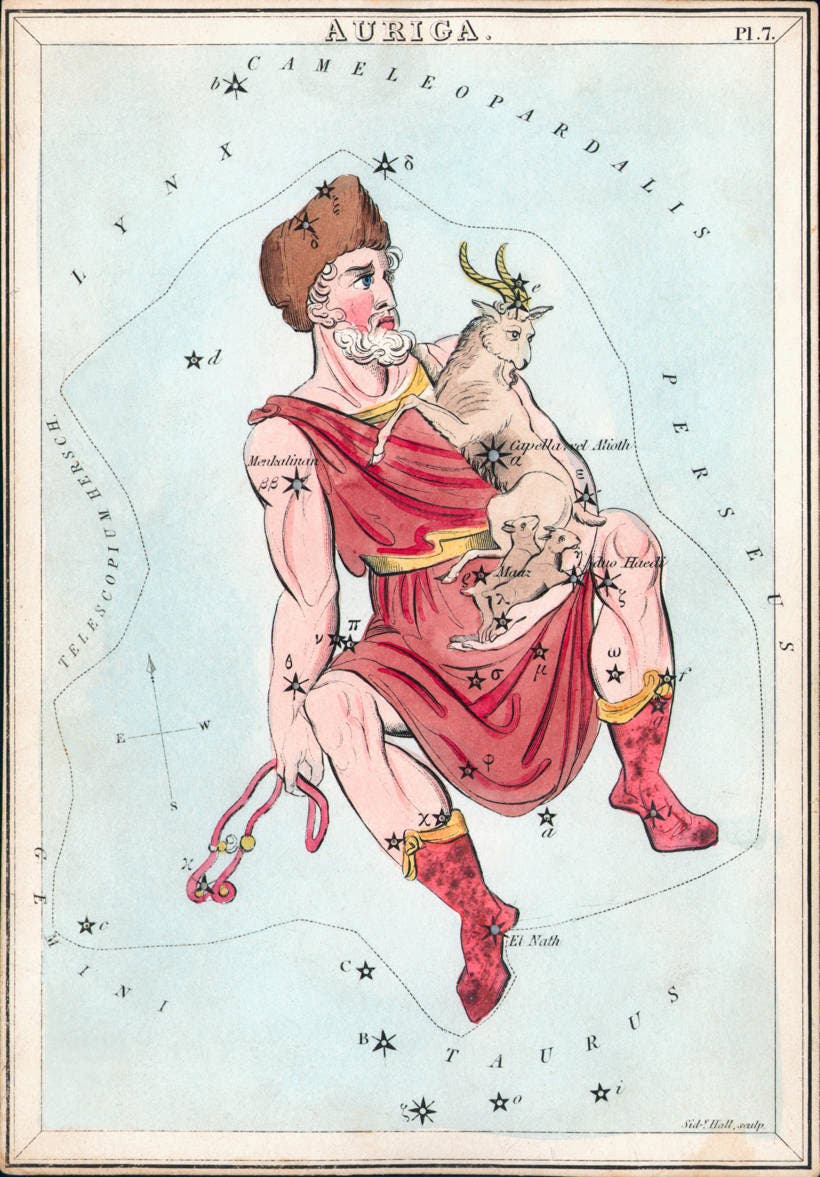
Star charts of that time showed perimeter lines snaking vaguely between the various constellation figures. These boundary lines varied from map to map, so faint stars could be in different constellations on different maps. What’s more, some stars were shared between constellations, a tradition that extended back to the catalogue in Ptolemy’s Almagest. For example, the star that marks the head of Andromeda, which we know as Alpha Andromedae, was also described by Ptolemy as being on the navel of Pegasus, the horse. Similarly, Ptolemy described the star we know as Beta Tauri as being both on the northern horn of Taurus and the right foot of Auriga (illustration below).
The idea of standardizing the boundaries of the constellations came from Belgian astronomers. At the IAU’s second General Assembly, held in Cambridge, England, in 1925, Eugène Joseph Delporte (1882–1955) of the Royal Observatory in Brussels presented a paper co-authored with Louis Casteels (1881–1965) arguing the need for a clearly defined system of constellation boundaries. The IAU took up the suggestion and formed a subcommittee to prepare official boundaries for the northern constellations. The lead role was given to Delporte, who worked at it over the next two years, consulting the subcommittee as he went along.
Delporte drew his boundaries along vertical lines of right ascension and horizontal parallels of declination. One governing principle was that all variable stars with an established designation would remain in that constellation, as requested by the IAU’s Variable Stars committee. Delporte ended the practice of shared stars, deciding that Andromeda should retain her head (and hence the horse would lose its navel), and that Taurus should retain the tip of its horn while Auriga sacrificed his foot.
Another conundrum was presented by the combined figure of Ophiuchus entwined by the snake, Serpens. Delporte solved this by dividing the snake into two, the head on one side of Ophiuchus and the tail on the other. Serpens is the only constellation so divided, but the two halves still count as only one constellation.
Delporte drew his boundaries for the epoch of 1875, the same date that the American astronomer Benjamin Gould had used when he drew up boundaries for the southern constellations. Gould’s southern constellation boundaries were published in his Uranometria Argentina of 1877.
Delporte’s new boundaries were approved by the IAU at its General Assembly at Leiden in 1928. The Assembly also asked him to modify Gould’s southern hemisphere boundaries to make them consistent with the new scheme for the north. This he did, in particular removing the diagonal lines that Gould had occasionally used and replacing them with verticals and horizontals. The final job was published in 1930 in Délimitation Scientifique des Constellations and an accompanying volume, Atlas Céleste. In both cases the text was in French. A translation of the introduction to Délimitation can be found here.
Borderline case
Auriga and its meandering boundary as shown in Urania’s Mirror, a set of constellation cards published in or around 1825, a century before the International Astronomical Union introduced official constellation borders in 1930. The right foot of Auriga is marked by a star here labelled El Nath. Before the standardization of constellation boundaries, this star was shared by Auriga and Taurus and was known both as Gamma Aurigae and Beta Tauri. It is now assigned exclusively to Taurus, as Beta Tauri.
(Author’s collection)