Surprising as it may seem, astronomical objects are the most common cause of mistaken UFO reports, including close encounters
APPROACHING Manchester airport, England, on the evening of 1995 January 6, a British Airways Boeing 737 with 60 passengers on board was buzzed by a bright, fast-moving UFO. The first officer ducked instinctively as it flashed past. The conversation between the pilot and Manchester air traffic control was as follows:
Pilot: We just had something go down the right hand side just above us very fast
Manchester: Well, there’s nothing seen on radar. Was it an aircraft?
Pilot: Well, it had lights, it went down the starboard side very quick
Manchester: And above you?
Pilot: Just slightly above us, yeah.
At the time of the incident, which occurred at 18.48 pm, the Boeing was descending through 4,000 ft altitude about nine miles southeast of Manchester. Visibility was over 10 km, it was dark and the Boeing was flying in clear air above cumulus cloud on a northerly heading. The UFO was moving in the opposite direction and was visible for about two seconds. There was no apparent sound or wake. No other pilots reported it, nor was it seen from the ground, presumably because of the intervening cloud.
The incident was considered so unusual that the pilots submitted a report which was investigated by the Civil Aviation Authority’s (CAA) Independent Joint Airmiss Working Group. Their findings were published in February 1996.
In his report to the CAA the pilot described the object as having a number of small white lights, like a Christmas tree. While he was convinced that the object itself was lit, the co-pilot differed, describing it as a dark wedge-shaped object with what could have been a black stripe down the side, and thought that it was illuminated by the Boeing 737’s landing lights. (In fact this is unlikely, since the object was above and to the side of the Boeing). The co-pilot was convinced that it was not a meteorological phenomenon, balloon, or any other craft they were familiar with, including a Stealth aircraft.
‘If you’ve never seen a UFO, you’re not very observant. And if you’ve seen as many as I have, you won’t believe in them.’
Arthur C. Clarke
In its investigation the CAA considered the possibility that the UFO could have been another aircraft ranging from a hang glider or microlight to a military flight, but found no evidence to support such suggestions. The CAA investigators did not consider other possible causes since they were outside their remit of air safety, but remarked that ‘almost all unusual sightings can be attributed to a wide range of well-known natural phenomena’. They concluded that the incident ‘remains unresolved’.
Had the CAA chosen to consider astronomical explanations, a likely answer would not have been difficult to find. From the captain’s description, the object sounds like a bright fireball, and in view of the lack of a radar return or a wake there is no good reason to suppose that it was anything else. Such a misidentification by experienced pilots is not unusual, as we shall see from what follows. In fact, another British Airways pilot and two RAF Tornado pilots had described a satellite re-entry in similar terms in 1990. But, in the annals of UFOlogy, the Manchester case has gone down as a UFO officially endorsed by the Civil Aviation Authority.
What causes UFOs?
Amateur astronomers know more about the causes of UFO sightings than most so-called UFO researchers. Arthur C. Clarke, not a man with a closed mind, once said: ‘If you’ve never seen a UFO, you’re not very observant. And if you’ve seen as many as I have, you won’t believe in them.’
To see what he meant, we need to look at some statistics. Astronomical objects are by far the main causes of mistaken UFO reports. In a classic analysis of 1,300 UFO reports made to the Center for UFO Studies in the US, published by Allan Hendry in The UFO Handbook (Sphere, 1980), just over half of all identified nocturnal lights were accounted for by astronomical causes: stars, planets, meteors, the Moon, artificial satellites, and satellite re-entries.
An astronomical solution should be uppermost in a UFO investigator’s mind, but few UFOlogists have even a rudimentary understanding of astronomy
What’s more, astronomical objects also featured prominently among the identified daytime UFOs, those involving apparent corroboration by radar, and the various classes of close encounters, including the celebrated Third Kind in which occupants are supposedly sighted. In short, an astronomical solution should always be uppermost in a UFO investigator’s mind, but experience shows that few UFOlogists have even a rudimentary understanding of astronomy and so fail to weed out even easily explicable cases.
How stars become UFOs
Why should simple lights in the sky cause such confusion? As amateur astronomers know, most people are totally unfamiliar with the sky. Highly credible witnesses such as teachers, policemen, and pilots (yes, and astronomers) can still be surprised by the unexpected appearance of a bright star, planet, meteor, or satellite.
Usually, a description such as ‘it seemed to hover for an hour [or more]’ is diagnostic of a star or planet – people get fed up watching after about an hour, cloud intervenes, or the object sets. Often there are other descriptions such as ‘flashing coloured lights’ or ‘it appeared to be rotating’ which is how bright stars appear when they are twinkling low down, notably Sirius on a cold, frosty night. Binoculars do not always help identification if they happen to be cheap and with optical defects that produce spurious colours and shapes.
Additional information such as ‘it wasn’t there before’, ‘it appeared to move slowly’, or ‘it dodged around’ are still consistent with characteristics of stars and planets. Many people don’t realize that stars rise and set during the night. Thin clouds can make stars appear to dim and brighten, as though they were receding or approaching. And, when seen between scudding clouds, stars really do appear to dodge around.
A more subtle effect is known technically as the autokinetic effect. In this, natural movements of the eye make a stationary object appear to move irregularly, sometimes zooming up and down or swinging from side to side in a movement sometimes described as like a ‘falling leaf’. Autokinetic motion can be uncanny when watching artificial satellites, which often appear to zig zag or even make deviations around stars in their path.
Another shortcoming of human perception is that it is impossible to judge the distances of lights in the sky. A planet millions of miles away, an aircraft several thousand feet away, or a torch bulb a few dozen yards away all appear much the same size and brightness at night. The examples in this article show the tendency of witnesses to grossly underestimate the distance of nocturnal lights.
Even sightings involving military radar are no more likely to involve ‘genuine’ UFOs. In 1989 a series of reports began to emanate from Belgium, culminating on the night of 1990 March 30–31 with widespread sightings by police and an aerial ‘chase’ by Belgian Air Force F-16 fighters involving radar contact with an unidentified target. This now-famous event turned out to have been sparked off by misidentifications of bright stars and planets by police while the radar returns were due to atmospheric effects and equipment malfunction. (For a more extensive analysis, see here.)
Venus, the biggest culprit of all
Let’s look at some instructive examples involving the planet Venus, the biggest UFO culprit of all, popularly known as the ‘evening star’ (although it can also appear in the morning sky as the ‘morning star’). As amateur astronomers know, Venus is the brightest object in the night sky after the Moon and can dazzle the eye, sometimes appearing cross-shaped. Back in 1967, there was a famous case in which two policemen in Devon, England, reported Venus as a UFO shaped like a ‘flying cross’ and chased it in their car at speeds up to 90 mile/h. The errors in their report are typical of those made by UFO witnesses: the size and brightness of the object is overestimated, the distance is underestimated, and spurious motion is attributed to the object.
In recent years, I have seen a number of videos on YouTube and elsewhere taken with hand-held camcorders which appear to show saucer-shaped objects making erratic motions in the evening sky. These videos are clearly of Venus in twilight. The ‘movement’, noticeable only when the camera is zoomed in, is due simply to tremors in the hands of the excited camera operator, while the apparent shapes of the objects are optical effects in the camera itself.
‘Close encounters’ with Venus and Jupiter
In The UFO Handbook, Allan Hendry describes an apparent close encounter of the third kind stimulated by Venus. A woman reported that a very bright object in the southwest had made a slow, jerky descent over a period of an hour one evening. As she stared at it, she became convinced that she could see occupants with rounded silvery heads looking out of the object’s windows. The UFO turned up again on subsequent nights, exactly where Venus should be.
Keep this report of apparent occupants in mind when considering the famous story of an American couple, Betty and Barney Hill, who claimed to have been chased by a UFO one night. Barney stopped to look at the object through binoculars and reported seeing a row of windows with alien faces peering out. Thinking they were going to be abducted, the Hills drove off in panic. Later, Betty Hill dreamed that they really were abducted, and many UFOlogists have believed her dream story.
Yet, from Betty Hill’s own sketch, Robert Sheaffer has identified the UFO as Jupiter, which is second only to Venus in brightness. The apparent ‘chasing’ is another phenomenon of celestial objects, which appear to keep pace with moving cars. Sheaffer also describes a hilarious 100 mph police chase of Venus through Ohio and Pennsylvania in 1966. They never did catch it, but they did inspire a scene in the movie Close Encounters of the Third Kind.
Seen a low-flying UFO?
It could have been one of these…
Chinese lanterns
Mini hot-air balloons called Chinese lanterns or sky lanterns have created a storm of sightings in recent years, including reports of orange-coloured ‘saucer fleets’.
Balloons
Many daytime UFOs are caused by helium-filled balloons, often released at fairgrounds and on sports days. Very common in summer.
Even black plastic bags when heated by the Sun can become UFO-like balloons.
Lit by LEDs
A startling addition to the ranks of UFO culprits are balloons containing LEDs, which can flash and change colour in ways previously possible only by the mothership in Close Encounters. And beware of remote-controlled blimps lit up in the same way.
Drones
Drones have been another source of sightings in recent years. In fact, many unidentified lights in the sky are now being reported as drones rather than UFOs. However, most of these sightings are not caused by drones at all, just the same misidentifications that give rise to UFO reports.
Kites
The Helikite, a combined kite and helium balloon, is used to scare birds, among other applications. Can be encountered over fields day or night.
Kites like this are capable of manoeuvres seemingly impossible by any man-made craft!
Birds
Individually and in flocks, birds can catch out the unwary.
Many fuzzy, elliptical UFOs captured by chance on photographs have been attributed to birds flying unnoticed through the field of view just as the shutter was pressed.

Migrating flocks of birds can create UFO ‘formations’, particularly if lit up by streetlights at night.
Other sightings can be caused by luminescing barn owls.
The voice of experience
‘We are receiving hundreds of reports every month of normal, terrestrial events, e.g. over-flights of the International Space Station, the Space Shuttle, or satellites; the appearance of typical meteors; and observations of normal, twinkling stars, planets, contrails, clusters of balloons, etc. In fact, the overwhelming majority of reports that we receive now are of these normal objects and events.
‘I am flabbergasted by what people report to our Center as UFOs which are nothing more than objects, or events, of normal, terrestrial, origin.
‘I believe the majority of time I spend on the Hotline is devoted to trying to convince people who have been staring for hours at a star or planet that the object is not a UFO.’
Peter Davenport,
Director of the National UFO Reporting Center, 2009 August 30
Astronomical causes of UFOs
Ian Ridpath
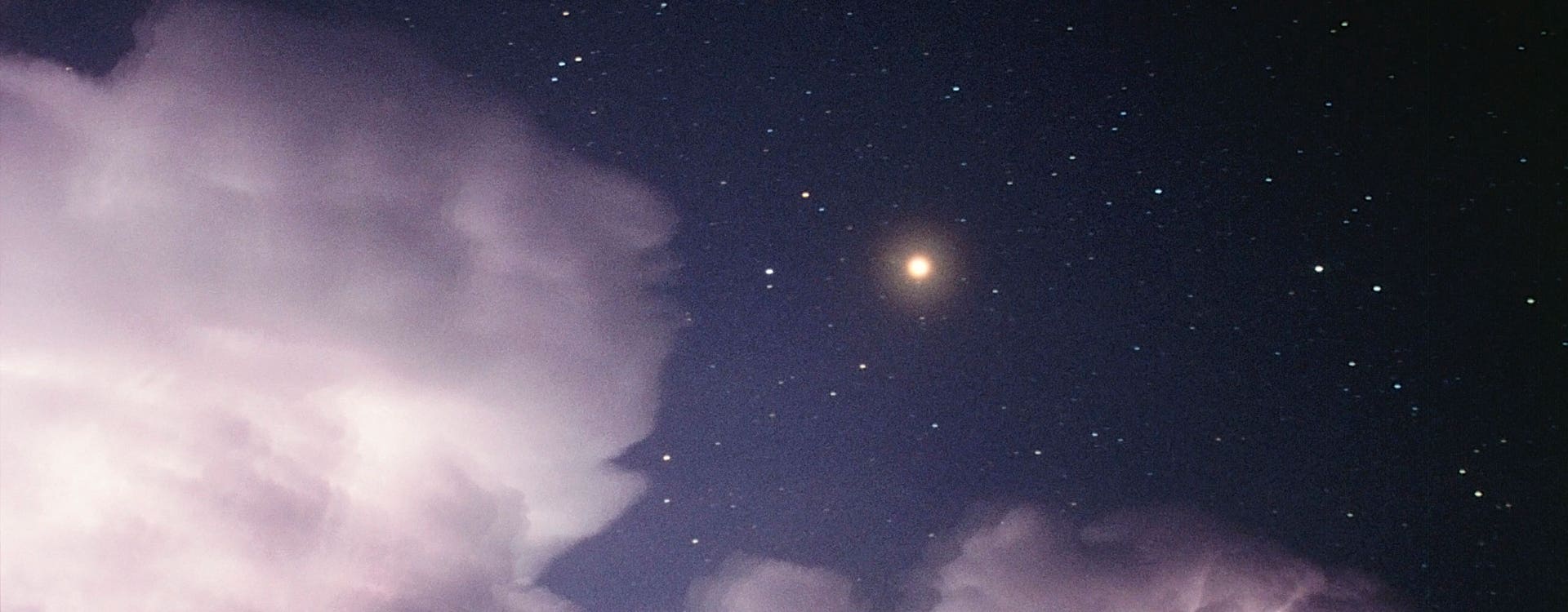
Mars shines above thunderclouds at a close approach in 2003. Bright planets are frequently reported as UFOs, and feature in some of the best-known cases. Photograph by Till Credner and Sven Kohle, AlltheSky.com.