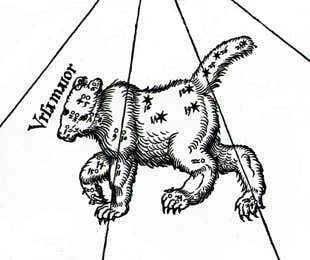


Genitive: Vulpeculae
Abbreviation: Vul
Size ranking: 55th
Origin: The seven constellations of Johannes Hevelius
A constellation introduced by the Polish astronomer Johannes Hevelius in his star catalogue of 1687. In his Firmamentum Sobiescianum star atlas published posthumously in 1690 he depicted it as a double figure of a fox, Vulpecula, carrying in its jaws a goose, Anser. Since then the goose has flown (or been eaten), leaving just the fox.
Hevelius placed the fox near two other hunting animals, the eagle (the constellation Aquila) and the vulture (which was an alternative identification for Lyra). He explained in the Introduction to the atlas that the fox was taking the goose to neighbouring Cerberus, another of his inventions – although this part of the tableau has been spoiled, as Cerberus is now obsolete.
Hevelius himself was somewhat inconsistent in his naming of this constellation. In his star catalogue he named the pair ‘Vulpecula cum Ansere’, the fox with goose, but showed them separately as ‘Anser’ and ‘Vulpecula’ on his star atlas. Others such as Flamsteed preferred the slightly amended title fox and goose (see chart below). Francis Baily in his British Association Catalogue of 1845 shortened the constellation’s name to just Vulpecula.
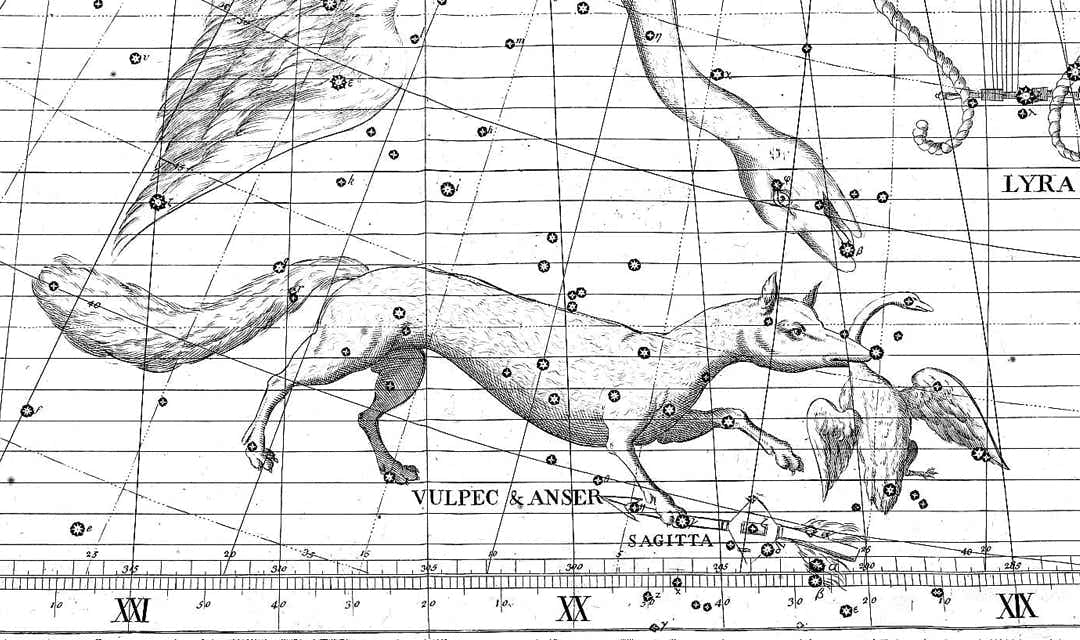
The fox and the goose shown as ‘Vulpec. & Anser’ on the Atlas Coelestis of John Flamsteed (1729). The Fox and Goose is a traditional pub name in Britain.
See here for the original depiction by Hevelius.
Its brightest star is Alpha Vulpeculae, magnitude 4.4, which lay on the fox’s nose. It is the only one honoured with a Greek letter, allocated by Baily in his British Association Catalogue. In 2017 this star was officially named Anser by the International Astronomical Union.
On the border with Sagitta is an asterism known as Brocchi’s Cluster, or more popularly the Coathanger because of its distinctive bar-and-hook shape. It consists of ten stars of 5th magnitude and fainter and is just visible to the naked eye under good conditions; it was first mentioned by the Arab astronomer al-Ṣūfī in his Book of the Fixed Stars, written in AD 964, who described it as a nebula containing stars of the 4th, 5th, and 6th magnitudes, a testament to his keen eyesight, particularly since the stars are actually fainter than he estimated.
None of the stars of Vulpecula featured in the Chinese constellation system, although they did briefly form part of the now-obsolete river Tigris, invented earlier in the 17th century by the Dutch astronomer Petrus Plancius.
© Ian Ridpath. All rights reserved
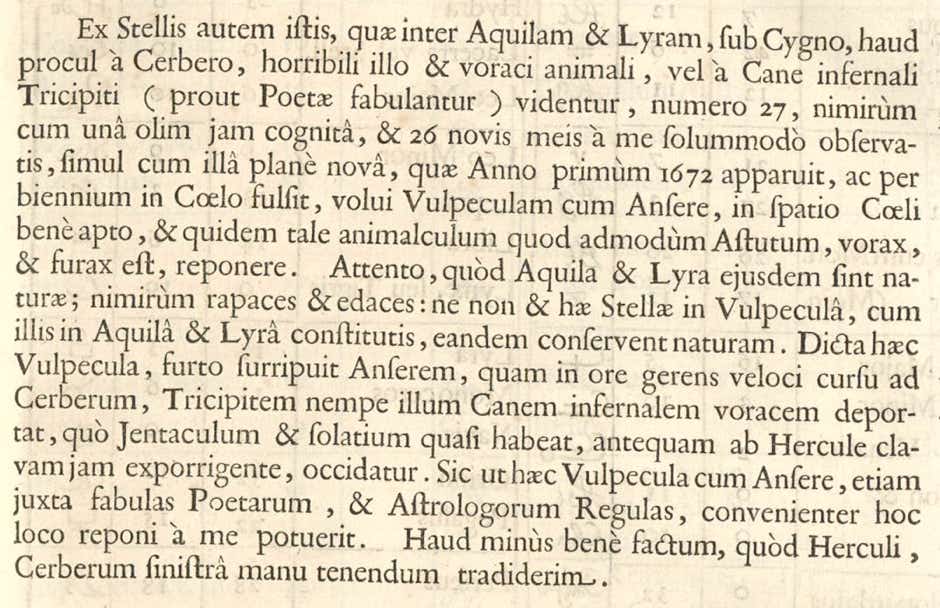
Hevelius’s description of Vulpecula cum Anser from Chapter 8 of his Prodromus Astronomiae, the introductory section to his star catalogue and atlas. Hevelius combined the description with that of Cerberus, the three-headed monster captured by Hercules. He explained that the fox was taking the goose to Cerberus for a shared breakfast.