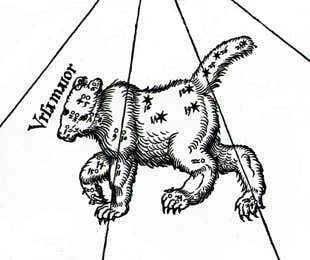


URSA MAJOR CONTINUED »
Stars of the Dipper
Johann Bayer, who allotted Greek and Roman letters to the brightest stars in 1603, labelled the seven stars of the Dipper from Alpha to Eta in order of right ascension, without regard for their relative brightness. Alpha and Beta Ursae Majoris (Dubhe and Merak) lie in the bowl of the Dipper and are popularly termed the Pointers because a line drawn through them points to the north celestial pole. Dubhe’s name comes from the Arabic al-dubb, ‘the bear’, while Merak comes from the Arabic word al-marāqq meaning ‘the flank’ or ‘groin’. In fact, all seven stars of the Dipper have names derived from Arabic.
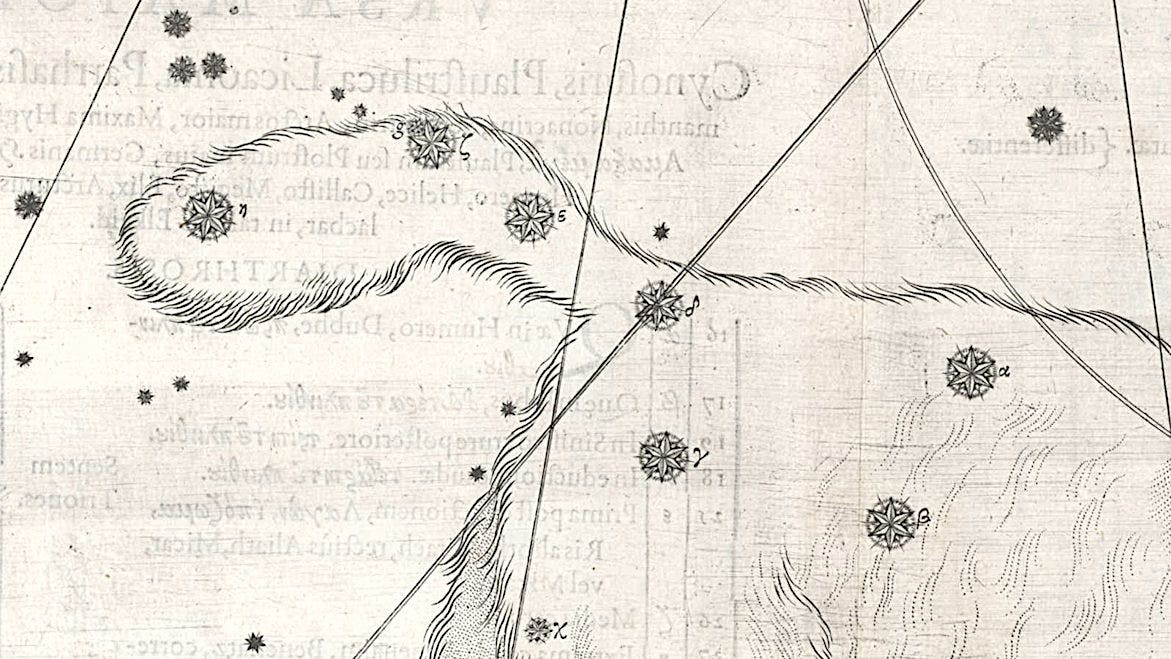
Greek letters were assigned to the stars of the Plough by Johann Bayer on his Uranometria atlas of 1603. The seven main stars are lettered from Alpha to Eta in order of right ascension (right to left) while Alcor, the fainter companion of Mizar, is given a lower case g. On this first edition of the atlas the charts were spoiled by show-through from the printed star catalogue on the back.
At the tip of the bear’s tail lies Eta Ursae Majoris, known as Alkaid, from the Arabic al-qā’id meaning ‘the leader’; an alternative name was Benetnasch, from the Arabic term Banāt Na’sh al-Kubrā meaning ‘the Daughters [or children] of the Greater Bier’, for the Arabs regarded this figure not as a bear but as a bier or coffin. They saw the tail of the bear as a line of three mourners (banāt, the daughters or children of the deceased) following the coffin, al-na’sh. Similarly, the seven stars making up the little dipper in Ursa Minor were known as the Daughters [or children] of the Smaller Bier.
Gamma Ursae Majoris, the third star in the Dipper’s bowl, is called Phecda, from the Arabic word fakhidh meaning ‘the thigh’. Delta Ursae Majoris, lying where the handle of the Dipper joins the bowl, is named Megrez, from the Arabic word maghriz meaning ‘root of the tail’.
Mizar and Alcor
Second in line along the tail of the Great Bear is the wide double star Zeta Ursae Majoris. The two members of the double, visible separately with keen eyesight, are called Mizar and Alcor. They were depicted as a horse and its rider on a diagram of the north polar region of the sky in the 1524 book Cosmographicus Liber by the German astronomer Petrus Apianus (the Latinized form of Peter Apian), apparently following a popular German tradition. The name Mizar is a corruption of the Arabic al-marāqq meaning ‘the flank’ or ‘groin’, the same origin as the name Merak. Its companion, Alcor, gets its name from a corruption of the Arabic al-jaun (also transliterated as al-jawn), meaning the black horse or camel. This is the same origin as the name Alioth which is applied to the next star along the tail, Epsilon Ursae Majoris. The name Alcor made its first appearance in Apianus’s book of 1524, and reappeared with the spelling Alkor on the magnificent coloured planisphere in his Astronomicum Caesareum six years later.
The name the Arabs used for Alcor was al-suhā, meaning the overlooked or neglected one. (Ptolemy certainly overlooked it, as he did not include it in the Almagest.) The 10th-century Arabic astronomer al-Ṣūfī noted that this star was used by people to test their eyesight. He quoted an Arabic saying: ‘I showed him al-suhā and he showed me the Moon’, as a comparison between people with good and bad eyesight. Ophthalmologist George M. Bohigian has concluded that the ability to divide Mizar and Alcor is comparable to the standard Snellen test for 20/20 vision. Bode gave both Suha and Alcor as names for this star on his chart of Ursa Major.
Other stars of Ursa Major
In addition to the famous seven stars of the Plough or Dipper there are three distinctive pairs of stars that mark the bear’s feet. The Arabs imagined these not as part of the bear but as the hoof prints of a jumping gazelle and called them qafazāt al-ẓibā’ (the leaps of the gazelle); according to an Arabic folk tale, the gazelle jumped away when the lion thumped its tail on the ground, ending up at a pond, al-ḥauḍ, represented by an arc of six stars from Tau to 15 UMa.
These pairs of stars have names derived from the Arabic words referring to the three leaps. The pair Nu and Xi Ursae Majoris (which mark the bear’s right hind paw, according to Ptolemy) are named Alula Borealis and Alula Australis. The word Alula comes from the Arabic phrase al-qafza al-ūlā meaning ‘first leap’; the distinctions ‘northern’ (Borealis) and ‘southern’ (Australis) are added in Latin. The second leap, al-qafza al-thānīya, is represented by Lambda and Mu Ursae Majoris, known as Tania Borealis and Tania Australis; these stars were described by Ptolemy as being in the bear’s left hind paw. The third leap (and the bear’s front left paw) is represented by Iota and Kappa Ursae Majoris; Iota has the name Talitha, from the Arabic al-thālitha meaning ‘third’, and Kappa is called Alkaphrah from al-qafza meaning ‘leap’.
Ptolemy listed 27 stars as members of the constellation, plus another eight that he regarded as lying outside it (i.e. they were unformed). Two of these unformed stars were later incorporated by Johannes Hevelius into Canes Venatici, where they are now known as Alpha and Beta CVn. The others became part of another Hevelius invention, Lynx.
Chinese associations
Chinese astronomers knew the shape of the Plough as Beidou, the Northern Dipper (they had a Southern Dipper as well, in Sagittarius). It was also seen as the chariot of the Emperor, controlling the sky as it revolves around the pole. Beidou is one of the few Chinese constellations that is readily recognizable to western eyes. Each of the seven stars had its own name: Alpha (Dubhe) was Tianshu, ‘celestial pivot’ (not to be confused with the Tianshu in Camelopardalis which was the pole star of its time); Beta (Merak) was Tianxuan, ‘celestial rotating jade’; Gamma (Phecda) was Tianji, ‘celestial shining pearl’; Delta (Megrez) was Tianquan, ‘celestial balance’; Epsilon (Alioth) was Yuheng, ‘jade sighting-tube’; Zeta (Mizar) was Kaiyang, ‘opener of heat’ (i.e. a regulator of the seasons); and Eta (Alkaid) was Yaoguang, ‘twinkling brilliance’ (also translated as ‘glittering light’). An eighth star, Fu, was regarded as the Emperor’s assistant or the prime minister; authorities differ as to whether this is Alcor, the companion to Mizar, or another faint star nearby.
A ring of six faint stars near Merak including 36 and 44 UMa was known as Tianlao, a prison for noblemen (the prison for commoners was in Corona Borealis), although some maps place this group south of Psi UMa. Tianli, the judge responsible for imprisoning the noblemen, was represented by four faint stars including 66 UMa within the bowl of the Dipper.
Six stars in the forelegs and head of the bear formed an arc called Wenchang, the administrative centre, representing six officers or departments of the celestial government. Sources differ as to exactly which six stars were involved, but Upsilon, Phi, Theta, and 15 UMa were among them.
There are various other faint Chinese constellations in this area which are difficult to identify with any certainty. To the north of Wenchang was Sanshi (formerly known as Sangong), a trio of stars representing three tutors. Neijie, ‘inner steps’, was a group of six stars representing steps between Wenchang and the polar region of the sky. The Chinese referred to the area around the celestial pole as the Purple Palace or Central Palace. The star 24 Ursae Majoris formed part of one of the walls enclosing this circumpolar region; the complete wall extended from Draco to Camelopardalis (for more on the Central Palace, see Ursa Minor).
South of the bowl of the Dipper were two named single stars. One was called Taiyangshou, ‘guard of the Sun’, usually identified as Chi Ursae Majoris, while Psi Ursae Majoris was Taizun, representing royal relatives or ancestors. In southern Ursa Major, the three pairs of stars that the Arabs visualized as the tracks of a leaping gazelle were known in China as Santai, ‘three steps’, either leading to the administrative centre Wenchang, or steps that allowed the Emperor to travel between Earth and sky – literally, three steps to Heaven.
© Ian Ridpath. All rights reserved
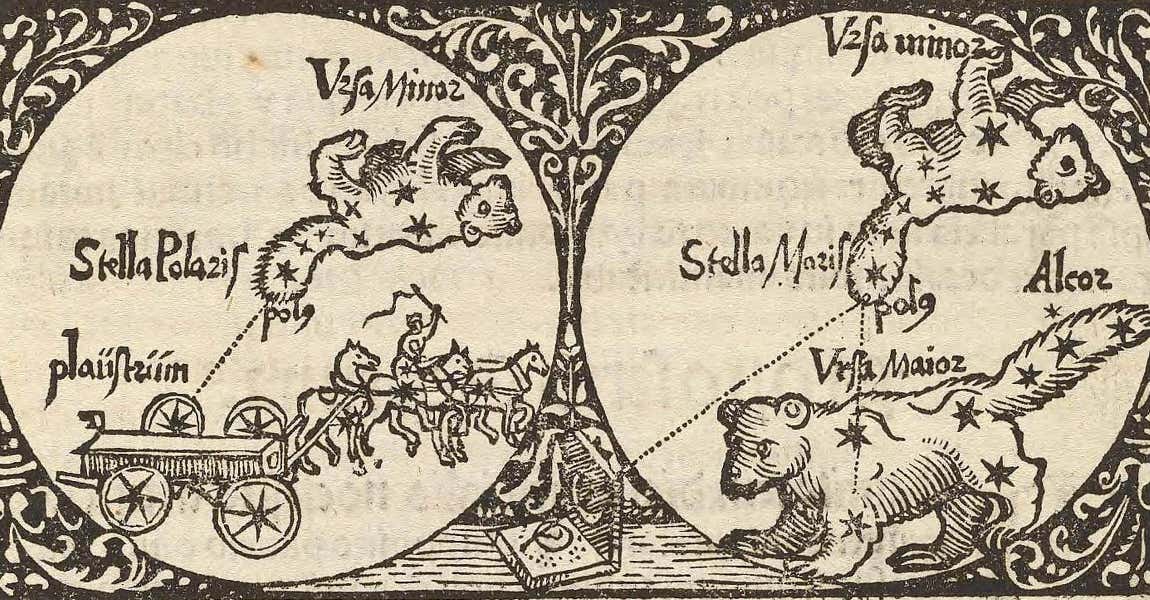
Ursa Major was imagined as a team of three horses pulling a four-wheeled cart in the Cosmographicus Liber of 1524 by the German astronomer and mathematician Petrus Apianus (1495–1552), also known as Peter Apian. The second horse is marked by the star Mizar and its rider by Alcor. On this chart the constellations are shown reversed, as on a celestial globe. A later version of the chart has the constellations the right way round.
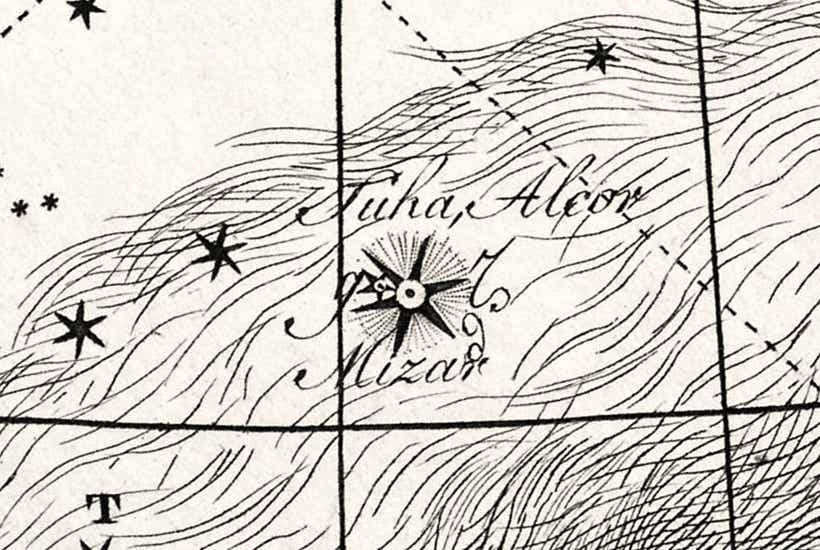
Johann Bode gave the names Suha and Alcor to the companion of Mizar on his Uranographia of 1801. Suha comes from the Arabic al-suhā meaning overlooked or neglected.