

Genitive: Tucanae
Abbreviation: Tuc
Size ranking: 48th
Origin: The 12 southern constellations of Keyser and de Houtman
One of the 12 southern constellations devised by the Dutch navigators Pieter Dirkszoon Keyser and Frederick de Houtman at the end of the 16th century. It represents the South American bird with a huge bill.
The Dutchman Petrus Plancius named it Toucan when he first depicted it on a globe in 1598, and Johann Bayer followed suit on his atlas of 1603. But de Houtman, in his catalogue of 1603, called it Den Indiaenschen Exster, op Indies Lang ghenaemt (‘the Indian magpie, named Lang in the Indies’). De Houtman was describing not a toucan but the Oriental pied hornbill (Anthracoceros albirostris), a similarly endowed bird that is native to the East Indies and Malaysia. This suggests that the original inventor of Tucana might have been Keyser, who had visited South America before his voyage to the East Indies and could have seen toucans there.
In some depictions which used de Houtman’s catalogue as a source, such as Willem Janszoon Blaeu’s globe of 1603, the bird was shown as a hornbill rather than a toucan, complete with casque above its bill, but the original identification by Plancius and Bayer as a toucan won out. The constellation’s brightest star, Alpha Tucanae, magnitude 2.8, marks the tip of the bird’s beak. This star was named Lang-Exster by the IAU in 2024 from a combination of the original local name for the bird, Lang, and the Dutch word Exster, meaning magpie.
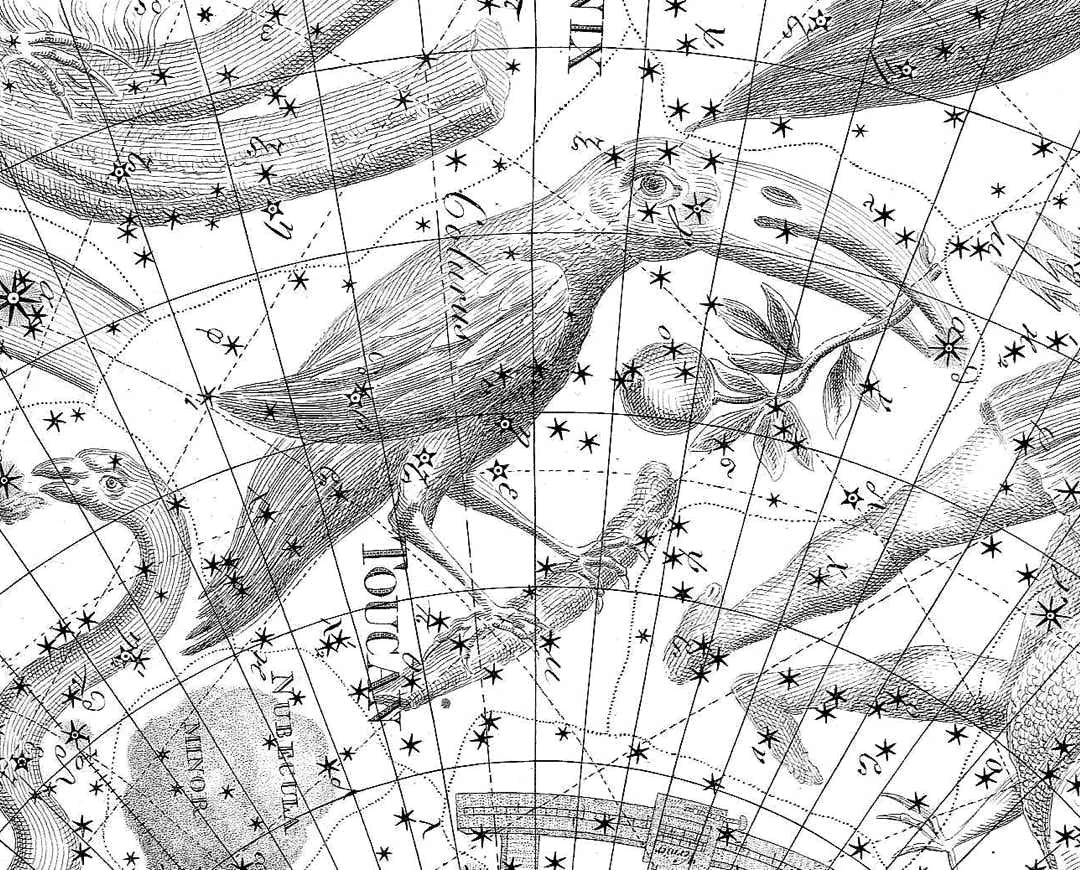
Tucana, holding in its beak a branch with a berry, as seen on Chart XX of the Uranographia star atlas of Johann Bode (1801). Behind its tail lies Nubecula Minor, the Small Magellanic Cloud (just visible at the lower right edge of the image), which is within the constellation’s modern borders.
Globular cluster 47 Tucanae
Tucana is distinguished by two features of particular interest: firstly, the globular star cluster 47 Tucanae, rated the second-best such object in the entire sky, so bright that it was given a catalogue number in the same way as a star; and the Small Magellanic Cloud, the smaller and fainter of the two companion galaxies of our Milky Way, termed Nubecula Minor on many old charts. These features were originally part of Hydrus but were transferred to Tucana when the French astronomer Nicolas Louis de Lacaille reorganized this part of the southern heavens in the 1750s on his planisphere and star catalogues.
Incidentally, 47 Tucanae is not a Flamsteed number; it comes from its listing in Johann Bode’s catalogue called Allgemeine Beschreibung und Nachweisung der Gestirne, published in 1801 to accompany his Uranographia star atlas. It was first recorded as a star by Keyser and de Houtman. Bayer showed it on his southern star chart of 1603 within one of the coils of Hydrus, beneath the claw of the toucan, but its nebulous nature was first noted by Lacaille a century and a half later. Lacaille gave it no identifying number, though, simply labelling it as ‘neb’.
© Ian Ridpath. All rights reserved
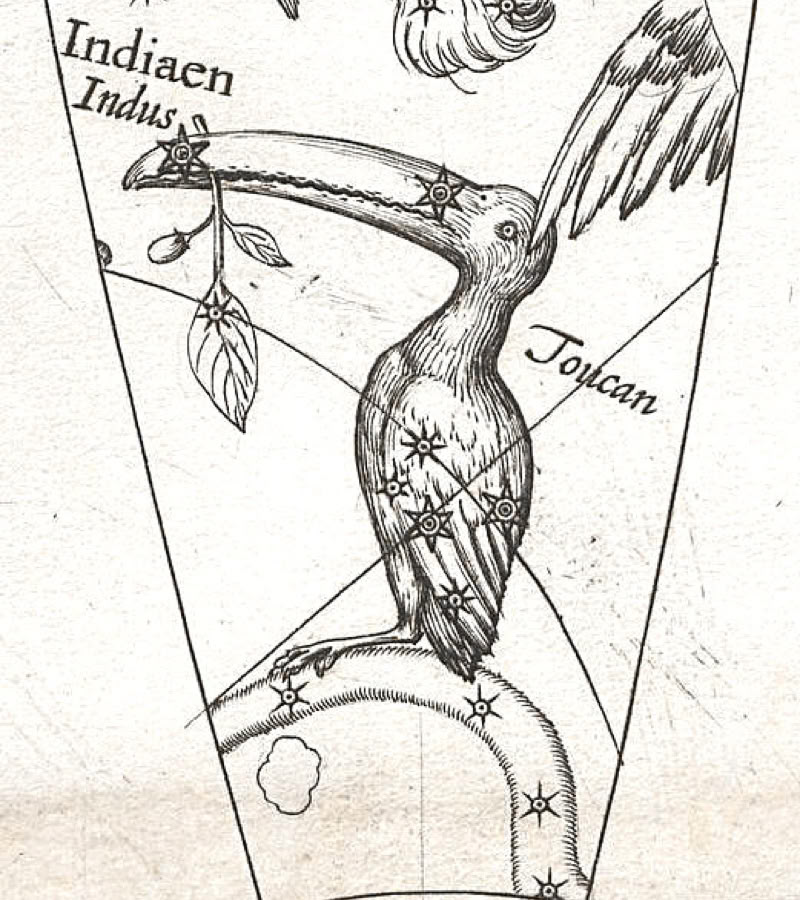
Tucana carries a branch in its long beak on a gore from Petrus Plancius’s celestial globe of 1598. It sits on a loop in the tail of Hydrus, the water snake. The ‘star’ beneath the toucan’s foot is the globular cluster now known as 47 Tucanae, and beneath that is the Small Magellanic Cloud. (Nicolai Collection of the State Library of Württemberg, Stuttgart)
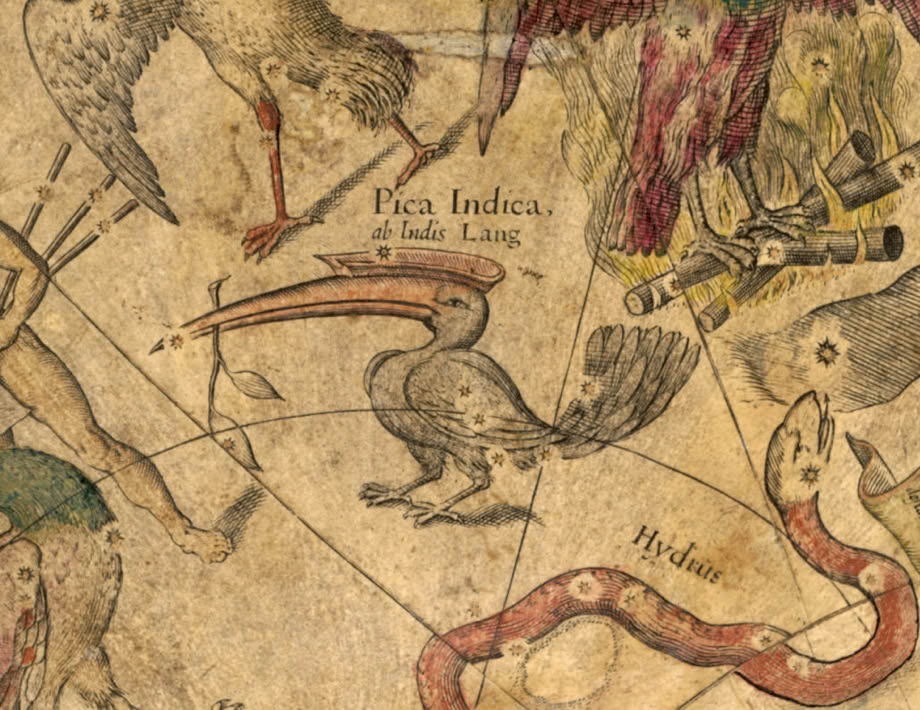
Tucana shown on Willem Janszoon Blaeu’s globe of 1603 on which it is named Pica Indica, ab Indis Lang, and is drawn as a hornbill, not a toucan. It is evidently meant to be an Oriental pied hornbill, a common Asian hornbill known in Malaysia as the langling bird.
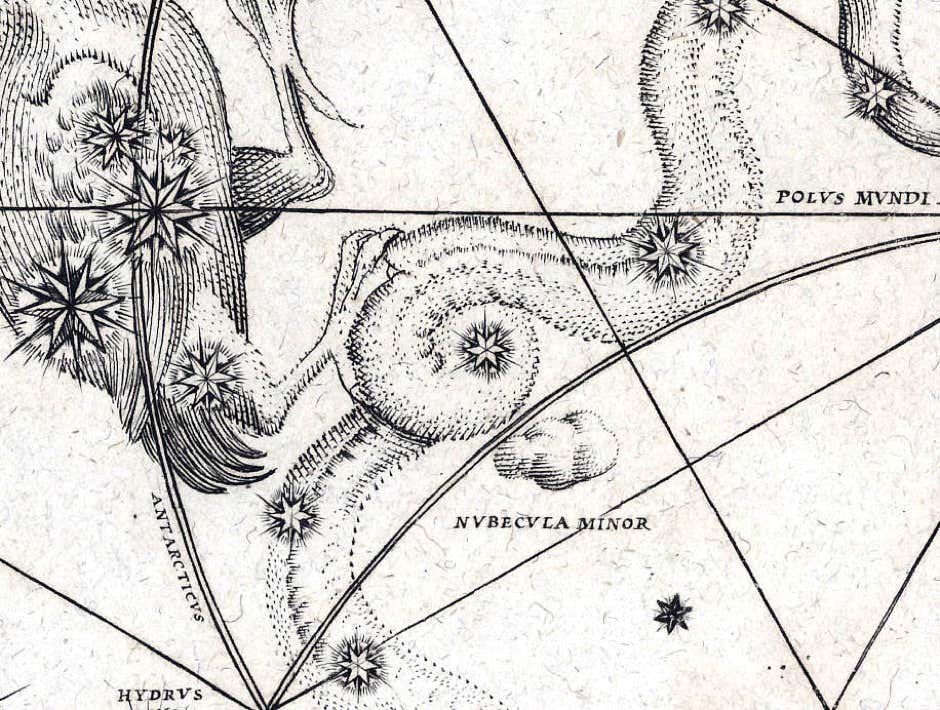
The globular cluster 47 Tucanae was drawn as a 5th-magnitude star in one of the coils of Hydrus on Chart 49 of Johann Bayer’s Uranometria (1603). It lies at the centre of this image, above left of the Small Magellanic Cloud, which Bayer labelled Nubecula Minor. Lacaille transferred it from Hydrus to Tucana in the 1750s.