

One of the least imaginative constellations, Triangulum Minus was invented in 1687 by Johannes Hevelius and first depicted on his star atlas, Firmamentum Sobiescianum, published posthumously in 1690. It was formed from three 5th-magnitude stars first catalogued by Hevelius himself. Triangulum Minus lay just south of the existing celestial triangle, Triangulum, which Hevelius renamed Triangulum Majus.
The little triangle achieved surprisingly wide acceptance among astronomers, including Johann Bode who showed it on his Uranographia in 1801. On some charts the pair were jointly named Triangula. Ultimately, though, the little triangle was deemed superfluous to requirements when the constellations came to be rationalized. Its stars were transferred to Triangulum proper where they are now known as 6, 10, and 12 Trianguli. In 2025 the IAU gave 6 Trianguli the name Triminus in commemoration of the obsolete figure.
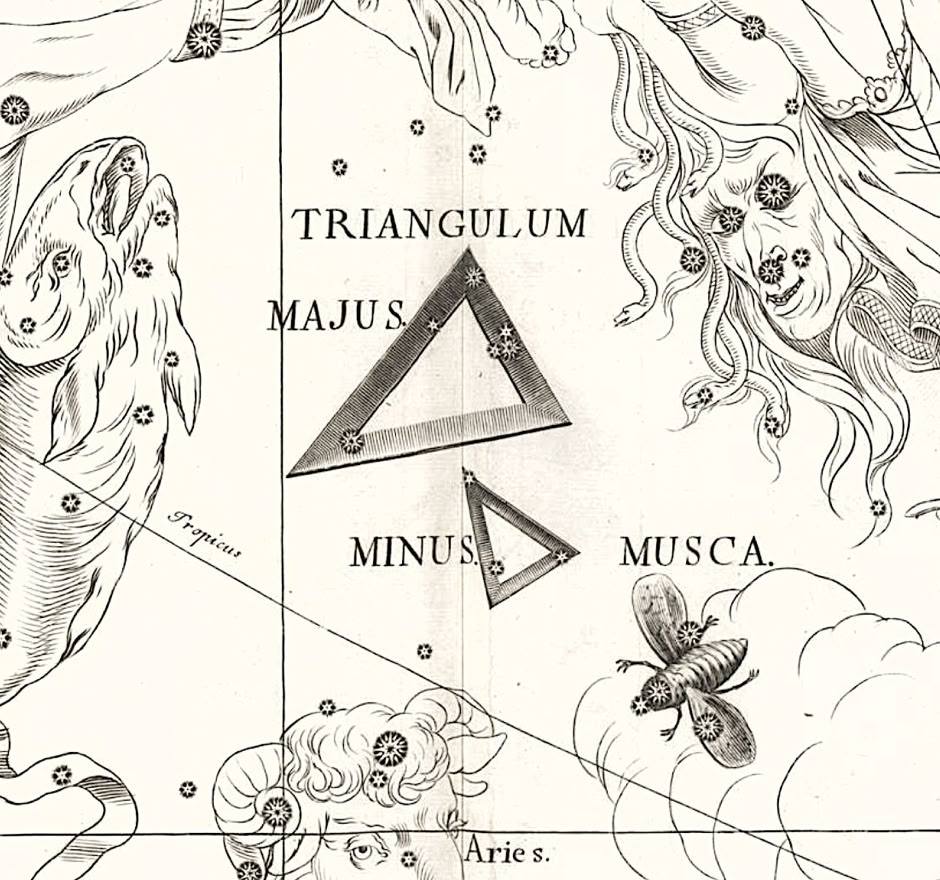
Triangulum Minus shown on the Firmamentum Sobiescianum star atlas of Johannes Hevelius, published posthumously in 1690. Hevelius showed the constellations as they would appear on a celestial globe rather than as seen in the sky; for a view of the two triangles the right way round on the star chart of John Flamsteed, see Triangulum. Next to Triangulum Minus is another doomed constellation, Musca Borealis, which was invented by Petrus Plancius.
© Ian Ridpath. All rights reserved

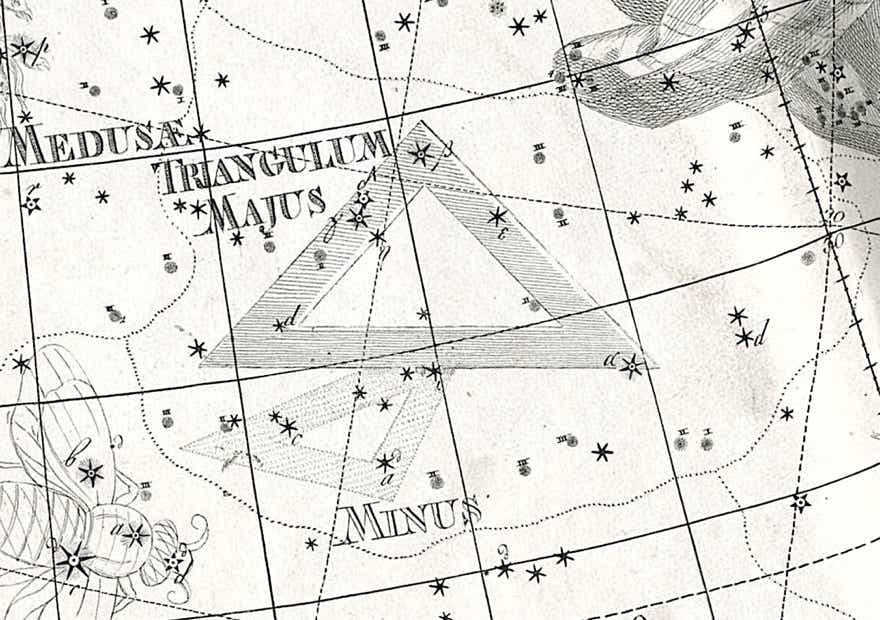
Triangulum Majus and Minus next to the head of Medusa (top left) and the now-defunct Musca Borealis (lower left) on Chart IV of Johann Bode’s Uranographia atlas of 1801.