

Genitive: Trianguli Australis
Abbreviation: TrA
Size ranking: 83rd
Origin: The 12 southern constellations of Keyser and de Houtman
One of the 12 constellations introduced at the end of the 16th century by the Dutch navigators Pieter Dirkszoon Keyser and Frederick de Houtman, and the smallest of them according to modern boundaries. A southern triangle had previously been shown in a completely different position, south of Argo Navis, on a globe of 1589 by the Dutchman Petrus Plancius, along with a southern cross, but they were not the constellations we know today. The modern Triangulum Australe was first depicted in 1598 on a globe by Petrus Plancius (but was left unnamed) and first appeared in print in 1603 on the Uranometria atlas of Johann Bayer.
The three main stars of Triangulum Australe are brighter than those of their northern counterpart, although the constellation is smaller. Navigators have named its brightest star Atria, a contraction of its scientific name Alpha Trianguli Australis.
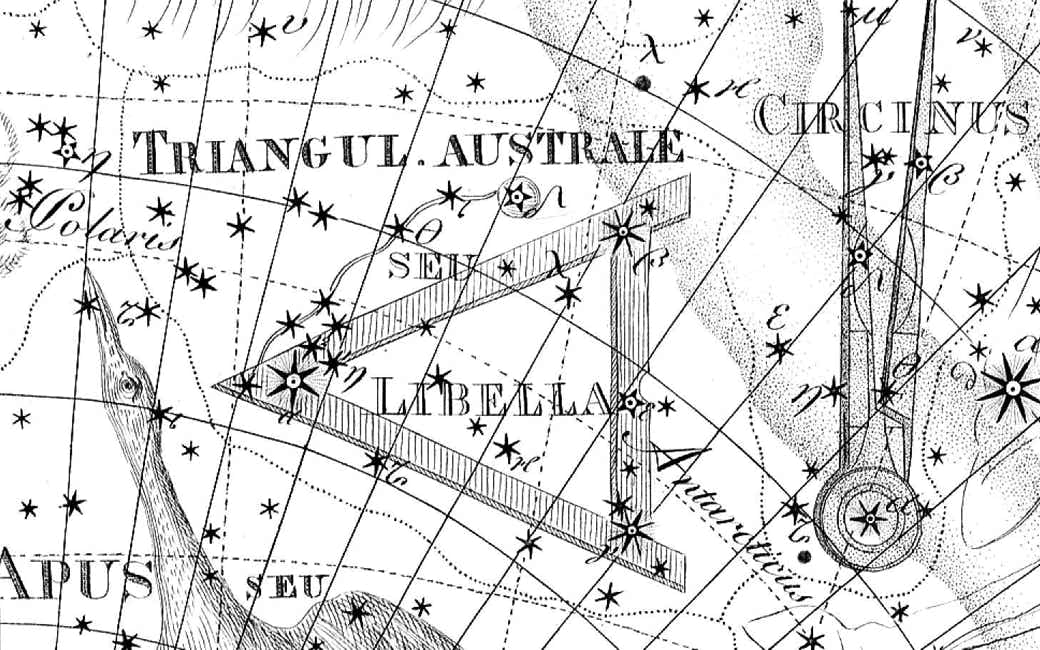
Triangulum Australe, with the alternative name Libella, the level, on Chart XX of Johann Bode’s Uranographia (1801). Bode followed Lacaille in showing a plumb bob attached to the triangle, thereby representing it as a surveyor’s level. To the right is Circinus, representing a drawing compass. Along with a set square (Norma) they formed a group of surveying instruments in this part of the sky.
On his 1756 planisphere of the southern stars Lacaille referred to it as ‘le Triangle Austral ou le Niveau’ (‘niveau’ meaning level) and he even showed it with an attached plumb bob, indicating that he regarded it as representing a surveyor’s level. ‘Niveau’ was later Latinized to ‘libella’, as on Bode’s atlas shown here. Through some misreading, the historian R. H. Allen transferred the appellation ‘level’ to the nearby constellation Norma and termed that constellation the Level and Square (instead of the Rule and Square), thereby confusing generations of astronomers.
Linguistic note: The word Triangulum is neuter in Latin so takes the neuter adjective Australe, whereas Corona Australis is a feminine noun that takes a feminine adjective and Piscis Austrinus is a masculine noun with a masculine adjective.
© Ian Ridpath. All rights reserved
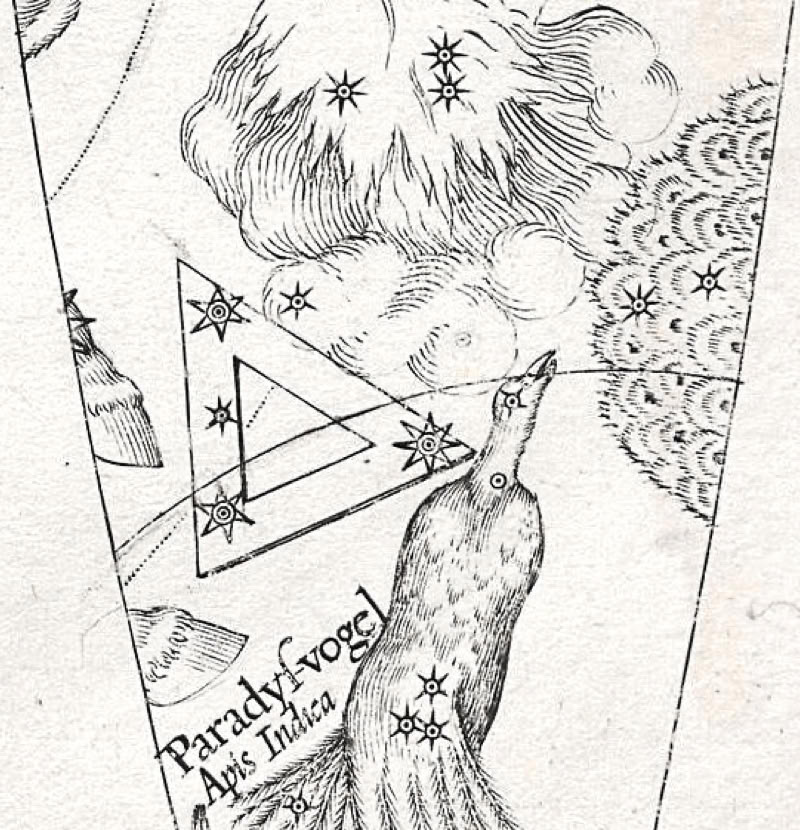
Triangulum Australe seen on a gore from Petrus Plancius’s celestial globe of 1598. For some reason the constellation was left unnamed. To the south of the triangle is Apus, the bird of paradise, while smoke from Ara, the altar, billows to the north. At right is the tail of Pavo, the peacock. (Nicolai Collection of the State Library of Württemberg, Stuttgart)