

There were originally two constellations of this name, both introduced in 1789 by the Hungarian-born astronomer Maximilian Hell (1720–92), director of the Vienna Observatory, to commemorate William Herschel’s discovery of the planet Uranus eight years earlier. Hell first showed them on charts contained in Monumenta, Aere Perenniora, Inter Astra Ponenda, the same publication in which he also announced his invention of Psalterium Georgianum (George’s Harp). The two telescopes were positioned either side of the area where the new planet had been found, near the star Zeta Tauri.
Tubus Hershelii Major, as it was named on Hell’s chart, represented Herschel’s 20-ft-long telescope and lay between Gemini, Lynx, and Auriga. Tubus Hershelii Minor (again, Hell’s spelling), crammed awkwardly between Orion and the head of Taurus, represented Herschel’s 7-ft reflector. Judging by the inaccurate representations, though, Hell had not seen either telescope – in the case of Tubus Hershelii Minor he even got the type of telescope wrong, depicting it as a refractor whereas Herschel used only reflectors of his own construction.
Johann Bode reduced the constellations to one in his Uranographia atlas of 1801 under the name Telescopium Herschelii, located where Hell had placed Tubus Hershelii Major. Bode, having bought telescopes from Herschel, knew what they looked like and he realistically depicted the 7-ft reflector with which Herschel actually made the discovery of Uranus. However it was an awkward fit, with the upper end of the tube overlapping Auriga’s shoulder and the lower part of the telescope’s stand obscured by northern Gemini.
In Bode’s representation the constellation’s brightest star was the present-day Psi-2 (ψ2) Aurigae (aka 50 Aurigae), magnitude 4.8, which he labelled with the lowercase letter ‘a’. This was originally part of the neighbouring charioteer’s whip, which Bode had to move to make way for the telescope’s tube. Eventually its stars were returned to Auriga, Gemini, and Lynx, from where they had been borrowed.
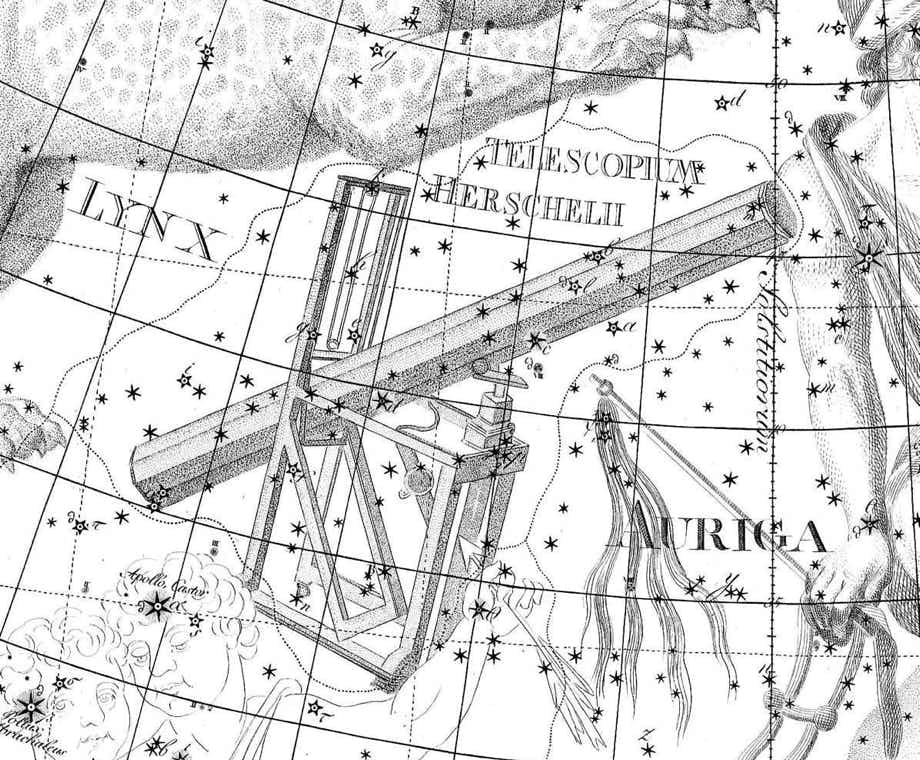
Telescopium Herschelii, depicting the reflecting telescope with which William Herschel discovered the planet Uranus in 1781, seen on Chart V of the Uranographia atlas of Johann Bode (1801). The telescope had a wooden tube 7 feet long with a mirror of 6.2 inches diameter on an altazimuth stand of Herschel’s own design. In those days telescopes were described by their length rather than their aperture.
© Ian Ridpath. All rights reserved
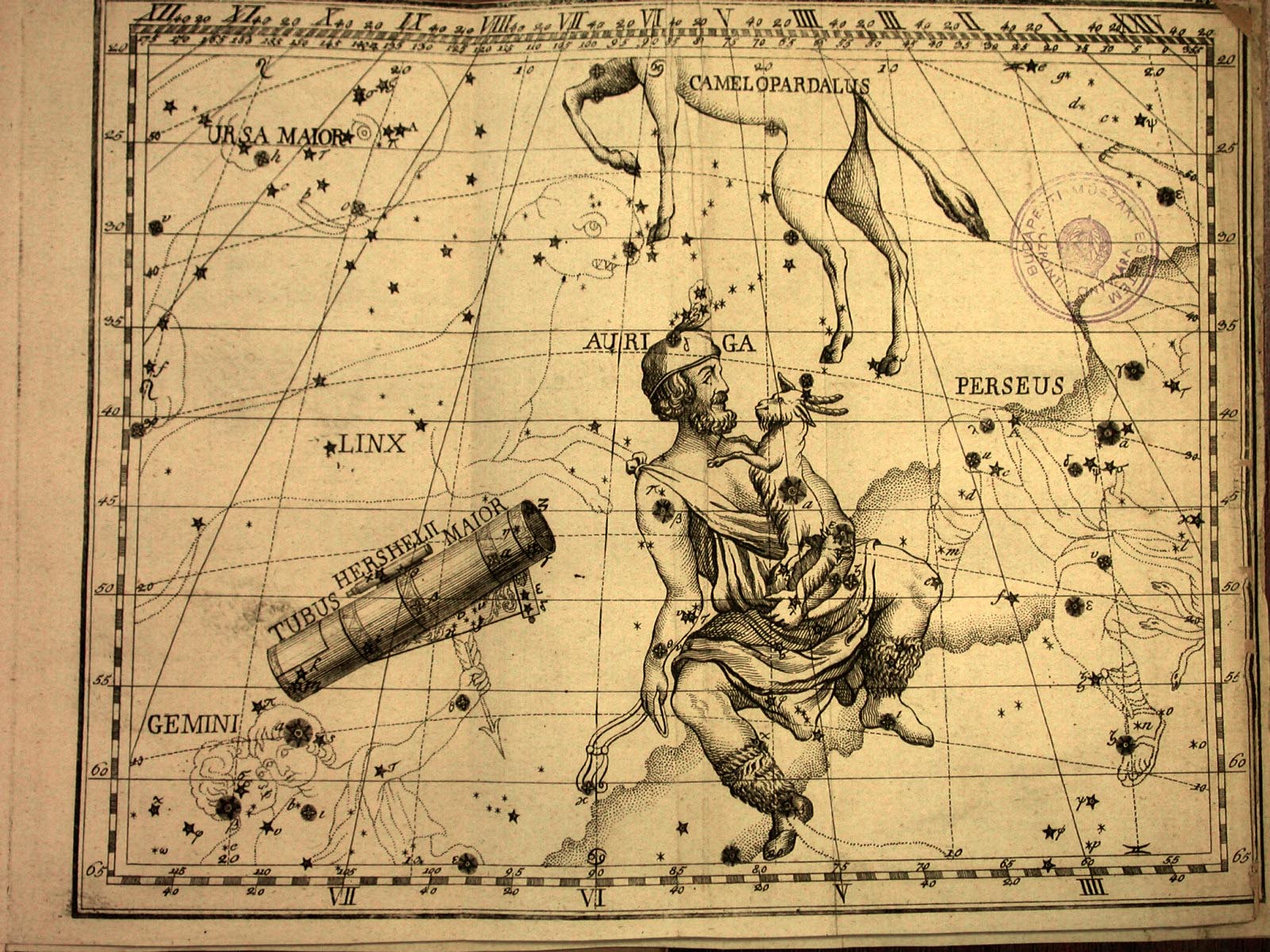
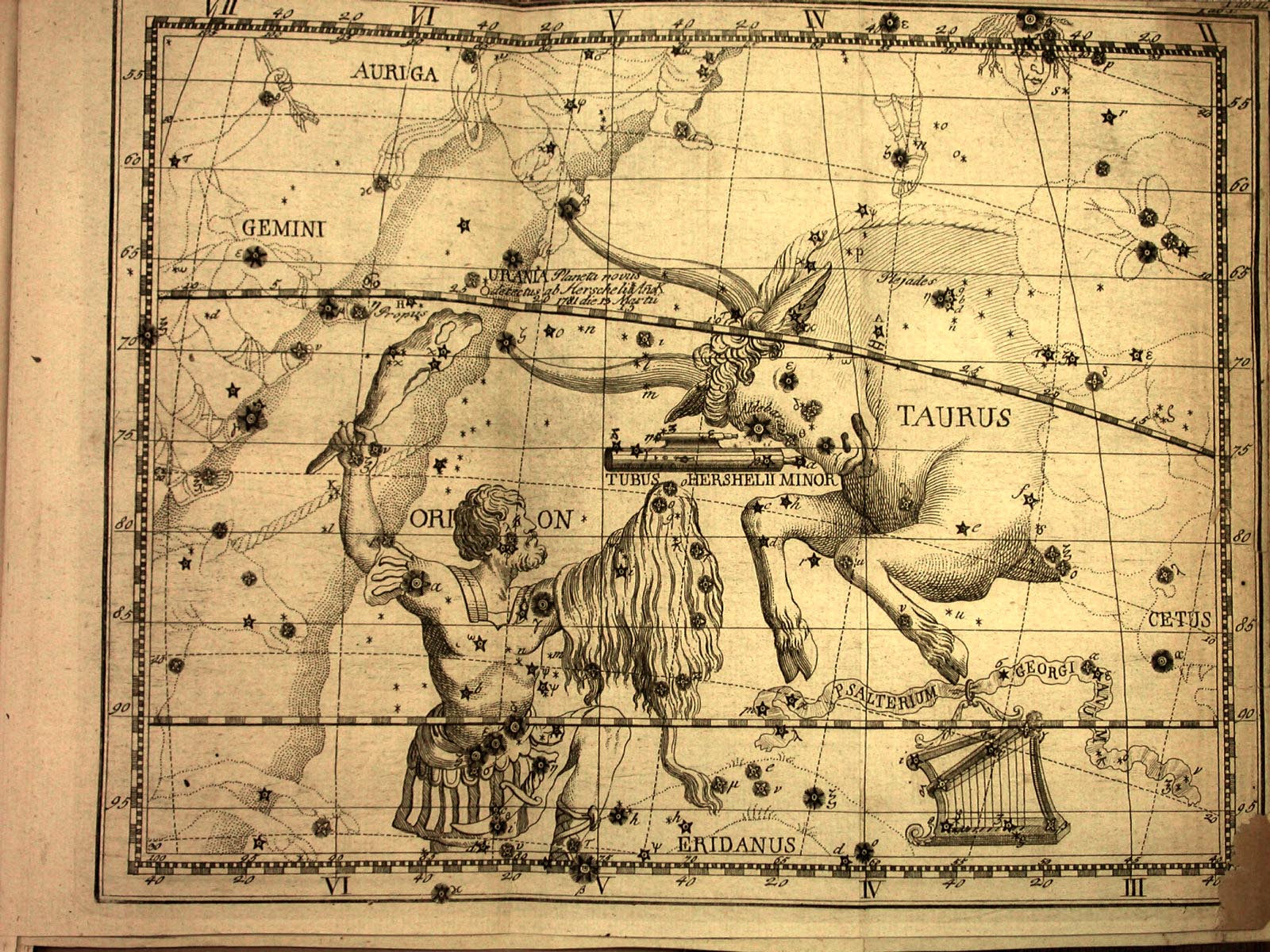

Maximilian Hell marked the site of Herschel’s discovery of the planet Uranus with a symbol on this chart from his Monumenta, Aere Perenniora, Inter Astra Ponenda of 1769. The discovery site lay almost on the ecliptic near Zeta Tauri (at the tip of the bull’s horn) and the top of Orion’s club. This was the publication in which he introduced his new constellations Tubus Hershelii Major, Tubus Hershelii Minor, and Psalterium Georgianum.