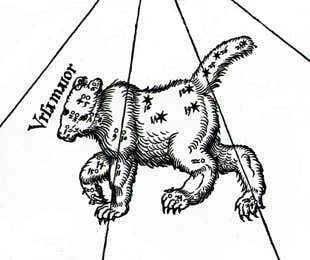


EVERY night, a pageant of Greek mythology circles overhead. Perseus flies to the rescue of Andromeda, Orion faces the charge of the snorting bull, Boötes herds the bears around the pole, and the ship of the Argonauts sails in search of the golden fleece. These legends, along with many others, are depicted in the star patterns that astronomers term constellations.
Constellations are the invention of human imagination, not of nature. They are an expression of the human desire to impress its own order upon the apparent chaos of the night sky. For navigators beyond sight of land or for travellers in the trackless desert who needed signposts, for farmers who wanted a calendar, and for shepherds who needed a nightly clock, the division of the sky into recognizable star groupings had practical purposes. But perhaps the earliest motivation was to humanize the forbidding blackness of night.
Newcomers to astronomy are soon disappointed to find that the great majority of constellations bear little, if any, resemblance to the figures whose names they carry; but to expect such a resemblance is to misunderstand their true meaning. The constellation figures are not intended to be taken literally. Rather, they are symbolic, a celestial allegory. The night sky was a screen on which human imagination could project the deeds and personifications of deities, sacred animals, and moral tales. It was a picture book in the days before writing.
Distant Suns
Each evening the stars emerge like magic spirits as the Sun descends to its nocturnal lair. Modern science has told us that those twinkling points scattered across the sky in their thousands are actually glowing balls of gas similar to our own Sun, immensely far away.
A star’s brightness in the night sky is a combination of its own power output and its distance from us. So far apart are the stars that light from even the nearest of them takes many years to reach us. The human eye, detecting the faint spark from star fires, is seeing across unimaginable gulfs of both space and time.
Such facts were unknown to the ancient Greeks and their predecessors, to whom we owe the constellation patterns that we recognize today. They were not aware that, with a few exceptions, the stars of a constellation have no connection with each other, but lie at widely differing distances. Chance alone has given us such familiar shapes as the ‘W’ of Cassiopeia, the square of Pegasus, the sickle of Leo, or the Southern Cross.
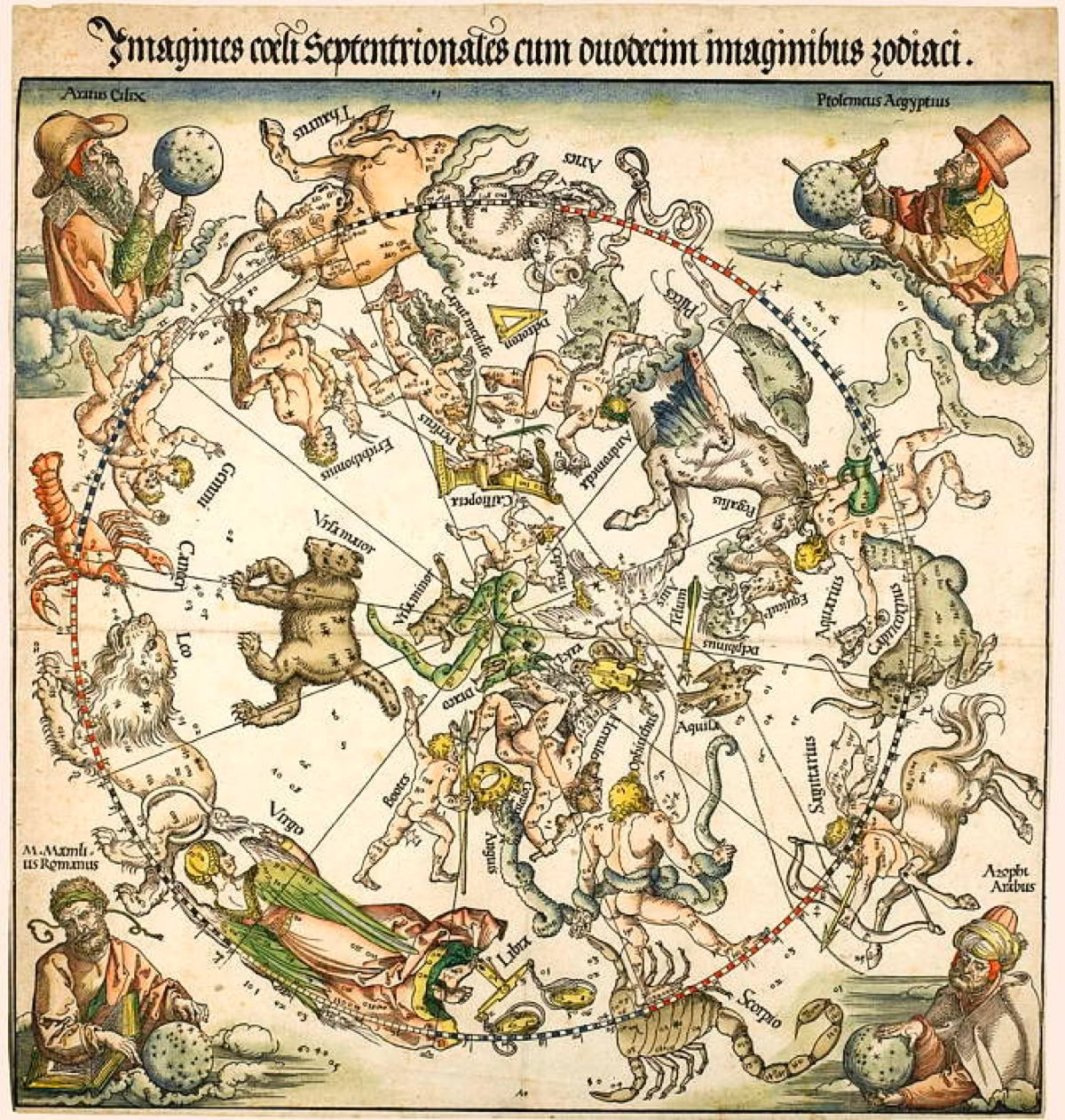
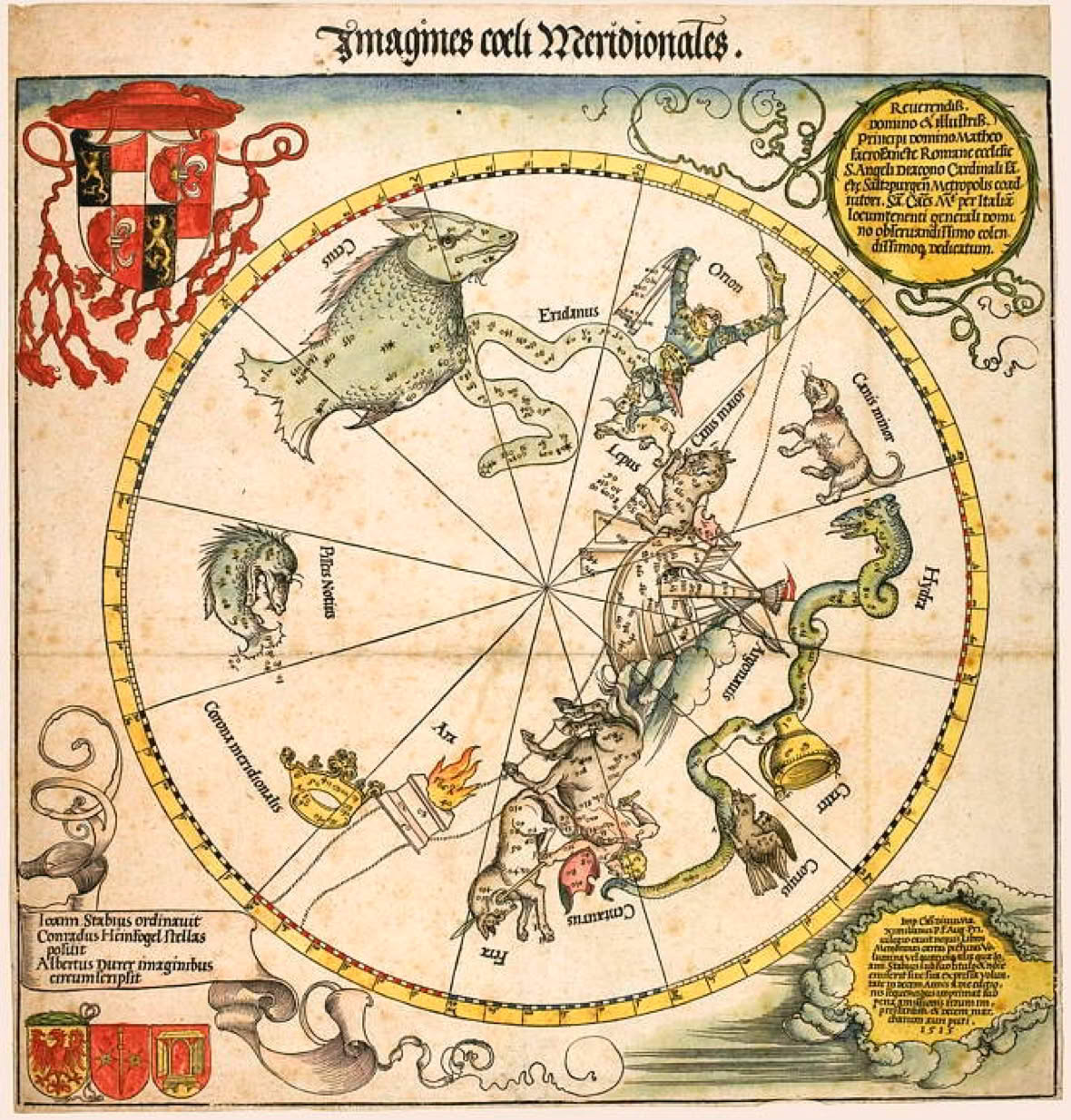
The 48 constellations of the Greek astronomer Ptolemy, illustrated on a pair of woodcuts made by Albrecht Dürer in 1515, one showing the northern sky (top) and the lower one the southern sky. The figures are depicted from the rear, as on a celestial globe. Note the large blank area of the southern sky that was below the horizon to the people who invented the constellations. The size of this blank zone is a clue to the latitude at which the constellation inventors lived.
Pictures in the sky
The constellation system that we use today has grown from a list of 48 constellations published around AD 150 by the Greek scientist Ptolemy in an influential book called the Almagest. Since then, various astronomers have added another 40 constellations, filling the gaps between Ptolemy’s figures and populating the region around the south celestial pole that was below the horizon of the Greeks.
The result is a total of 88 contiguous constellations that all astronomers accept by international agreement. The tales of these constellations are told on this website – along with two dozen others that fell by the wayside.
Ptolemy did not invent the constellations that he listed. They are much older than his era, although exactly when and where they were invented is lost in the mists of time. The early Greek writers Homer and Hesiod (c.700 BC) mentioned only a few star groups, such as the Great Bear, Orion, and the Pleiades star cluster (the Pleiades was then regarded as a separate constellation rather than being incorporated in Taurus as it is today).
The major developments evidently took place farther east, around the Tigris and Euphrates rivers in what is now Iraq. There lived the Babylonians, who at the time of Homer and Hesiod had a well-established system of constellations of the zodiac, the strip of sky traversed by the Sun, Moon, and planets.
We know this from a star list written in cuneiform on a clay tablet dated to 687 BC. Scholars call this list the MUL.APIN series, from the first name recorded on the tablet. The Babylonian constellations had many similarities with those we know today, but they are not all identical. From other texts, historians have established that the constellations known to the Babylonians actually originated much earlier, with their ancestors the Sumerians before 2000 BC.
Eudoxus, Aratus, and the Phaenomena
If the Greeks of Homer and Hesiod’s day knew of the Babylonian zodiac they did not write about it. The first clear evidence we have for an extensive set of Greek constellations comes from the astronomer Eudoxus (c.390–c.340 BC). Eudoxus reputedly learned the constellations from priests in Egypt and introduced them to Greece, which makes his contribution to astronomy highly significant.
He published descriptions of the constellations in two works called Enoptron (Mirror) and Phaenomena (Appearances). Both these works are lost, but the Phaenomena lives on in a poem of the same name by another Greek, Aratus (c.315–c.245 BC). Aratus’s Phaenomena gives us a complete guide to the constellations known to the ancient Greeks; hence he is a major figure in our study of constellation lore.
Aratus was born at Soli in Cilicia, on the southern coast of what is now Turkey. He studied in Athens before going to the court of King Antigonus of Macedonia in northern Greece. There, at the king’s request, he produced his poetic version of the Phaenomena of Eudoxus around 275 BC.
In the Phaenomena Aratus identified 48 constellations, although they are not exactly the same as Ptolemy’s 48. Aratus included the Water (now regarded as part of Aquarius) and the Pleiades, while Corona Australis was only alluded to as an anonymous ring of stars beneath the feet of Sagittarius; evidently it had not yet become a separate constellation. Neither does he mention Equuleus, which first appeared in the Almagest.
Aratus also named six individual stars: Arcturus, Capella (which he called Aix), Sirius, Procyon (which formed a constellation on its own), Spica (which he called Stachys), and Vindemiatrix (which he called Protrygeter). This last star is a surprise, since it is so much fainter than the others, but the Greeks used it as a calendar star because its rising at dawn in August marked the start of the grape harvest.
Identifying the constellation inventors
Neither the Greeks nor the Egyptians actually invented the constellations that are described in the Phaenomena. The evidence for that statement lies not just in written records, but in the sky itself.
It is not too difficult to work out roughly where the constellations known to Eudoxus and Aratus were invented. The clue is that Aratus described no constellations around the south celestial pole, for the reason that this area of sky was permanently below the horizon of the constellation makers. From the extent of the constellation-free zone we can conclude that the constellation makers must have lived at a latitude of around 35–36° north – that is, south of Greece but north of Egypt.
A second clue comes from the fact that the constellation-free zone is centred not on the south celestial pole at the time of Aratus but on its position many centuries earlier. The position of the celestial pole changes slowly with time because of a wobble of the Earth on its axis, an effect known as precession, and in principle this effect can be used to estimate the date of any set of star positions.
Because of the uncertainties involved, however, attempts to date the constellations as described by Aratus have produced a wide range of results. Derived values extend back to nearly 3000 BC, with a majority preference for somewhere around 2000 BC.
A newer and more comprehensive analysis by Bradley Schaefer of Louisiana State University has concluded that Aratus’s descriptions correspond to the sky as it appeared close to 1130 BC. At present, the best we can say is that the constellations known to Eudoxus and Aratus were probably invented in the second millennium BC by people who lived just south of latitude 36° north.
This date is too early for the Greeks and the latitude is too far south; Egyptian civilization is sufficiently old, but the required latitude is well north of them. The time and the place, though, ideally match the Babylonians and their Sumerian ancestors who lived in the area we know as Mesopotamia and who, as we have already seen, had a well-developed knowledge of astronomy by 2000 BC. Hence two independent lines of evidence point to the Babylonians and Sumerians as the originators of our constellation system.
© Ian Ridpath. All rights reserved
NEXT ►