

This flighty and ultimately doomed constellation was introduced in 1776 by the French astronomer Pierre-Charles Le Monnier (1715–99) in a paper titled ‘Constellation du Solitaire’ published in the Mémoires of the French Royal Academy of Sciences. He listed 22 constituent stars and described it as a ‘bird of the Indies and the Philippines’, evidently without realizing that these are two separate birds. It was perched on the end of the tail of Hydra, the water snake, with its head awkwardly overlapping the southern pan of Libra, the scales.
Le Monnier said he introduced the constellation in memory of the voyage to the island of Rodrigues in the Indian Ocean by another Frenchman, Alexandre-Guy Pingré, who observed the transit of Venus from there in 1761. Presumably Le Monnier had intended his constellation to represent the Rodrigues solitaire (Pezophaps solitaria), a flightless bird related to the Dodo which Pingré had hunted for on the island but was unable to find, for they were by then on their way to extinction.
However, the bird shown on Le Monnier’s diagram of the constellation resembles a female blue rock thrush (Monticola solitarius of the family Turdidae), dubbed the ‘solitaire of the Philippines’ by the French ornithologist Mathurin Jacques Brisson. This is a quite different bird from the Rodrigues solitaire, so it seems that when Le Monnier came to illustrate his new constellation he (or perhaps his illustrator, Yves-Marie Le Gouaz) chose the wrong solitaire.
Its brightest star was of third magnitude, positioned in the bird's lower chest. Le Monnier labelled it Gamma, because it had been Johann Bayer’s Gamma Scorpii; but Ptolemy in the Almagest had included it in Libra and it is now back in that constellation, where it is known as Sigma Librae.
Johann Bode changed the constellation’s name to Turdus Solitarius in his Uranographia atlas of 1801 (below). The present-day 58 Hydrae (also known as E Hydrae), mag. 4.4, was named Solitaire by the IAU in 2024 to commemorate the obsolete constellation.
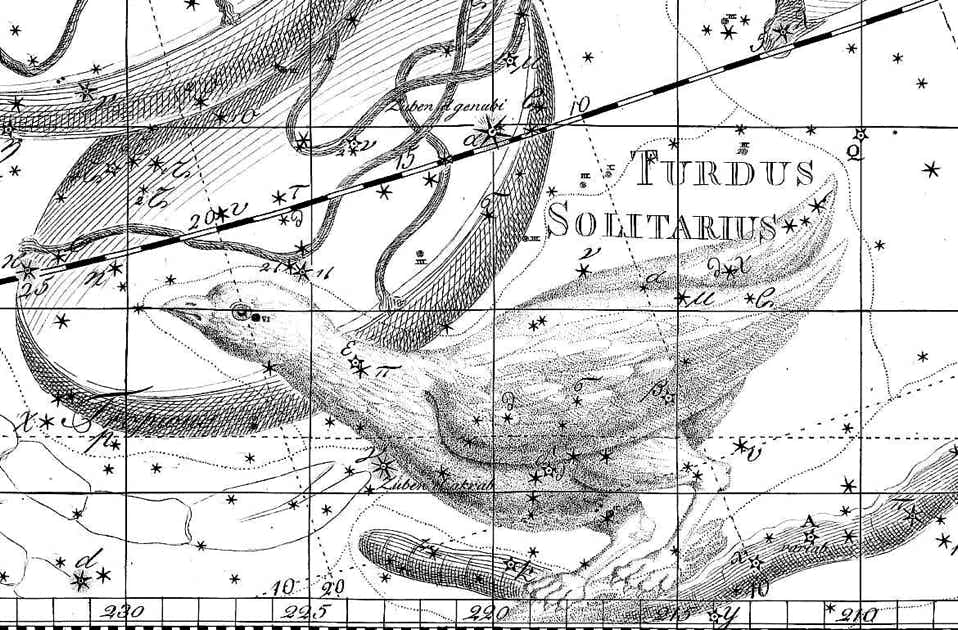
Above: Turdus Solitarius shown on Chart XIV of the Uranographia of Johann Bode (1801). The star marked k on this chart, next to the bird’s right foot, is the modern-day 58 Hydrae, now named Solitaire in memory of the obsolete constellation.
Two other identifications: the Mockingbird and Noctua
The British scientist Thomas Young (1773–1829) renamed the constellation the Mockingbird on a star chart published in 1807 in A Course of Lectures on Natural Philosophy and the Mechanical Arts (illustration below), while the British amateur astronomer Alexander Jamieson (1782–1850) transformed it into Noctua, the owl, on Plate 27 of his Celestial Atlas of 1822, turning it so it faced the opposite way from Le Monnier’s creation (bottom illustration). Jamieson said he thought it was strange that no such bird had previously been placed among the constellations ‘considering the frequency it is met with on all Egyptian monuments’. The bird he depicted has ear tufts and is presumably intended to be an Egyptian owl such as the pharaoh eagle-owl, posed side-on but with its head facing the onlooker as though in a hieroglyph.
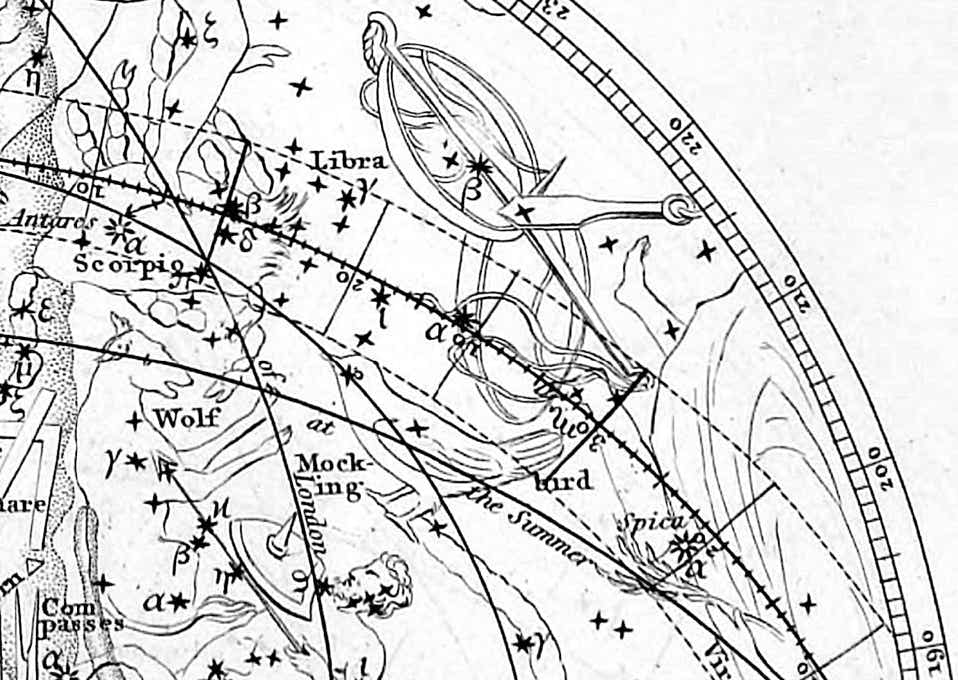
Above: The Solitaire was renamed the Mockingbird on the southern hemisphere planisphere published in Thomas Young’s A Course of Lectures on Natural Philosophy and the Mechanical Arts (1807).

Above: Noctua on Plate 27 of the Celestial Atlas of Alexander Jamieson (1822). By turning the bird so that its head is to the right, Jamieson has made it fit more naturally next to Libra. On this representation, the bird’s head extends into southern Virgo. Jamieson’s figure was copied by the American astronomy popularizer Elijah Burritt for his Atlas Designed to Illustrate The Geography of the Heavens but otherwise was not widely adopted. (Image: Author’s collection.)
© Ian Ridpath. All rights reserved