

Genitive: Sextantis
Abbreviation: Sex
Size ranking: 47th
Origin: The seven constellations of Johannes Hevelius
A faint constellation south of Leo, introduced by the Polish astronomer Johannes Hevelius in his star catalogue of 1687 under the name Sextans Uraniae and depicted in his star atlas published posthumously in 1690. It commemorated the instrument he used for measuring star positions, which was destroyed along with other instruments in a fire at his home in 1679. In his book Machina Coelestis (1673) he provided an engraving of himself displaying his sextant at his rooftop observatory, which was built over three adjoining properties he owned in the present-day Korzenna Street, Danzig (the modern Gdańsk).
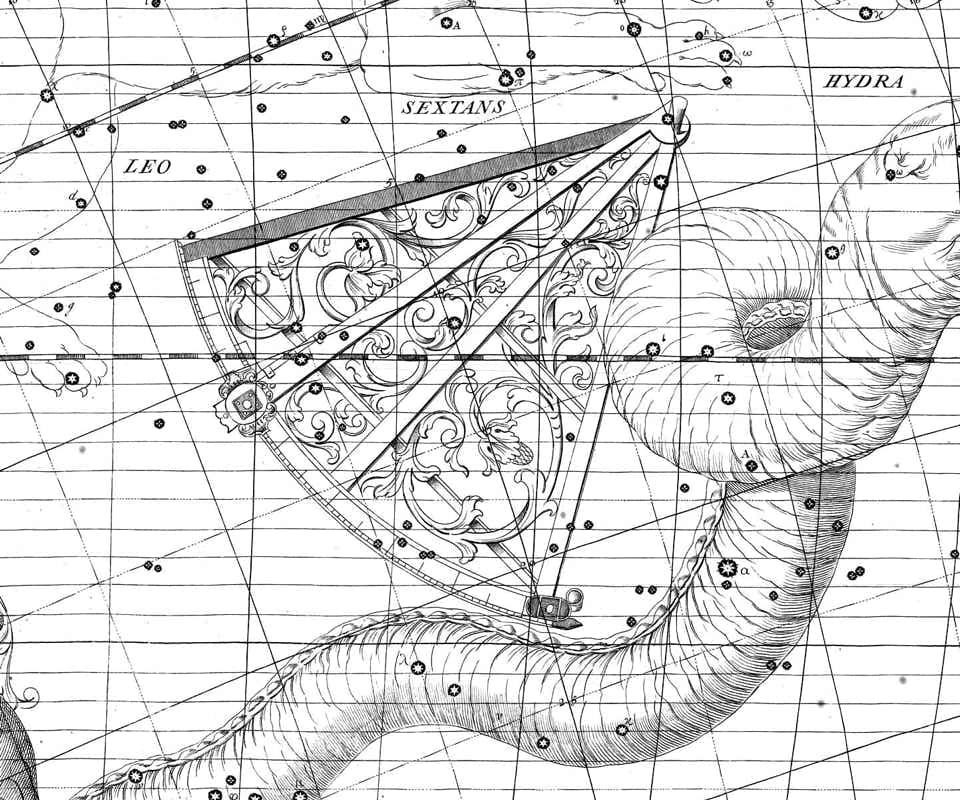
Sextans above the coils of Hydra, illustrated in the Atlas Coelestis of John Flamsteed (1729). For the original depiction by Hevelius, see here.
Hevelius had continued to make naked-eye sightings with his sextant throughout his life, even though he used telescopes for observing the Moon and planets; it was perhaps to demonstrate the keenness of his eyes that he formed Sextans out of such faint stars, as he also did with another of his inventions, Lynx.
John Flamsteed shortened the constellation’s name to Sextans in his Catalogus Britannicus of 1725 and on his accompanying Atlas Coelestis (see the illustration above). Francis Baily also called it simply Sextans in his British Association Catalogue of 1845, but did not allocate Greek letters to any of its stars because none of them is brighter than 5th magnitude. That job was done later by the American astronomer Benjamin Gould in his Uranometria Argentina catalogue of 1879.
The brightest star in the constellation, Alpha Sextantis, is magnitude 4.5.
Chinese associations
Three stars in Sextans formed the Chinese constellation Tianxiang, ‘celestial minister’, symbolizing the prime minister, although the description of their position is vague and sources differ as to which three stars these were.
© Ian Ridpath. All rights reserved
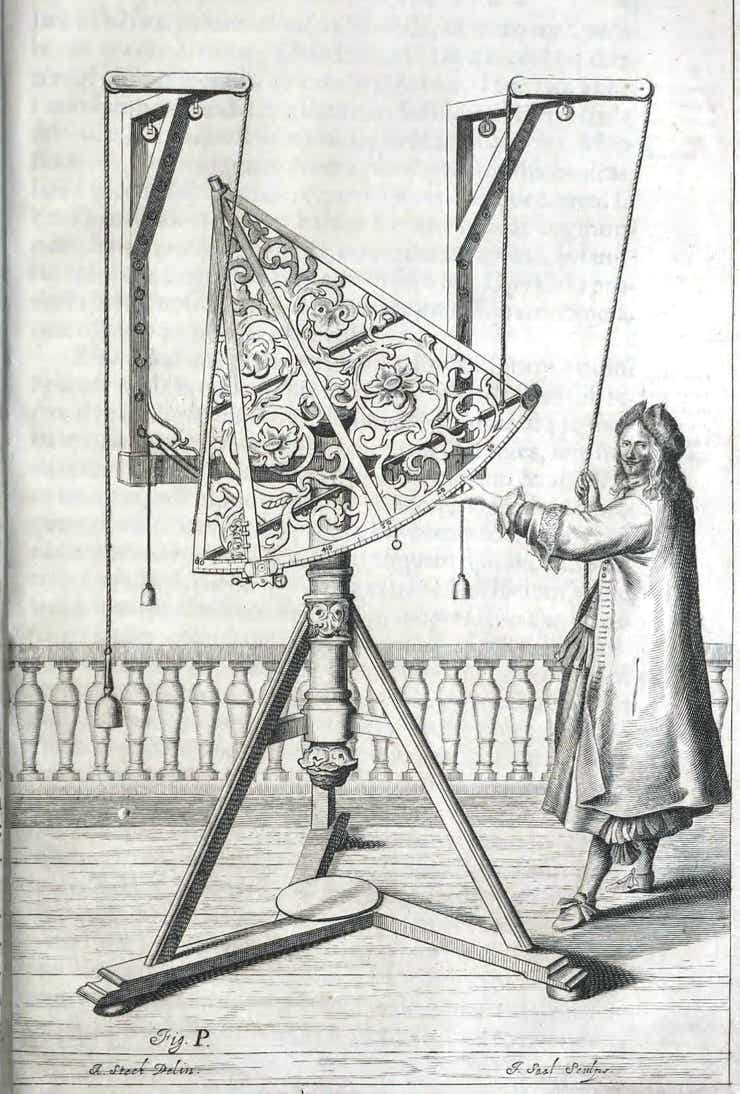
Johannes Hevelius displays the metal sextant he used for measuring star positions in an illustration from his book Machina Coelestis of 1673.