
Genitive: Puppis
Abbreviation: Pup
Size ranking: 20th
Origin: Part of the original Greek constellation Argo Navis
The largest of the three sections into which the ancient constellation of Argo Navis, the ship of the Argonauts, was divided by Nicolas Louis de Lacaille in his catalogue of the southern stars published in 1756. In that catalogue he gave it the French name Pouppe du Navire. His final catalogue, Coelum australe stelliferum, appeared in 1763 containing the same subdivisions but with Latin rather than French names.
Puppis represents the stern, or poop, of the ship; the other sections were Carina, the keel, and Vela, the sails. Lacaille wrote that ‘the poop is separated from the body of the vessel [Carina] by the rudder’. It is on the rudder that the bright star Canopus is placed, but this is included in the section now known as Carina.
Puppis has no stars labelled Alpha or Beta (and nor does Vela). When Lacaille divided up Argo Navis, he decided to reassign Greek letters to the stars, but he did so on the basis of the ship as a whole, as Bayer had done before him; Alpha, Beta, and Epsilon were allocated to stars in the subdivision of Carina, while Gamma and Delta went to stars in Vela. The brightest star in Puppis is in fact second-magnitude Zeta Puppis, called Naos from the Greek word for ship, ναῦϛ.
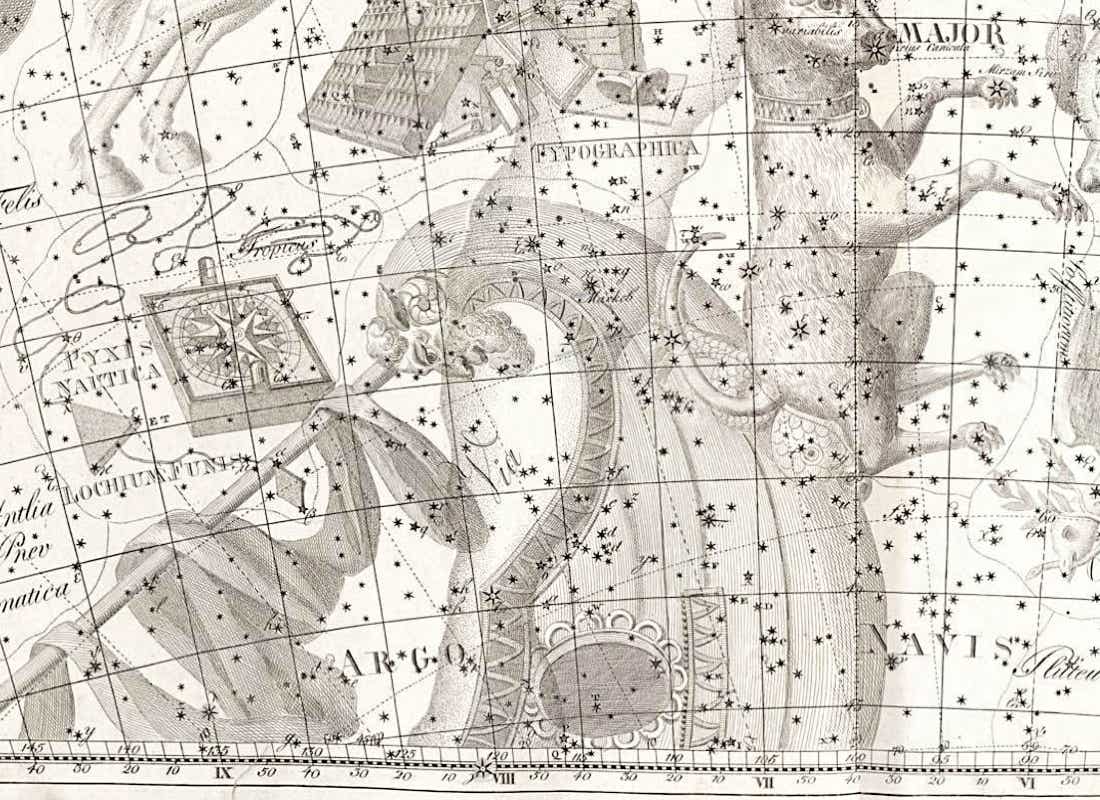
Puppis, the ornately carved stern of the ship Argo Navis, curves northwards between the tail of Canis Major and Lacaille’s constellation Pyxis, as seen on Chart XVIII of Johann Bode’s Uranographia (1801). Bode’s new constellation Officina Typographica is at top, while another of his inventions, Lochium Funis, lies within the borders of Pyxis. Partially concealed behind the hind quarters of Canis Major lurks what appears to be a scaly sea creature, identity unknown. Could this be a little joke that Bode put in to amuse those who looked carefully enough – the equivalent of what in modern software terms would be called an ‘Easter egg’?
Chinese associations
Parts of two ancient Chinese constellations lay in present-day Puppis, although sources differ as to which stars were involved – as with many Chinese constellations, member stars were not always clearly identified, and in any case the stars recognized as belonging to a particular constellation could change over time.
One such constellation in this area was Tianshe, representing an altar or temple to the Earth god Julong. One depiction shows it consisting of six stars in Puppis – Pi, Nu, and four fainter ones. Sun and Kistemaker, though, draw it with one star in Carina, one in Vela, and four in Puppis (Zeta, Sigma, Pi, and Nu). A third version contradicts both these views, placing it entirely in Vela.
There are also alternative versions of Hushi, the bow and arrow. In an early depiction, Xi Puppis marked the northern end of the bow, with most of the other stars in Canis Major. But later on, the bow became a much larger figure, expanding to include five stars in Puppis, although there is no complete agreement as to which five stars they were.
© Ian Ridpath. All rights reserved
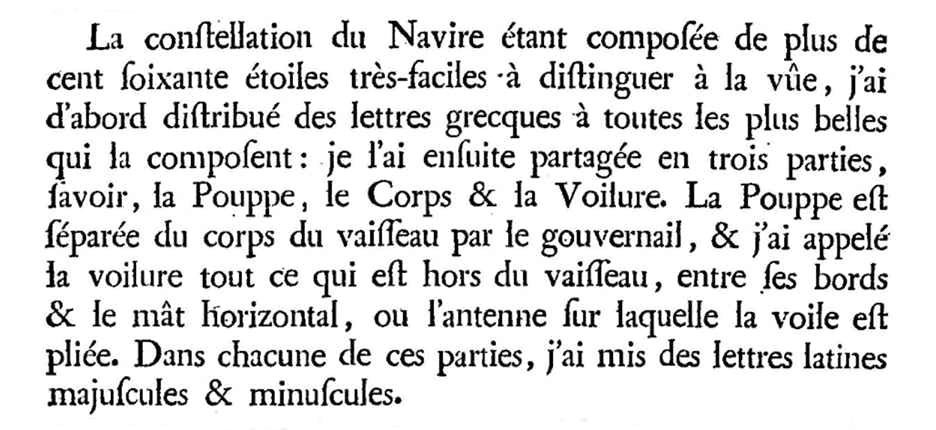
Lacaille’s description of his division of Argo into three parts: the stern or poop deck (Pouppe), the hull (Corps), and the sails (Voilure). He said that ‘the poop is separated from the body of the vessel [Carina] by the rudder [le gouvernail]’.
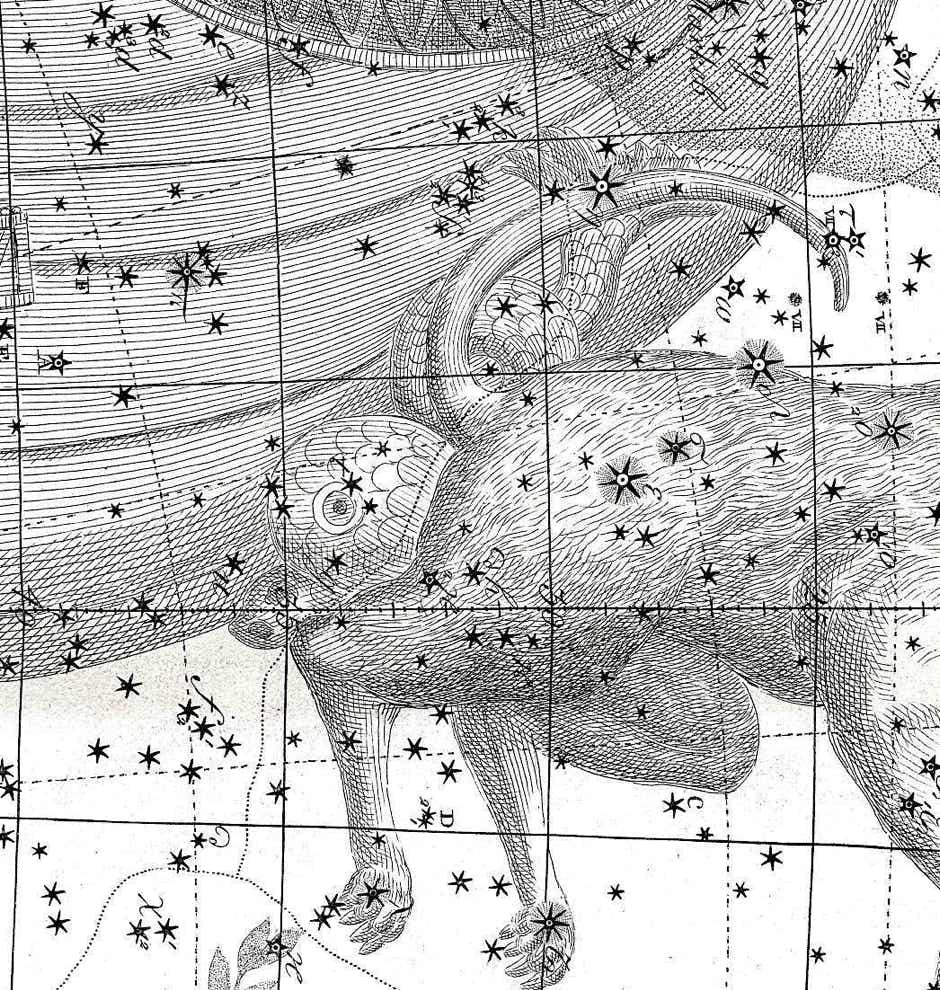
Bode’s Easter egg
This scaly sea creature with a looping tail lurks against the hull of Argo Navis, partly obscured by Canis Major, on Johann Bode’s Uranographia. It can be found on Chart 18, as here, and also at lower right on Chart 2. There seems to be no scientific or mythological explanation for its presence. Could it be Bode’s version of what in modern software jargon is termed an ‘Easter egg’, i.e. an undocumented surprise he put in to amuse those who look closely, like Cassini’s Moon maiden?