

Genitive: Phoenicis
Abbreviation: Phe
Size ranking: 37th
Origin: The 12 southern constellations of Keyser and de Houtman
A constellation representing the mythical bird that supposedly was reborn from its own ashes. It is the largest of the 12 figures invented at the end of the 16th century from the observations made by the Dutch navigators Pieter Dirkszoon Keyser and Frederick de Houtman. As with all the Keyser and de Houtman constellations it was first depicted on a globe by Petrus Plancius in 1598 and first appeared in print in 1603 on the Uranometria atlas of Johann Bayer. The constellation lies near the southern end of the river Eridanus and its brightest star, Alpha Phoenicis, known as Ankaa, is of magnitude 2.4.
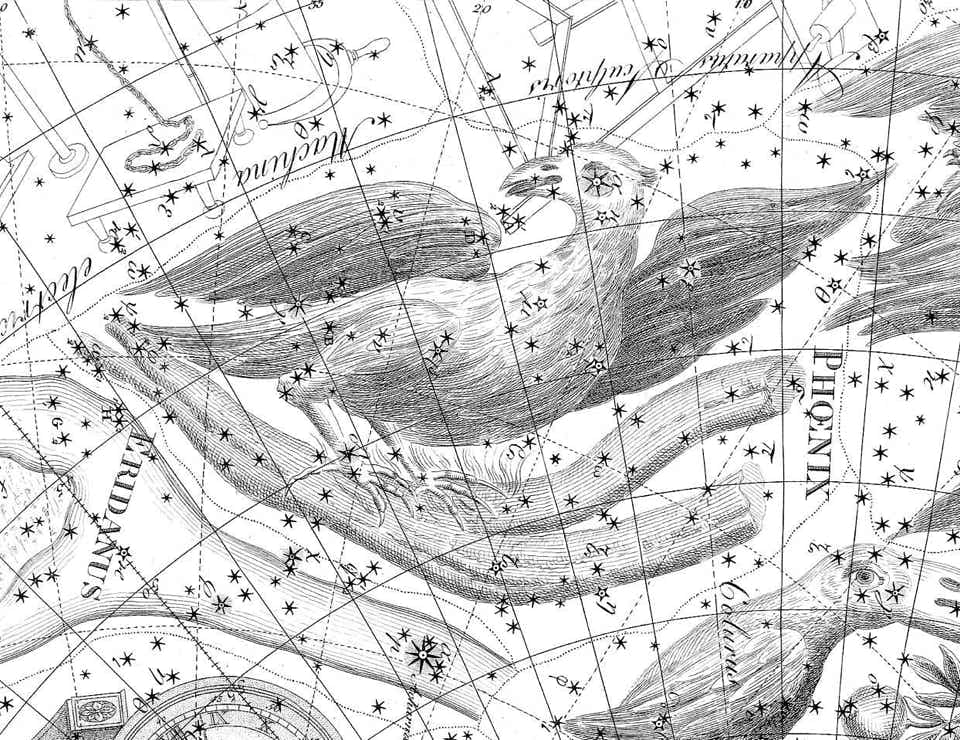
Phoenix, the multicoloured bird that ended its life on a funeral pyre, seen on
Chart XX of the Uranographia of Johann Bode (1801).
The phoenix was said to resemble a large eagle with scarlet, blue, purple, and gold plumage. Ovid in his Metamorphoses tells us that the phoenix lived for 500 years, eating the gum of incense and the sap of balsam. At the end of its allotted span the bird built itself a nest from cinnamon bark and incense among the topmost branches of a palm tree, ending its life on the fragrantly scented nest. A baby phoenix was born from its father’s body. The nest was both the tomb of one phoenix and the cradle of the next. When it was old enough to bear the weight, the young phoenix lifted the nest from the tree and carried it to the temple of Hyperion, the Titan who was the father of the Sun god. The death and rebirth of the phoenix has been seen as symbolizing the daily rising and setting of the Sun.
Why name a constellation after the phoenix when, bar Triangulum Australe, all the other 12 southern inventions of Keyser and de Houtman were based on real living creatures? Perhaps the answer lies with the exotic bird of paradise. When the first colourful specimens, all dead, arrived in Europe in the 16th century, speculation arose that they might be the mythical phoenix, or at least relatives thereof. The Portuguese called them passaros da sol, birds of the Sun. The 16th-century French naturalist Pierre Belon believed in the possible existence of the phoenix and even gave it an entry in his 1555 book L’histoire de la nature des oyseaux. So there was good authority for the reality of such a bird at the end of the 16th century, when the constellation first entered the sky, even though neither it nor the bird of paradise had yet been seen alive.
Chinese associations
When the ancient Chinese constellations were formed 2,000 or more years ago, the star we know as Alpha Phoenicis was the brightest member of a constellation called Bakui, representing a net for catching birds. Bakui extended northwards into Sculptor, but as precession carried this part of the sky beneath the horizon the constellation was moved farther north into Cetus.
© Ian Ridpath. All rights reserved
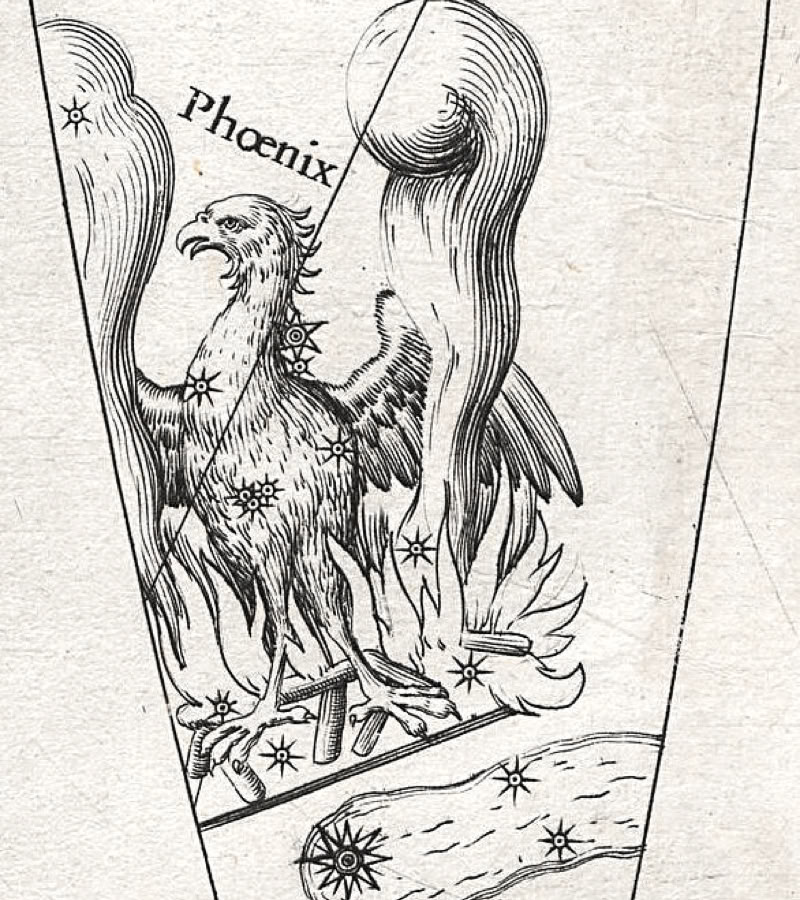
Phoenix rises from the flames on a gore from Petrus Plancius’s celestial globe of 1598. The bright star below it is Achernar at the southern end of Eridanus. (Nicolai Collection of the State Library of Württemberg, Stuttgart)