

Genitive: Pavonis
Abbreviation: Pav
Size ranking: 44th
Origin: The 12 southern constellations of Keyser and de Houtman
The peacock is one of the 12 figures introduced into the southern skies at the end of the 16th century from the observations by the Dutch navigators Pieter Dirkszoon Keyser and Frederick de Houtman. Pavo seemingly represents not the common blue, or Indian, peacock commonly seen in parks but its larger, more colourful, and more aggressive cousin, the Java green peacock which Keyser and de Houtman would have encountered in the East Indies. Pavo was first depicted in 1598 on a globe by Petrus Plancius and first appeared in print in 1603 on the Uranometria atlas of Johann Bayer. As visualized by Plancius and Bayer the peacock had a more expansive tail, but its feathers were later trimmed by Lacaille to make room for his own invention Telescopium to the north.
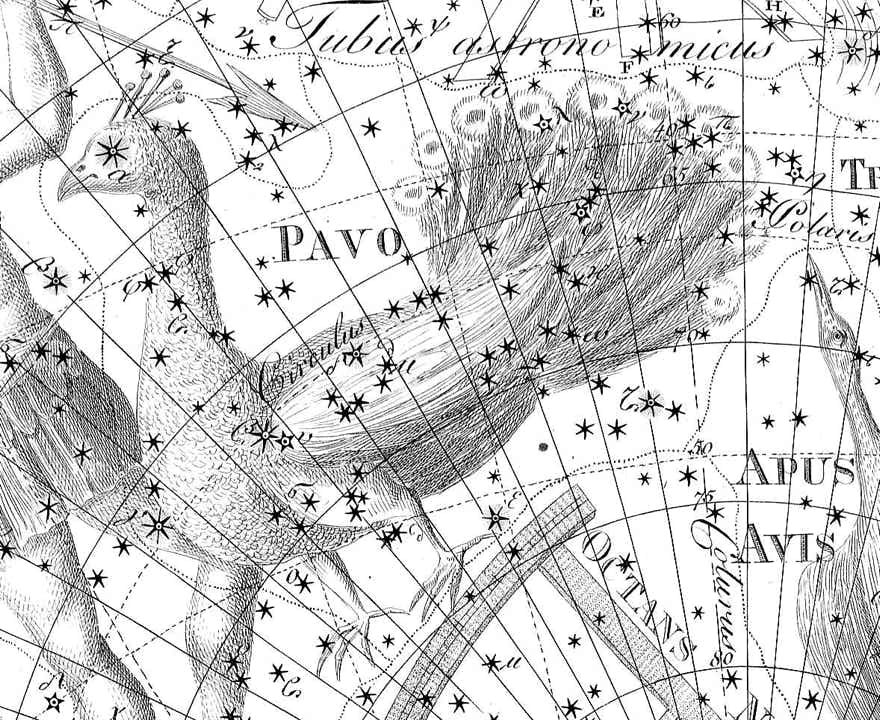
Pavo flourishes a truncated tail on Chart XX of the Uranographia of Johann Bode (1801).
Its tail originally spread farther north but was trimmed by Lacaille after his addition of Telescopium to the sky.
In mythology the peacock was the sacred bird of Hera, who drove through the air in a chariot drawn by peacocks. How the peacock came to have eyes on its tail is the subject of a Greek myth that began one day when Zeus turned his illicit love Io into a white cow to disguise her from his wife, Hera, who nearly caught them together. Hera was suspicious and put the heifer under the guardianship of Argus, who tethered the animal to an olive tree. Argus was ideally suited to the task of watchman, since he had 100 eyes, of which only two were resting at a time while the others kept a look out. Wherever Argus stood, he could always keep several of his eyes on Io.
Zeus sent his son Hermes to release Io from her captivity. Hermes swooped down to Earth and spent the day with Argus, telling him stories and playing his reed pipes until, one by one, the eyes of Argus became sleepy and began to close. When Argus was finally asleep, Hermes lopped off his head and released the heifer. Hera placed the eyes of Argus on the tail of the peacock.
The constellation’s brightest star, second-magnitude Alpha Pavonis, is called Peacock, a name given in or around 1937 by the UK’s Nautical Almanac Office for use in The Air Almanac, a navigation guide produced for the Royal Air Force. The RAF specified that all navigation stars should have proper names, so this name was coined for the otherwise unnamed Alpha Pavonis.
© Ian Ridpath. All rights reserved
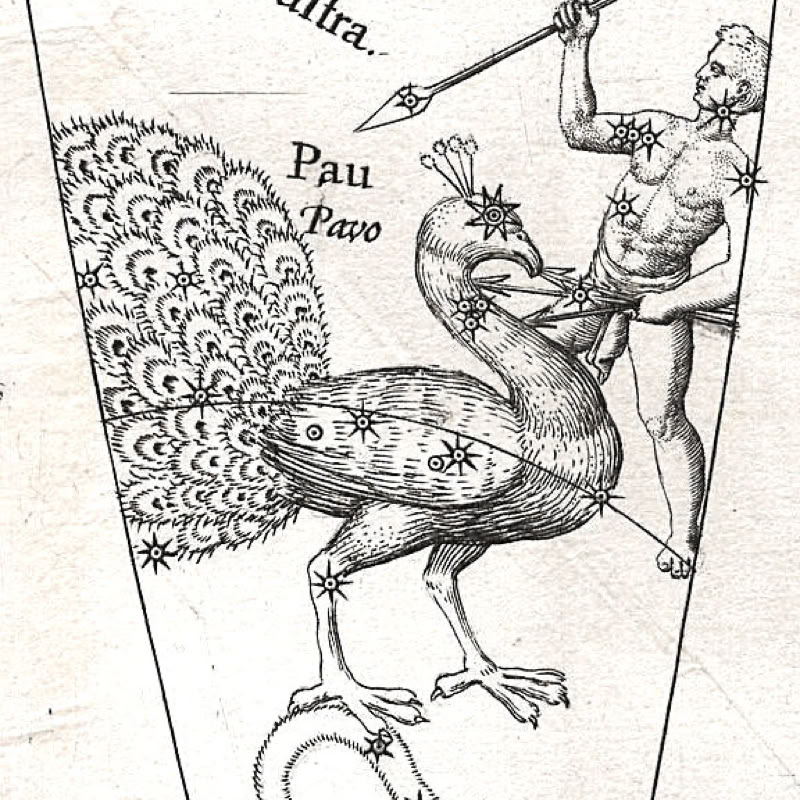
Pavo the peacock seen on a gore from Petrus Plancius’s celestial globe of 1598. Its foot rests on one of the coils of Hydrus, but Hydrus was subsequently rerouted by Lacaille to make way for his new constellation Octans. (Nicolai Collection of the State Library of Württemberg, Stuttgart)