

ORION CONTINUED »
Death of Orion
Stories of the death of Orion are numerous and conflicting. Astronomical mythographers such as Aratus, Eratosthenes, and Hyginus were agreed that a scorpion was involved. In one version, told by Eratosthenes and Hyginus, Orion boasted that he was the greatest of hunters. He declared to Artemis, the goddess of hunting, and Leto, her mother, that he could kill any beast on Earth. The Earth shuddered indignantly and from a crack in the ground emerged a scorpion which stung the presumptuous giant to death.
Aratus, though, says that Orion attempted to ravish the virgin Artemis, and it was she who caused the Earth to open, bringing forth the scorpion. Ovid has still another account; he says that Orion was killed trying to save Leto from the scorpion. Even the location varies. Eratosthenes and Hyginus say that Orion’s death happened in Crete, but Aratus places it in Chios.
In both versions, the outcome was that Orion and the scorpion (the constellation Scorpius) were placed on opposite sides of the sky, so that as Scorpius rises in the east, Orion flees below the western horizon. ‘Wretched Orion still fears being wounded by the poisonous sting of the scorpion’, noted Germanicus Caesar.
A very different story, also recounted by Hyginus, is that Artemis loved Orion and was seriously considering giving up her vows of chastity to marry him. As the greatest male and female hunters they would have made a formidable couple. But Apollo, twin brother of Artemis, was against the match. One day, while Orion was swimming, Apollo challenged Artemis to demonstrate her skill at archery by hitting a small black object that he pointed out bobbing among the waves. Artemis pierced it with one shot – and was horrified to find that she had killed Orion. Grieving, she placed him among the constellations.
Bright stars in Orion, and the meaning of Betelgeuse
Orion is one of several constellations in which the star labelled Alpha is not the brightest. The brightest star in Orion is actually Beta Orionis, called Rigel from the Arabic rijl meaning ‘foot’ from Ptolemy’s description of it as ‘the bright star in the left foot’. Ptolemy also said it was shared with the river Eridanus, and some old charts depict it in this dual role.
Alpha Orionis is called Betelgeuse (pronounced BET-ell-juice), one of the most famous yet misunderstood star names. Ptolemy described it in the Almagest as ‘the bright, reddish star on the right shoulder’ but did not give it a name. The 10th-century Arabic astronomer al-Ṣūfī said in his Book of the Fixed Stars that this star was known both as mankib al-jauzā’ (meaning the shoulder of al-jauzā’, as described by Ptolemy) and also yad al-jauzā’ (i.e. the hand of al-jauzā’, which was the Arabic visualization). The name Betelgeuse comes from the second of these alternatives and hence means ‘the hand of al-jauzā’; however, it is often wrongly said to mean ‘armpit of the central one’ due to a misreading of the Arabic, an error perpetuated by R. H. Allen in his classic book Star Names.
Who (or what), though, was al-jauzā’? It was the name given by the Arabs to the large constellation that they saw in this area, a female figure encompassing the stars of both Orion and Gemini. The word al-jauzā’, which can also be transliterated as al-jawzā’, apparently comes from the Arabic jwz meaning ‘middle’, so the best translation that modern commentators can offer is that al-jauzā’ means something like ‘the lady in the middle’. The reference to the ‘middle’ may be to do with the fact that the constellation lies astride the celestial equator. The Greeks did not give a name to either Betelgeuse or Rigel, surprisingly for such prominent stars, which is why we know them by their Arabic titles.
The left shoulder of Orion is marked by Gamma Orionis, known as Bellatrix, a Latin name meaning ‘the female warrior’. The star at the hunter’s right knee, Kappa Orionis, is called Saiph. This name comes from the Arabic saif, meaning ‘sword’, and is clearly misplaced. The three stars of the belt – Zeta, Epsilon, and Delta Orionis – are called Alnitak, Alnilam, and Mintaka. The names Alnitak and Mintaka come from the Arabic words niṭāq and minṭaqat both meaning ‘the belt’ or ‘girdle’. Alnilam comes from the Arabic al-niẓām meaning ‘the string of pearls’, another reference to the belt of Orion.
The Orion Nebula
Below the belt lies a hazy patch marking the giant’s sword or hunting knife. This is the location of the Orion Nebula, one of the most-photographed objects in the sky, a mass of gas from which an immense swarm of stars is being born. The gas of the Nebula shines by the light of the hottest stars that have already formed within; it is visible to the naked eye on clear nights.
Despite being a naked-eye object, the Orion Nebula was not mentioned by Ptolemy in the Almagest, al-Ṣūfī in the Book of Fixed Stars, or anyone else before the French astronomer Nicolas-Claude Fabri de Peiresc (1580–1637) noted it telescopically in 1610 November as ‘a small illuminated cloud’, although he did not publish his observations. The first reference to it in print was by the Swiss astronomer Johann Baptist Cysat (c.1587–1657) who described it as ‘a diffused light like a radiant white cloud’ in a book on the comet of 1618, Mathemata astronomica de loco, motu, magnitudine, et causis cometae, published in 1619.
Near the centre of the nebula is a small cluster of stars, the four brightest members of which were named the Trapezium by William Herschel in his double star catalogue of 1782. William’s son, John Herschel, published a magnificent drawing of the Orion Nebula showing the Trapezium stars at its heart in his Results of Astronomical Observations … at the Cape of Good Hope (1847).
Chinese associations
Chinese astronomers knew Orion as Shen, a great hunter or warrior, one of the rare cases in which a constellation was visualized almost exactly the same way in China as in Europe. Shen was at the centre of a great celestial hunting scene, for the full Moon was in this part of the sky during the hunting season, November and December. Shen (‘three stars’, referring to the stars of Orion’s belt) is also the name of the 21st lunar mansion; evidently Shen originally consisted of just the three belt stars, and the others were incorporated later.
In its final form Shen consisted of 10 stars: the four that make up the traditional outline of Orion (Alpha, Gamma, Beta, and Kappa), the three stars of the belt, and three stars in the sword. The sword stars had a dual identity, for they also formed a sub-constellation, Fa. In keeping with Shen’s identity as a warrior chief, the 10 stars were also imagined as various generals in his army.
The triangle of stars that forms Orion’s head (Lambda, Phi-1, and Phi-2) was known as Zi (also written Zui), ‘turtle beak’, although it might also be the beak of a falcon used for hunting. Zi was also the name of the 20th lunar mansion. It was the narrowest of all 28 mansions, barely 2° wide. The arc of stars that we see today as Orion’s shield was interpreted in China as a banner, Shenqi, or sometimes a longbow.
Being one of the oldest Chinese constellations, Shen gathered many different and conflicting identities down the ages. Early on, it was seen as the forequarters of the White Tiger, one of the four seasonal divisions of the Chinese sky. It was also somehow associated with judicial investigations and punishments.
Shen featured in an ancient Chinese legend concerning two sons of the Emperor, Shichen and Ebo, who were always fighting. So bad was the antagonism that the Emperor had to banish them both. Shichen was sent away to become responsible for sacrifices to Shen, while Ebo became responsible for sacrifices to the lunar mansion Xin, in present-day Scorpius on the opposite side of the sky from Shen. This story parallels the Greek legend of Orion and his antagonist the scorpion being placed on opposite sides of the sky to keep them permanently apart.
Two stars in northernmost Orion, Chi-1 and Chi-2 Orionis, were joined with 1 Geminorum and 139 Tauri to form Siguai, another constellation with two distinct identities. In one interpretation it represented a group of observers watching for omens in the sky (Tiangao in Taurus was their lookout post), but it was also visualized as a master of hounds and hence a character in the hunting scene. To the south of this, Nu, Xi, 69, and 72 Orionis formed Shuifu, a manager in charge of irrigation, including the construction of dams and reservoirs. Sun and Kistemaker suggest this might represent the palace of the water god Hebo.
The star just north of Rigel, Tau Orionis, marked one corner of Yujing, the jade well for noblemen, most of which lay in Eridanus.
© Ian Ridpath. All rights reserved
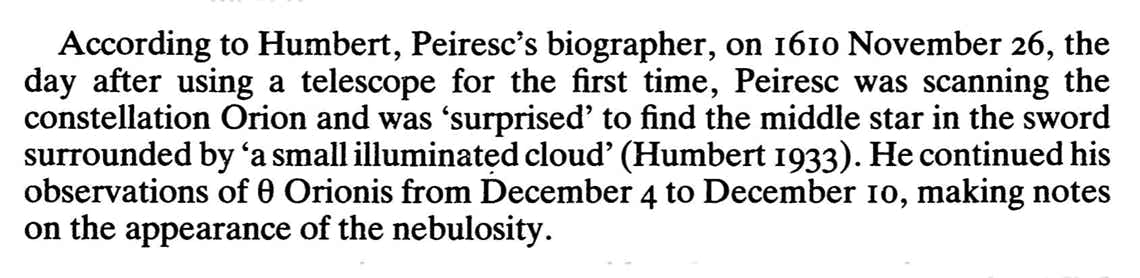
Nicolas-Claude Fabri de Peiresc’s description of the Orion Nebula in 1610.
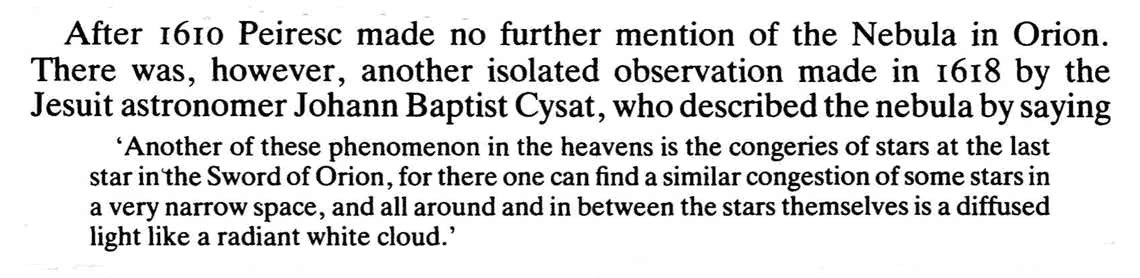
Johann Baptist Cysat’s description of the Orion Nebula in 1618.
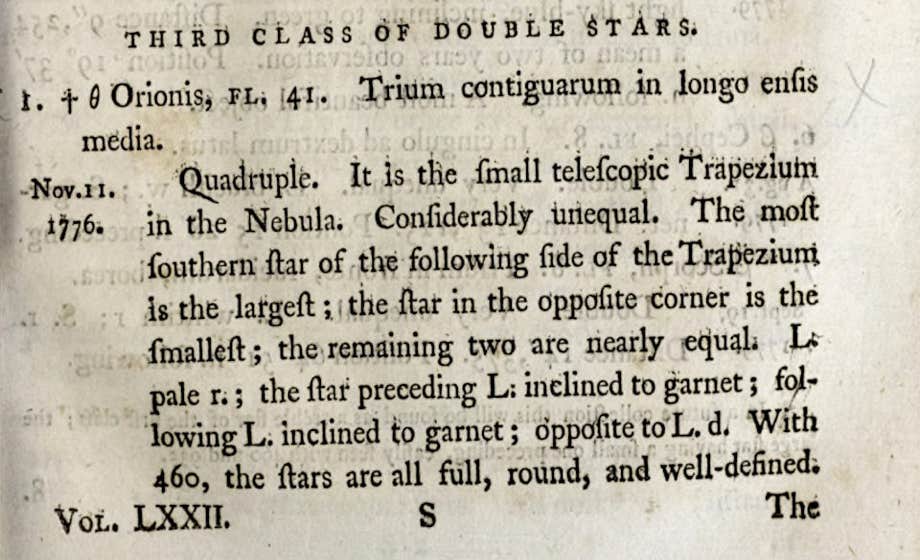
William Herschel’s description of the Trapezium cluster, also known as Theta-1 Orionis, from his Catalogue of Double Stars published in 1782.