

Genitive: Octantis
Abbreviation: Oct
Size ranking: 50th
Origin: The 14 southern constellations of Nicolas Louis de Lacaille
Octans was one of 14 new southern constellations introduced in the 1750s by the French astronomer Nicolas Louis de Lacaille. It represents a navigational instrument known as a reflecting octant, invented in 1730 by the Englishman John Hadley (1682–1744). Lacaille originally named it l’Octans de Reflexion on his chart published in 1756, but changed this simply to Octans on the second edition of 1763 on which he Latinized the names of the constellations.
Lacaille referred to it as the ‘principal instrument des Navigateurs pour observer la hauteur du pole, &c’ (i.e. the main instrument of navigators for observing the altitude of the pole), and fittingly enough Octans encompasses the south celestial pole. But despite this privileged position it contains little of note, consisting of no stars brighter than fourth magnitude. When constructing the constellation, Lacaille annexed several stars that had previously been part of Hydrus, the lesser water snake, and Apus, the bird of paradise, two of the constellations formed at the end of the 16th century by Dutch navigators; in doing so he considerably remodelled this part of the sky.
An octant consists of an arc of 45°, i.e. an eighth of a circle, hence the name. The navigator sighted the horizon through a telescope and adjusted a movable arm until the reflected image of the Sun or a star overlay the direct view of the horizon. In later designs the arc was extended from one-eighth of a circle to one-sixth and the instrument became the modern sextant.
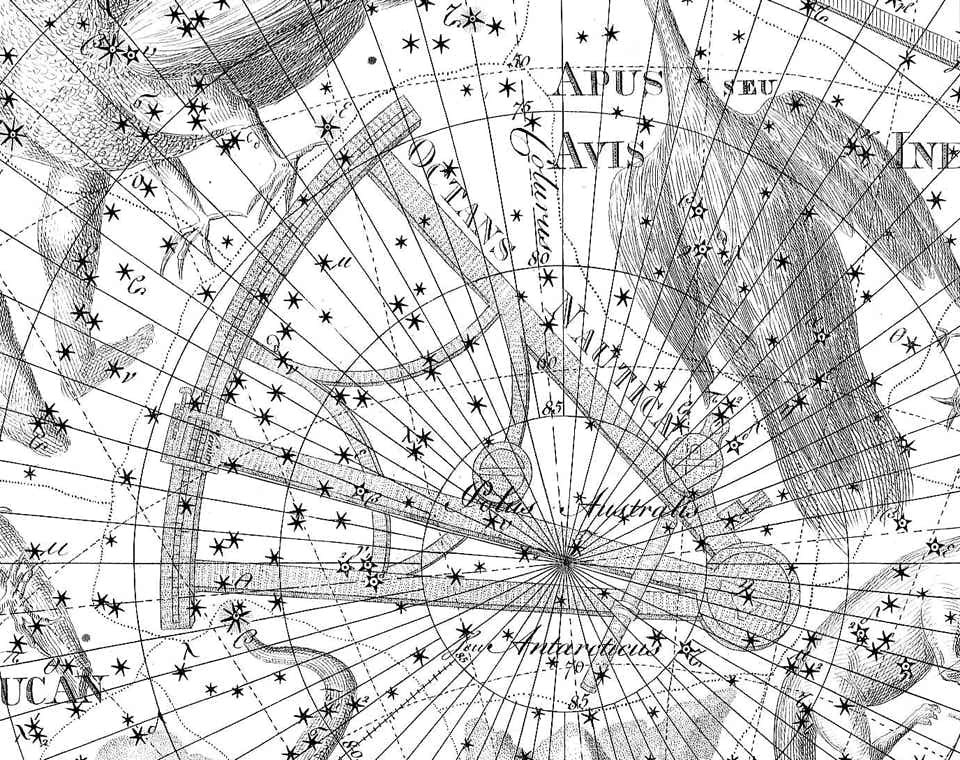
Octans encompasses the south celestial pole, as shown on Chart XX of Johann Bode’s Uranographia star atlas, where it was called Octans Nautica. The octant was the forerunner of the modern sextant. On this illustration Apus, the bird of paradise, is above right; the tip of the tail of Hydrus is at bottom left; and the feet of Pavo, the peacock, are at top left. Click here for Lacaille’s original depiction of the constellation.
Stars of Octans and the southern pole
There is, unfortunately, no southern equivalent of the bright northern pole star, Polaris. The nearest naked-eye star to the south celestial pole is Sigma Octantis, a degree away from the pole, although at magnitude 5.4 it is far from prominent. Lacaille gave this star the letter Sigma in his catalogue, but he did not label it on his chart. Currently the south celestial pole is moving away from Sigma Octantis into an even blanker region of sky. The next naked-eye star to come anywhere near the southern pole will be Iota Octantis, magnitude 5.5, which will be just over 1½ degrees away around AD 2800.
Octans is another example of a constellation in which the star labelled Alpha is not the brightest. In this case, the brightest star is Nu Octantis, magnitude 3.7. Alpha Octantis, magnitude 5.2, has the distinction of being the faintest star labelled Alpha in any constellation, although not by much – its closest rival, Alpha Mensae, is less than 0.1 magnitude brighter.
© Ian Ridpath. All rights reserved

Lacaille’s description of Octans, published with his chart and preliminary catalogue of the southern stars in the Histoire de l'Académie royale des sciences for 1752 (actually issued in 1756).
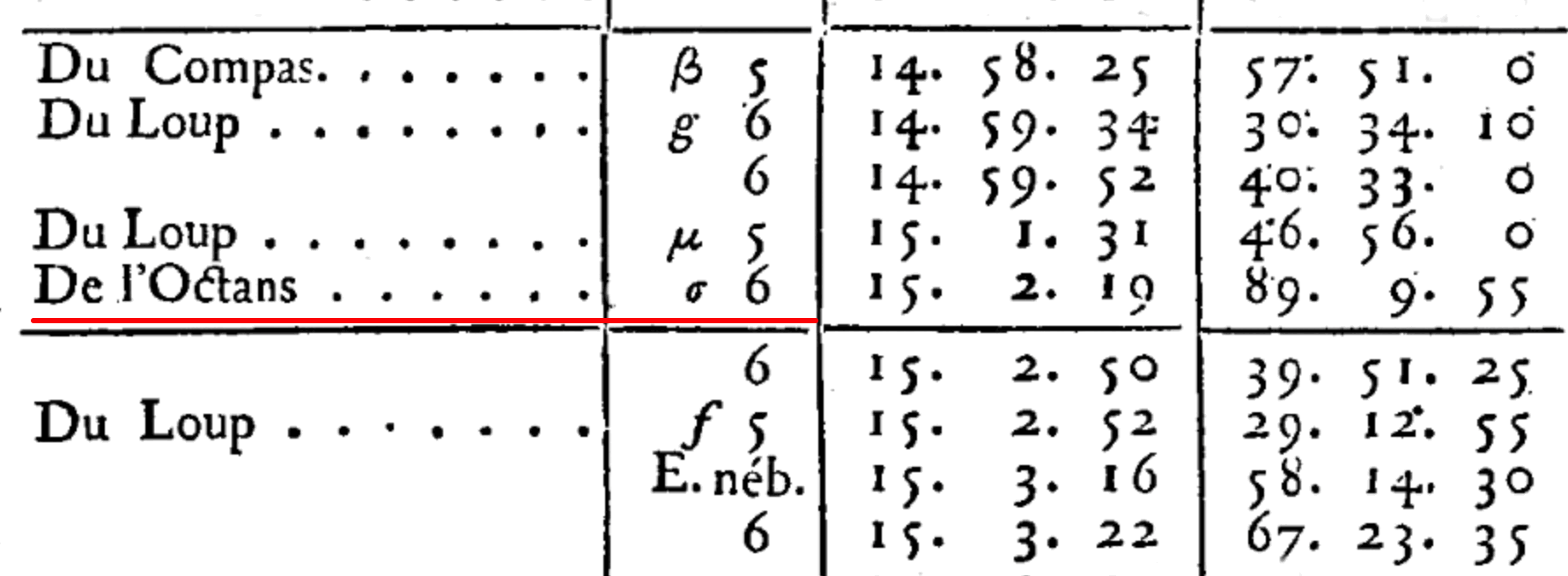
Sixth-magnitude Sigma (σ) Octantis, currently the closest naked-eye star to the south celestial pole, received its Greek-letter designation in Lacaille’s star catalogue in the Mémoires of the Académie Royal des Sciences dated 1752 (but actually published in 1756).