

This abandoned constellation, which lay in the northern part of present-day Aries, has a confusing history. It was introduced on a globe of 1612 by the Dutchman Petrus Plancius under the name Apes, the Bee. He created it from four of Ptolemy’s unformed stars of 4th and 5th magnitude which were described in the Almagest as lying ‘over the rump’ of Aries. The German astronomer Jacob Bartsch altered its name to Vespa, the Wasp, on his map of 1624, but retained the name Apes in his accompanying text.
Johannes Hevelius changed the type of insect altogether when he renamed it Musca, the fly, on his Firmamentum Sobiescianum atlas of 1687. This was confusing, since there already was a Musca in the southern hemisphere, created almost a century earlier from the observations of Keyser and de Houtman. Hevelius did not list his northern Musca as a separate constellation in his accompanying catalogue, but retained its four stars under his entry for Aries. We now know them as 33, 35, 39, and 41 Arietis. Johann Bode showed Musca on his Uranographia atlas of 1801, but within the borders of Aries (below).
The constellation later became known as Musca Borealis, the northern fly, to distinguish it from its southern namesake. This longer name seems to have first appeared on Alexander Jamieson’s Celestial Atlas of 1822 (Plate 13). Eventually, the northern fly was swatted by astronomers, although the southern Musca remains.
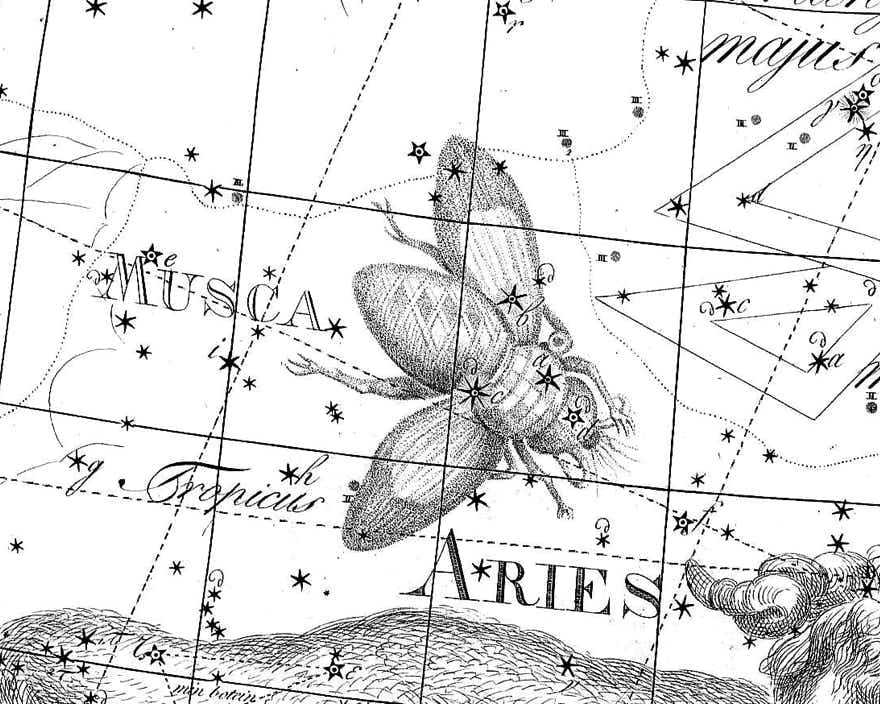
Musca Borealis crawls across Chart XI in the Uranographia of Johann Bode (1801).
Lilium, the fleur-de-lis
To add to the confusion, the same four stars were used by the Frenchman Ignace-Gaston Pardies (1636–73) to form Lilium, the fleur-de-lis of France (see illustration below). This appeared in an atlas entitled Globi coelestis in tabulas planas redacti descriptio published in 1674, the year after his death (with a second edition in 1693), but was a very short-lived addition to the sky. A trace of it still exists, though: the star 39 Arietis is now known as Lilii Borea, the name given to it by Nicolas Louis de Lacaille in a short star catalogue in his Astronomiæ fundamenta novissimis solis et stellarum observationibus stabilita published in 1757 and officially adopted by the IAU in 2017.
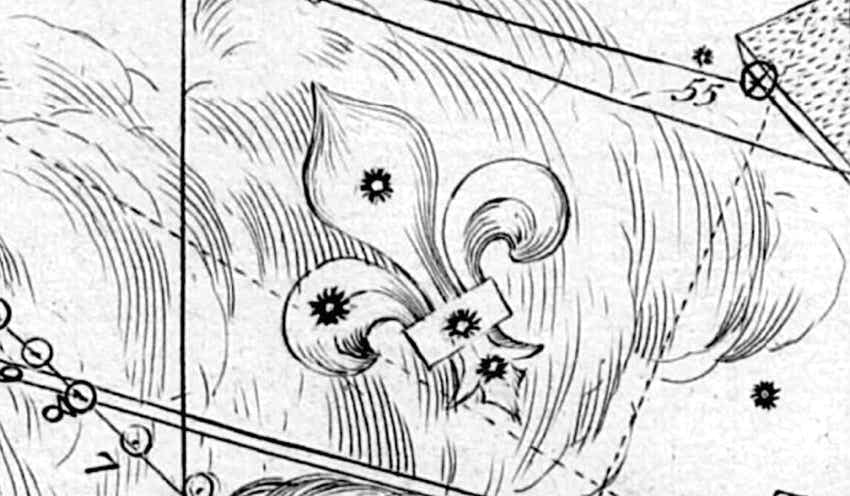
The four stars of Musca became Lilium, the fleur-de-lis, in an atlas published in 1674 by the French scientist Ignace-Gaston Pardies (above). Pardies did not label the constellation, though. The name Lilium first seems to have appeared five years later in a chart and catalogue called Cartes du Ciel published in 1679 by another Frenchman, Augustin Royer, who enlarged the lily and increased its number of stars to seven.
© Ian Ridpath. All rights reserved

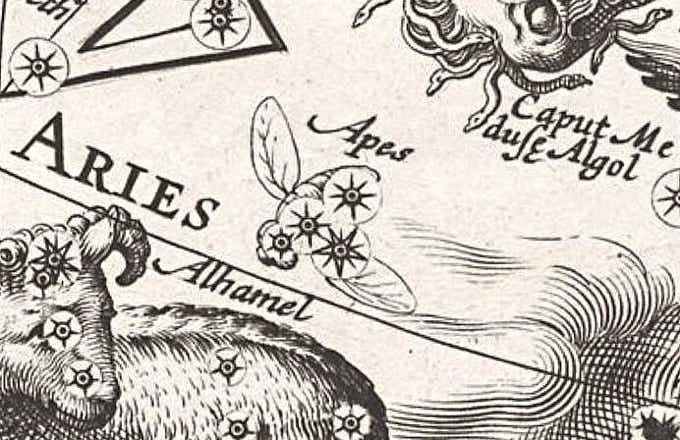
Apes on a gore from a globe made in 1612 by Petrus Plancius and the Dutch engraver and cartographer Pieter van den Keere (Petrus Kaerius) (1571–c.1646). Being on a globe, the constellations are drawn in reverse from the way they appear in the sky.
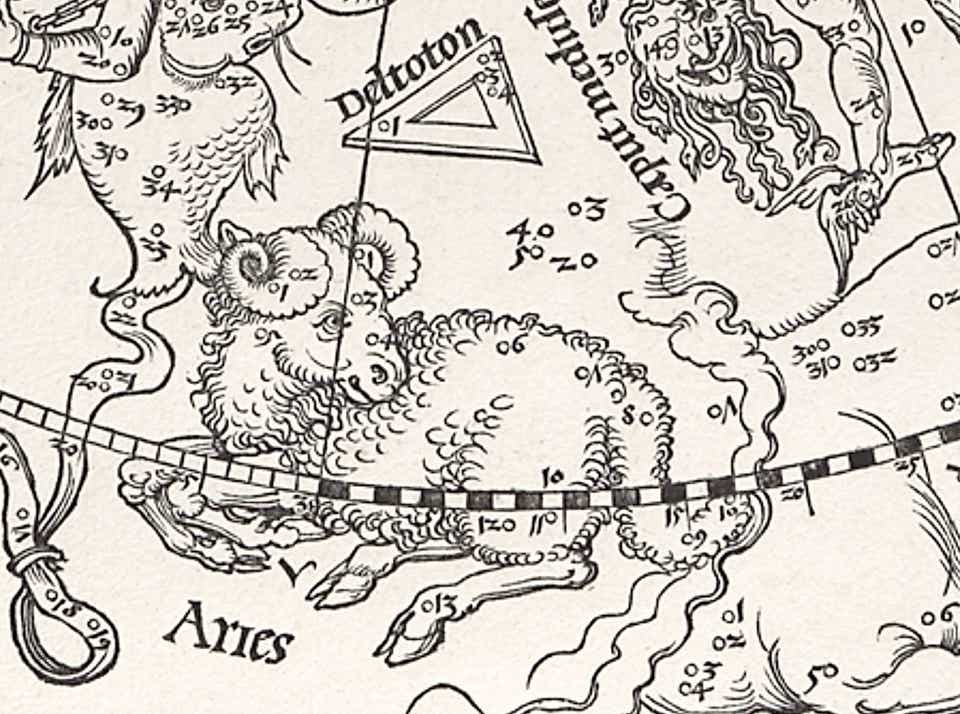
The four ‘unformed’ Ptolemaic stars above the body of Aries which were used by Plancius to create Musca Borealis, as seen on Albrecht Dürer’s star chart from 1515. Dürer numbered them 2 to 5, which is the order they were listed by Ptolemy in the Almagest; they are now known as 41, 39, 35, and 33 Arietis, respectively. Ptolemy’s unformed star number 1 lay over the ram’s head and was not part of the new constellation; Dürer showed this star within the curl of the ram’s horn. The figure labelled Deltoton at the top of the illustration is the modern Triangulum. Dürer drew the constellations on his charts in reverse, as they would appear on a celestial globe.

Jacob Bartsch’s entry on Apes (aka Musca Borealis) from his book Usus Astronomicus Planisphaerii Stellati of 1624.
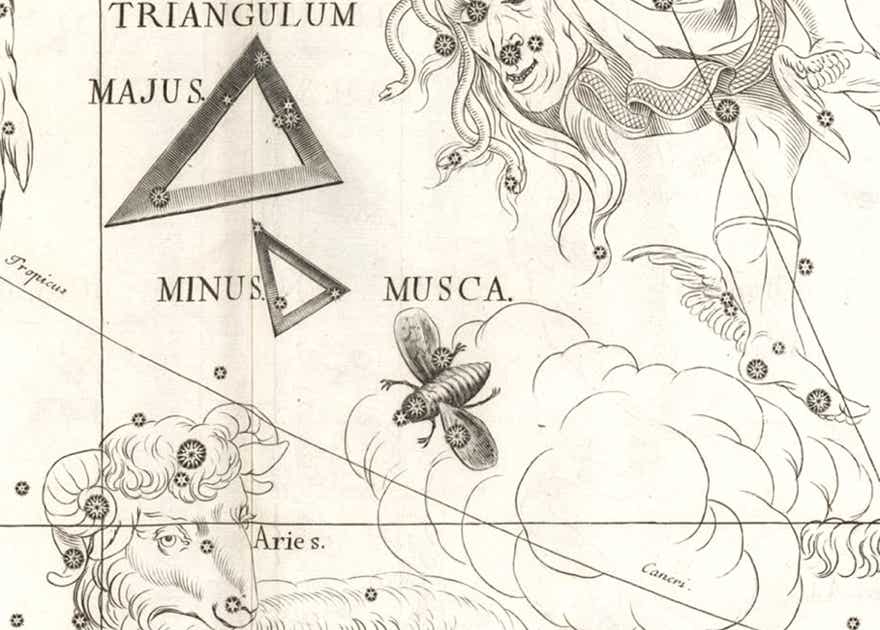
Musca was first shown as a fly on Johannes Hevelius’s Firmamentum Sobiescianum star atlas. Next to it is Hevelius’s invention Triangulum Minus, also now obsolete. Hevelius’s charts showed the sky as it appears on a globe, so all constellations are back to front from the way they appear in the sky.
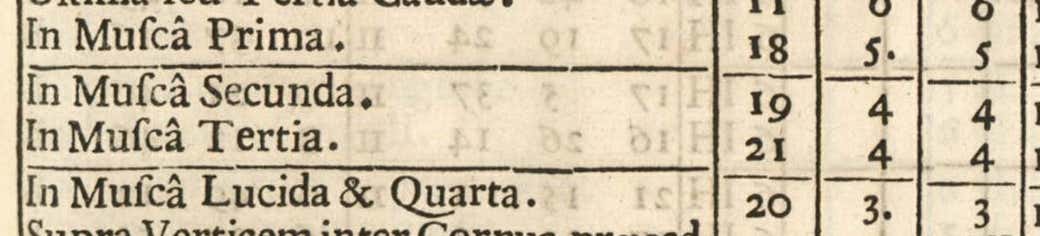
The four stars of Musca Borealis were listed by Hevelius simply as Musca under the entry for Aries in his Catalogus Stellarum Fixarum published in 1690.
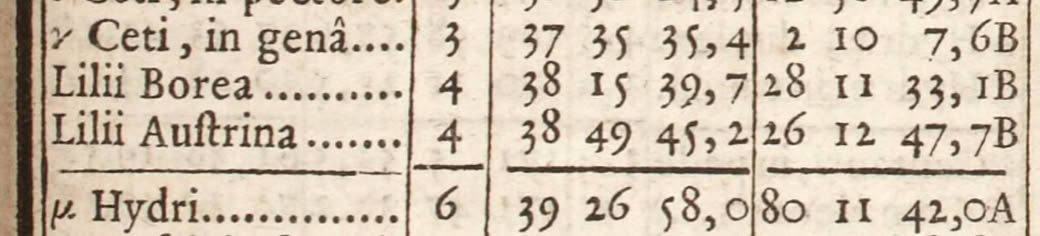
Lilii Borea and Lilii Austrina listed in Lacaille’s Astronomiae fundamenta novissimis solis et stellarum observationibus stabilita of 1757. These stars have the Flamsteed designations 39 and 41 Arietis. The IAU has officially given 39 Arietis the name Lilii Borea, while 41 Arietis (Lacaille’s Lilii Austrina) has been named Bharani after the second nakshatra (lunar mansion) in Hindu astronomy, which consisted of the three stars 35, 39, and 41 Arietis.
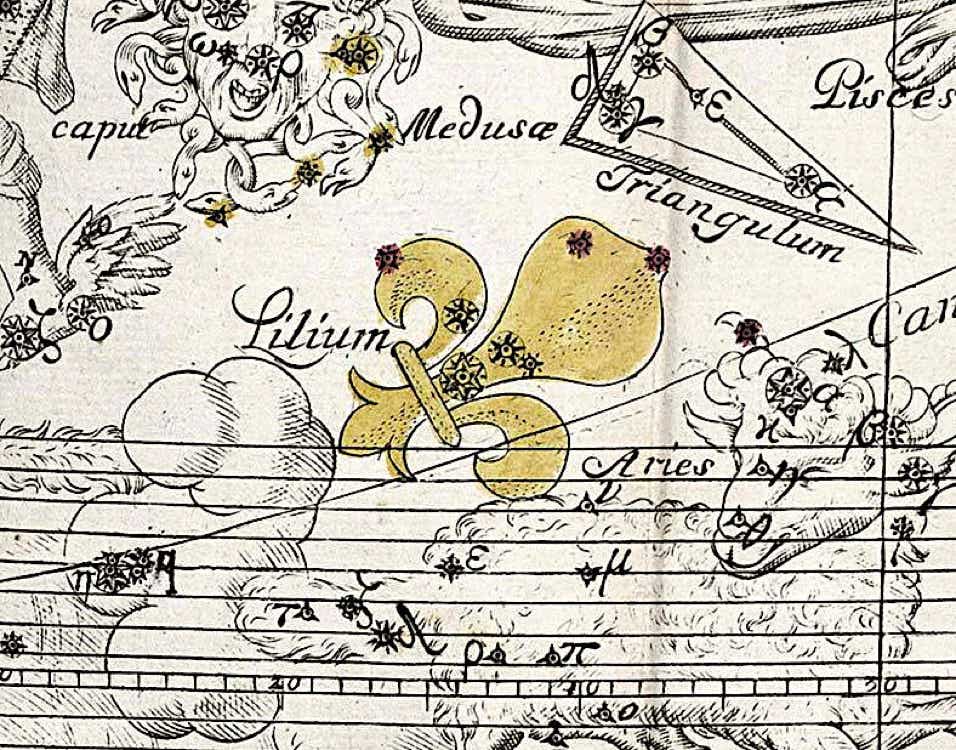
Lilium on a chart in Cartes du Ciel published in 1679 by the French architect and astronomer Augustin Royer (life dates unknown). Royer enlarged the lily from four stars to seven, as listed in his accompanying catalogue, and rotated it to the right by comparison with the original version of his compatriot Ignace-Gaston Pardies.