Representing a real mountain of Arcadia in the central Peloponnese, Mons Maenalus was a subdivision of Boötes introduced by Johannes Hevelius in his Firmamentum Sobiescianum star atlas published in 1690, where it was depicted with Boötes standing on its slopes. However, in his accompanying catalogue Hevelius listed its stars under Boötes, not as a separate constellation. The mountain appeared on many later maps made by other astronomers including Bode, below, but always as part of Boötes, and it never had an independent existence.
As originally visualized by Hevelius, most of Mons Maenalus lay in the northern part of present-day Virgo, extending into Serpens Caput, but in Bode’s later depiction, shown here, it was restricted to southern Boötes. Its brightest star listed by Hevelius was the present-day 109 Virginis, magnitude 3.7, which was officially named Maenalus by the IAU in 2026 in memory of Hevelius’s invention.
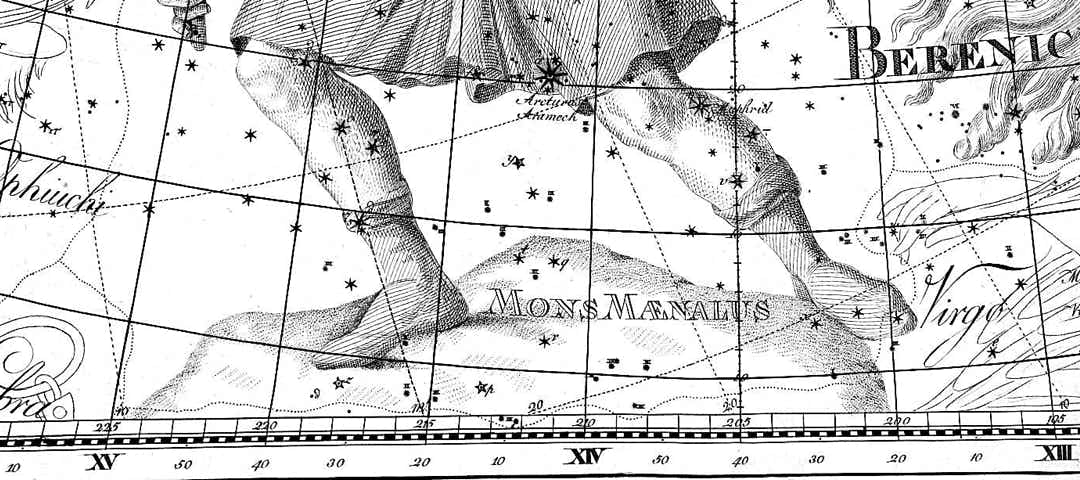
The feet of Boötes rest on Mons Maenalus, as shown on Chart VII of the Uranographia of Johann Bode (1801). The mountain did not have a separate boundary as it was intended to be part of Boötes. Click on the following link to see Hevelius’s original depiction, including a change of mind over the spelling of the name.
Mons Maenalus took its name from a character in Greek mythology. Maenalus was said by some mythologists to have been the eldest son of Lycaon, king of Arcadia; this would have made Maenalus brother of Callisto and hence uncle of her son Arcas, whom the constellation Boötes represents. Others, though, say he was actually the son of Arcas and hence the grandson of Callisto. Either way, Maenalus gave his name to the mountain in Arcadia and to the city of Maenalon which he founded. Its modern name is Mainalo.
Mons Maenalus was sacred to the god Pan who frequented it. Ovid in his Metamorphoses said that Mons Maenalus bristled with the lairs of wild beasts and was a favourite hunting ground of Diana and her entourage, including Callisto. In saying this, Ovid clearly rejected the story that Maenalus was Callisto’s grandson, as the mountain would not yet have got its name.
© Ian Ridpath. All rights reserved