

Genitive: Microscopii
Abbreviation: Mic
Size ranking: 66th
Origin: The 14 southern constellations of Nicolas Louis de Lacaille
One of the southern constellations representing scientific instruments that were invented in 1751–52 by the French astronomer Nicolas Louis de Lacaille. In this case the instrument concerned is an early form of compound microscope, i.e. one that uses more than one lens.
Lacaille first showed the constellation on his map of 1756 under the name le Microscope but Latinized this to Microscopium on the second edition published in 1763. He described it as consisting of ‘a tube above a square box’, although Johann Bode added a slide carrier containing specimens when he depicted it in his Uranographia atlas of 1801 (below).
Microscopium lies beneath the forelegs of the zodiacal constellation Capricornus in an area of sky containing stars of only fifth magnitude and fainter. It incorporates six ‘unformed’ stars that Ptolemy had listed in his star catalogue as lying outside Piscis Austrinus. One of these is the constellation’s brightest star, Gamma Microscopii of magnitude 4.7, seen on the side of the tube in the chart below. The eyepiece end of the microscope is marked by 6th-magnitude Delta. The only remarkable thing about Microscopium is that anyone could imagine a separate constellation here.
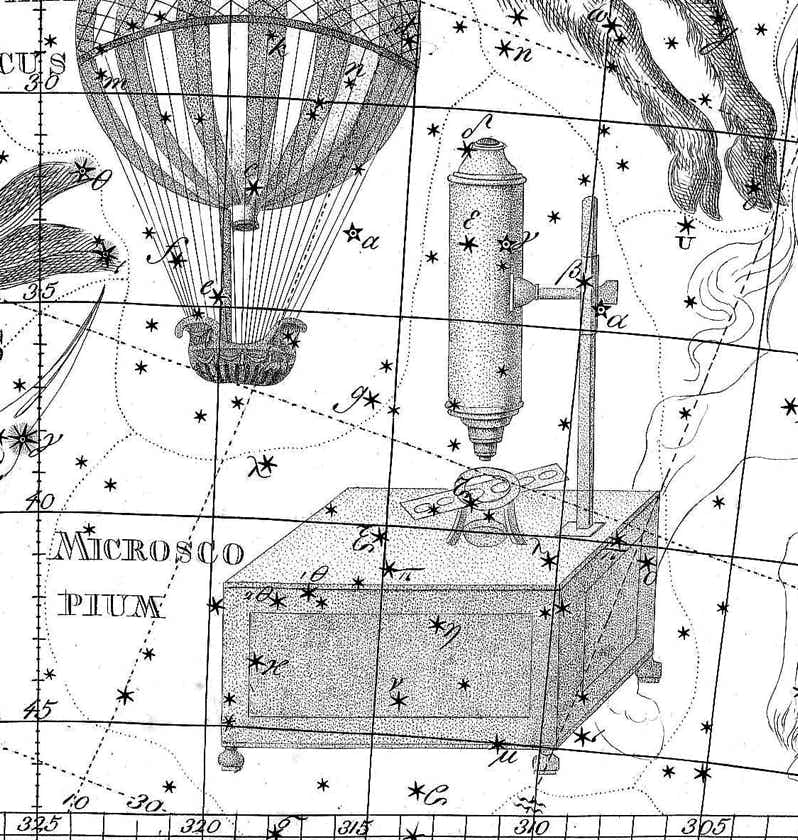
Microscopium shown ready to examine specimens on a glass slide on Chart XVI of the Uranographia of Johann Bode (1801). Next to it on this chart lies the obsolete constellation Globus Aerostaticus, the hot-air balloon. Above it are the forefeet of Capricornus. Click here for Lacaille’s original depiction of the constellation.
Chinese associations
Although the area we know as Microscopium was ignored by the ancient Greeks on account of its faintness, Chinese astronomers imagined at least one constellation here, called Jiukan, meaning nine water wells or canals. Water from Jiukan would no doubt have been used to irrigate Tiantian, the Emperor’s farmland in Capricornus to the north. (Not all authorities agree that Jiukan was in Microscopium, though – Sun and Kistemaker show it farther west in Sagittarius, incorporating Theta and Iota Sagittarii.)
Some sources also place Liyu, three stars representing jade jewellery, in Microscopium, but a location in Capricornus seems a better fit to the location described.
© Ian Ridpath. All rights reserved

Lacaille described Microscopium as ‘un tuyau placé au dessus d’une boîte carrée’ (a tube placed above a square box) in the notes to his preliminary catalogue and chart, published in 1756 in the Histoire de l'Académie royale des sciences. He originally gave it the French name Le Microscope, but this was Latinized to Microscopium in his final catalogue and chart of 1763.
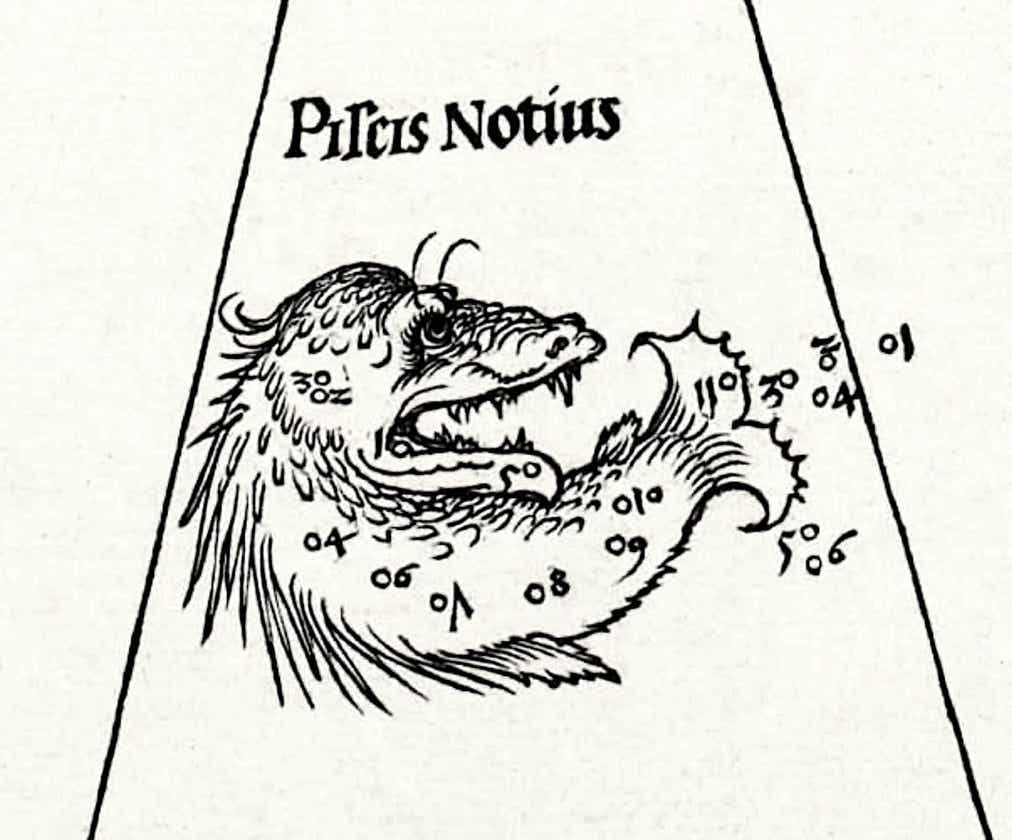
Ptolemy listed six ‘unformed’ stars outside the constellation Piscis Austrinus, shown here on Albrecht Dürer’s celestial chart of 1515 under its alternative name Piscis Notius. Dürer numbered the stars from 1 to 6 in the order they were listed by Ptolemy. Because the stars are so far south, Ptolemy’s coordinates were very unreliable. Stars 1 to 3 are probably the three brightest in this area, namely Alpha, Gamma, and Epsilon Microscopii. Star 4 is possibly HR 8076, but stars 5 and 6 cannot be identified with any certainty. The constellation is drawn in mirror image, as on a celestial globe, and south is at the top.