

Genitive: Mensae
Abbreviation: Men
Size ranking: 75th
Origin: The 14 southern constellations of Nicolas Louis de Lacaille
A small, faint constellation of the far southern sky invented by the French astronomer Nicolas Louis de Lacaille to commemorate Table Mountain near Cape Town, South Africa, from where he catalogued the southern stars in 1751–52. Lacaille originally gave it the French name Montagne de la Table on the first version of his planisphere published in 1756 but this was Latinized to Mons Mensae on the second edition of 1763. In 1844 the English astronomer John Herschel proposed shortening it to Mensa. Francis Baily adopted this suggestion in his British Association Catalogue of 1845, and it has been known as Mensa ever since.
Mensa contains part of the Large Magellanic Cloud, a neighbour galaxy to our Milky Way, which gives Mensa the appearance of being capped by a white cloud, like the so-called ‘table-cloth’ cloud that is sometimes seen over the real Table Mountain ‘at the approach of a strong south-easterly wind’ (‘à l’approche d'un vent violent de sud-est’), as Lacaille put it in the notes to his catalogue of 1756.
Mensa’s brightest stars are of only fifth magnitude, making this the faintest of all the 88 constellations.
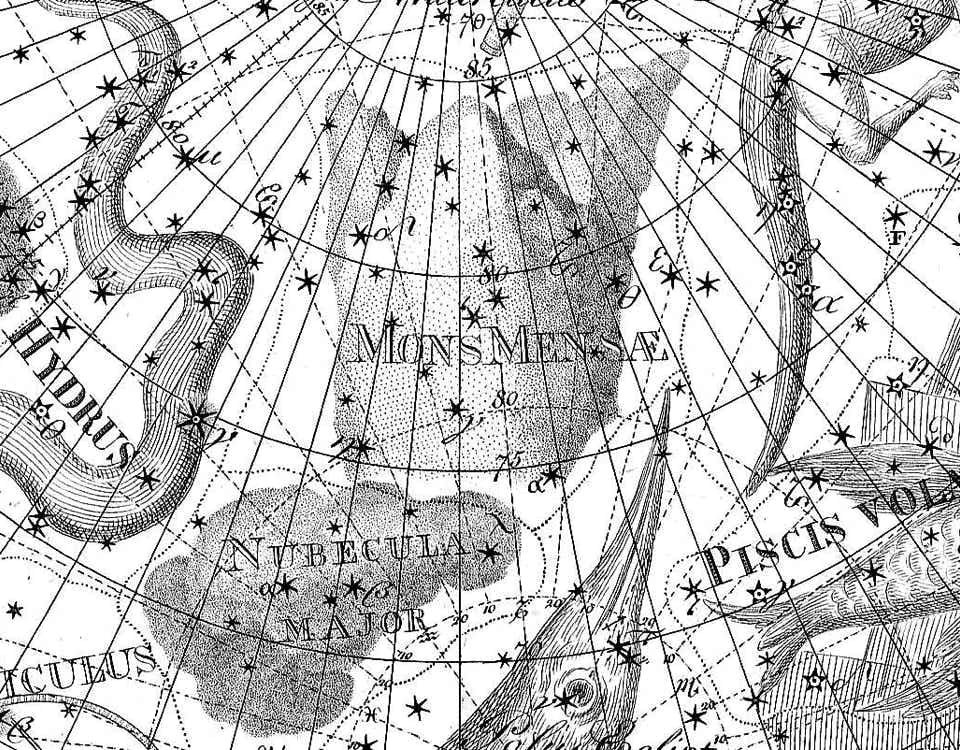
Mensa, introduced by Lacaille under the name Mons Mensae, as illustrated
on Chart XX of the Uranographia of Johann Bode (1801).
Nubecula Major is the Large Magellanic Cloud, reminiscent of the cloud
that caps the real Table Mountain. Click to see Lacaille’s original depiction.
© Ian Ridpath. All rights reserved
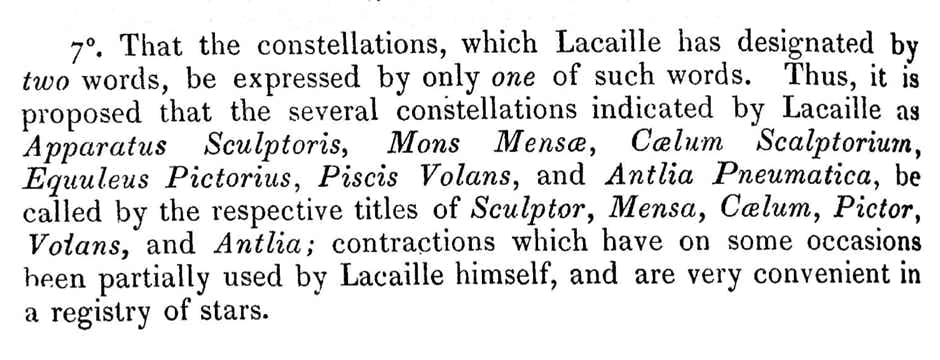
John Herschel proposed shortening the names of six of Lacaille’s southern constellations from two words to one in a paper published in the Monthly Notices of the Royal Astronomical Society in 1844. His proposal was readily adopted, and we now know these constellations as simply Antlia, Caelum, Mensa, Pictor, Sculptor, and Volans.
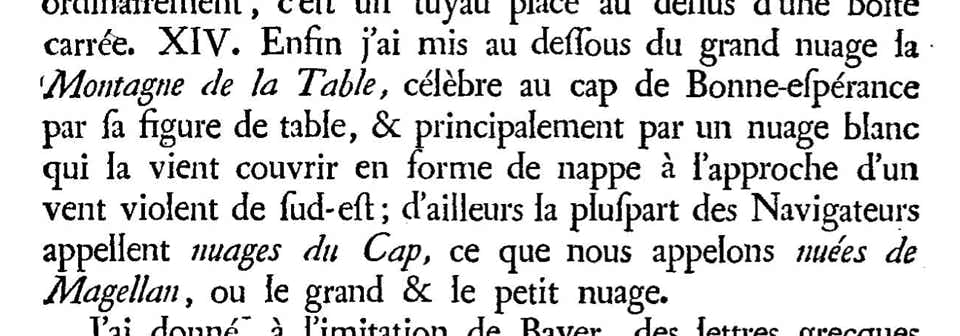
Lacaille’s description of Mensa, which he called Montagne de la Table (Table Mountain), in the notes that accompanied his preliminary star catalogue and chart published in 1756. Here he describes how he placed it next to the Large Magellanic Cloud (‘grand nuage’) which resembles the white cloud that forms over the real mountain ‘at the approach of a strong south-easterly wind’.