

Genitive: Leonis Minoris
Abbreviation: LMi
Size ranking: 64th
Origin: The seven constellations of Johannes Hevelius
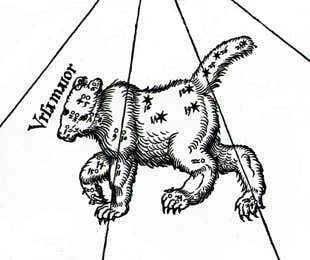
A lion cub accompanying Leo, introduced by the Polish astronomer Johannes Hevelius in his star catalogue of 1687 and depicted in his star atlas published posthumously in 1690. He formed it from 18 faint stars between Ursa Major and Leo where the short-lived constellation Jordanus once flowed. The brightest stars of Leo Minor are of only fourth magnitude and there are no legends associated with it.
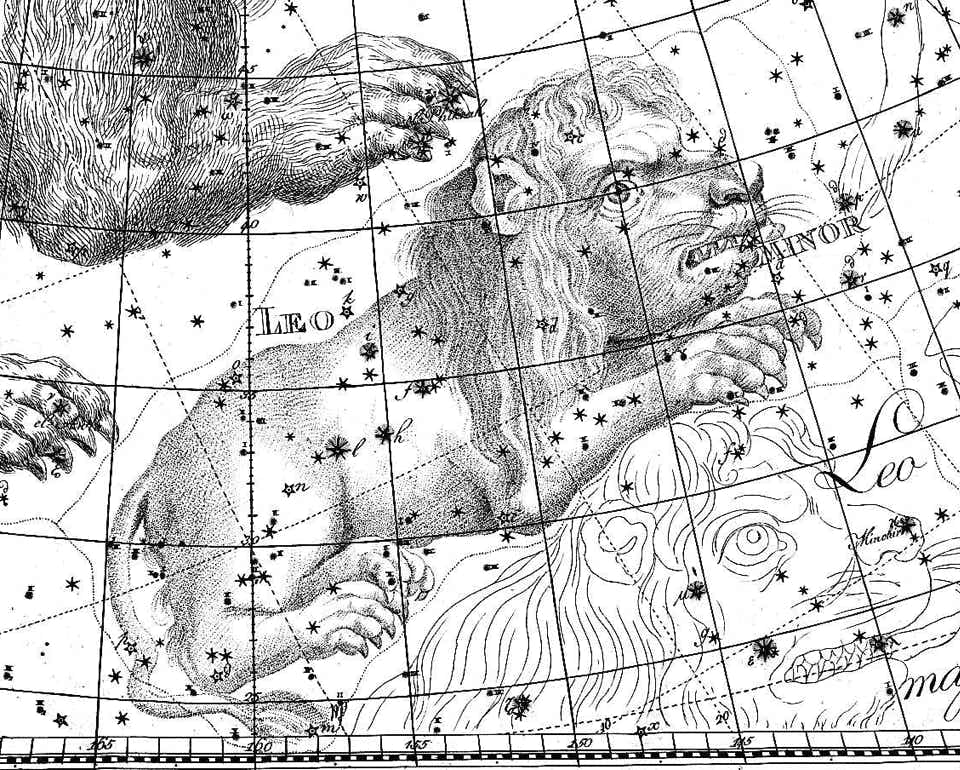
Leo Minor, the lion cub, lies immediately above the head of Leo itself, and beneath the rear paws of Ursa Major. From Chart VI of the Uranographia of Johann Bode (1801). Click to see Hevelius’s original depiction.
Why no Alpha? The tale of a curious oversight
Curiously, Leo Minor has no star labelled Alpha, although there is a Beta Leonis Minoris. This seems to have resulted from an oversight on the part of the 19th-century English astronomer Francis Baily. Hevelius did not label the stars in any of his newly formed constellations, so 150 years later Baily did it for him. In his British Association Catalogue of 1845, Baily assigned the letter Beta to the second-brightest star in Leo Minor, but left the brightest star (46 Leonis Minoris, on the rump of the lion) unlettered by mistake.
Which star is Praecipua?
There is further confusion regarding the naming of the brightest star in this constellation. In his book Star Names, Their Lore and Meaning, R. H. Allen says that Hevelius described the brightest star in Leo Minor as Praecipua, meaning ‘chief’, and that it was later used as a star name by the Italian astronomer Giuseppe Piazzi in his Palermo Catalogue of 1814. However, I am unable to find any mention of a Praecipua in Hevelius’s catalogue, although the name does appear in Piazzi’s catalogue. Allen also states that the star named Praecipua by Piazzi was 46 LMi, but again he is wrong; the star Piazzi named Praecipua was actually 37 LMi, which he wrongly assessed as brighter than 46 LMi. Reasonably enough, the name Praecipua is now officially applied to the brightest star, 46 LMi (mag. 3.8), rather than the fainter 37 LMi (mag. 4.7).
Chinese associations
Confusion also surrounds the Chinese constellations in Leo Minor. Chinese astronomers originally described a constellation called Neiping, the court of a judge or mediator, consisting of the stars Beta, 30, 37, and 46 LMi. But later on, an entirely different constellation called Shi, a court eunuch, was visualized in this same position, with Neiping transferred to some fainter stars to the west.
Equally confusing is a line of four stars extending southwards into Leo called Shaowei, representing four scholarly advisors to the Emperor. Sources differ as to whether Shaowei included one, two, or three stars of Leo Minor, and which they were. Chinese astronomers added to the confusion when they later used the same stars to form Changyuan, a border wall. The name Shaowei was then transferred to four other stars nearby, but their identities are not certain either.
© Ian Ridpath. All rights reserved
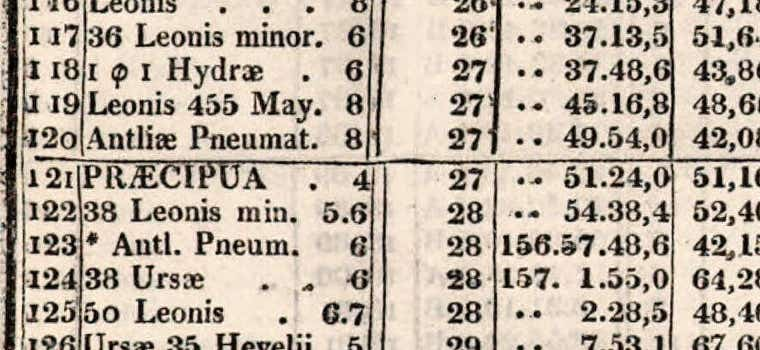
Giuseppe Piazzi gave the name Praecipua to the star 37 Leonis Minoris, which he wrongly judged to be the brightest in Leo Minor. The name has now been transferred to 46 LMi, which is the brightest in the constellation.