

Genitive: Lacertae
Abbreviation: Lac
Size ranking: 68th
Origin: The seven constellations of Johannes Hevelius
This inconspicuous constellation, sandwiched between Cygnus and Andromeda like a lizard between rocks, was introduced by the Polish astronomer Johannes Hevelius in his star catalogue of 1687 and depicted in his star atlas published posthumously in 1690. Hevelius gave it the alternative title of Stellio, a type of lizard also known as a starred agama (Laudakia stellio in modern classification), but this secondary name soon fell into disuse.
Lacerta was extended northwards by the English astronomer John Flamsteed, who incorporated into it a triangle of stars that Hevelius had included as part of the turban of Cepheus. Later mapmakers such as Bode showed these three stars as the head of the enlarged lizard (below); they are now known as Alpha, Beta, and 9 Lacertae. Alpha and Beta are the constellation’s two brightest stars, but are of only fourth magnitude. They are the only two stars in Lacerta with Greek letters; these letters were allocated not by Hevelius but by Francis Baily in his British Association Catalogue of 1845.
In memory of Hevelius’s alternative name for the constellation, Alpha Lacertae was officially named Stellio by the International Astronomical Union in 2024.
There are no legends associated with the constellation.
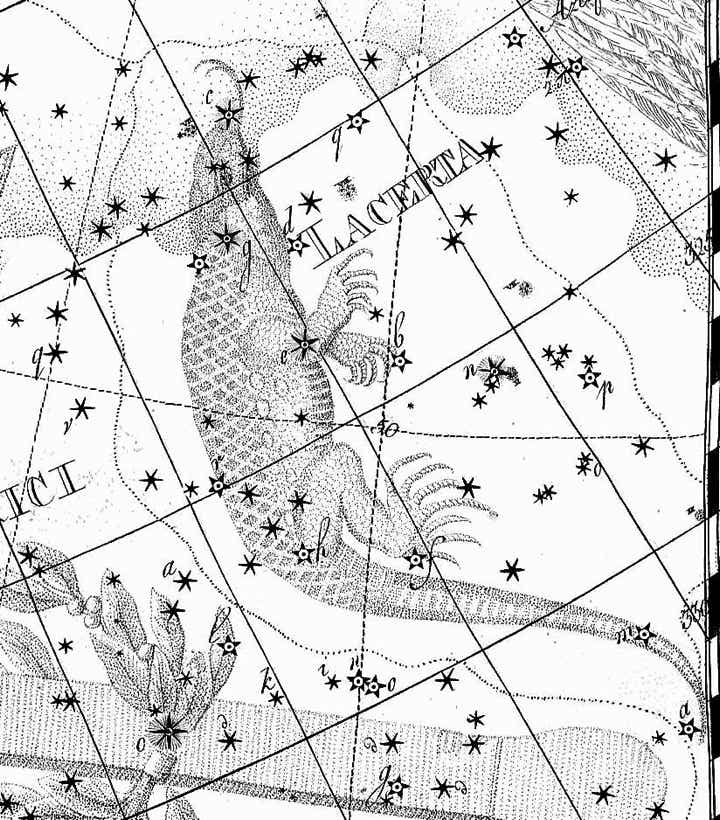
Lacerta slithers between Cygnus, top right, and the obsolete constellation of Honores Friderici (now part of Andromeda), bottom, as seen on Chart IV in the Uranographia of Johann Bode (1801). For Hevelius’s original depiction, see here.
Chinese associations
In Chinese astronomy, northern Lacerta was the centre of a spidery shaped figure called Tengshe, the flying serpent. There were 22 stars involved in all, an unusually high number for a Chinese constellation, and sources differ widely in their depiction of the shape and extent of the figure. There is general agreement that one chain of stars extended over the border into Andromeda, ending at Iota Andromedae, while other parts are variously shown overlapping into neighbouring Cassiopeia, Cepheus, and Cygnus. Sun and Kistemaker, though, restrict the figure to just Lacerta and Andromeda. In recognition of this ancient Chinese figure, the IAU has given the name Tengshe to its central star, the 5th-magnitude variable V424 Lacertae (= HR 8726), almost on the border with Andromeda.
In the south of Lacerta the star now known as 1 Lacertae formed the top end of Chu, a pestle hovering above a mortar, Jiu, in adjoining Pegasus. The constellation Chefu, a parking lot for chariots, overlapped into Lacerta from Cygnus.
© Ian Ridpath. All rights reserved