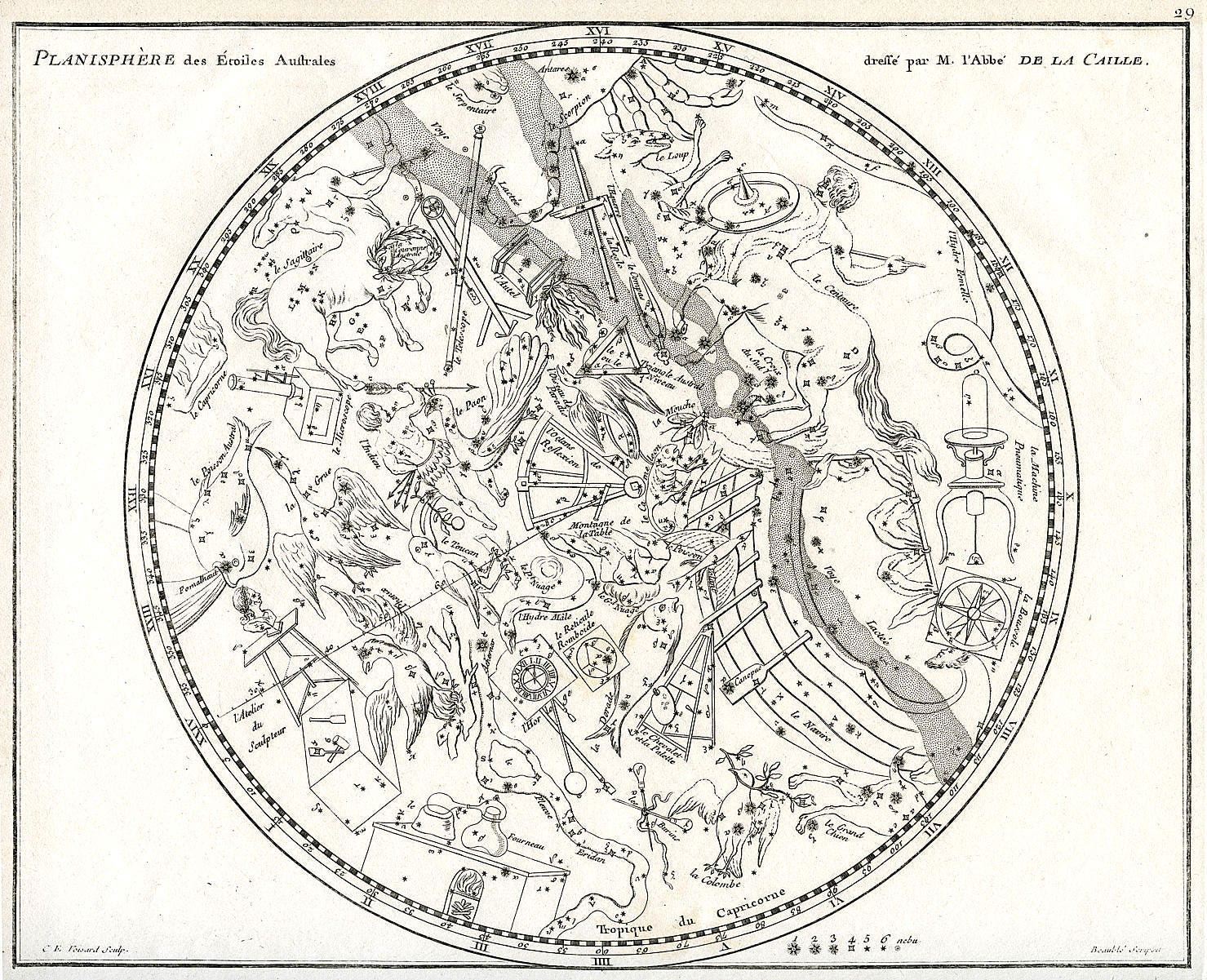
ABOVE is a copy of Nicolas Louis de Lacaille’s star chart on which his 14 new southern constellations were first published. They are mixed in with the old Ptolemaic figures and the newer additions by Keyser, de Houtman, and Plancius. Lacaille rearranged some of Keyser and de Houtman’s southern constellations to make way for his own, notably in the case of Hydrus, which was rerouted and had its tail cropped. He also removed Edmond Halley’s invention Robur Carolinum. The constellations on this chart formed the basis for the arrangement of the southern sky that we know today.
Lacaille’s chart, containing some 530 stars and nebulae, covered the southern sky from declination –23.5° (the Tropic of Capricorn) to the south celestial pole. The original engraving appeared in the Mémoires of the Académie Royal des Sciences dated 1752 but actually published in 1756. Lacaille described his new constellations in the accompanying text. The copy of the planisphere reproduced here is from the Atlas Céleste of 1776 by the French cartographer Jean-Baptiste Fortin (1740–1817) and gives constellation names in French, as did Lacaille’s original.[note]
A second edition of Lacaille’s planisphere was published posthumously in 1763 in Coelum Australe Stelliferum (for a zoomable version of it, see here). On that 1763 edition Lacaille Latinized the constellation names and labelled stars with Greek letters but the figures were the same as in 1756. Fortin’s version, above, adopted Lacaille’s Greek letters for the stars, but being for a popular audience kept the constellation names in French. Fortin’s Atlas Céleste was highly popular, and it is in this form that Lacaille’s constellation inventions would have been most widely disseminated.
LACAILLE’S 14 NEW SOUTHERN FIGURES
(names as given in French, with modern equivalents):
l’Atelier du Sculpteur (Sculptor); la Boussole (Pyxis); les Burins (Caelum); le Chevalet et la Palette (Pictor); le Compas (Circinus); l’Equerre et la Regle (Norma); le Fourneau (Fornax); l’Horloge (Horologium); la Machine Pneumatique (Antlia); le Microscope (Microscopium); Montagne de la Table (Mensa); l’Octans de Reflexion (Octans); le Reticule Romboide (Reticulum); le Telescope (Telescopium).
Lacaille also included the 12 constellations of Keyser and de Houtman under the following names: le Cameleon (Chamaeleon); le Dorade (Dorado); la Grue (Grus); l’Hydre Mâle (Hydrus); l’Indien (Indus); la Mouche (Musca); l’Oiseau de Paradis (Apus); le Paon (Pavo); le Phenix (Phoenix); le Poisson Volant (Volans); le Toucan (Tucana); le Triangle Austral ou le Niveau (Triangulum Australe, ‘or the level’ – he depicted it with an attached plumb bob).
Note that although Lacaille subdivided Argo Navis into the Keel (Corps), Poop (Pouppe), and Sails (Voilure) in his accompanying catalogue, he still depicted it as a unified figure on his chart (le Navire). He also included the Southern Cross under the name la Croix du Sud (Latinized to Crux Australis in the 1763 version of the chart).
© Ian Ridpath. All rights reserved
Lacaille’s southern planisphere of 1756
It is often said that the author was the unrelated Jean Nicolas Fortin (1750–1831), but that is now known to be the wrong Fortin.