

Genitive: Indi
Abbreviation: Ind
Size ranking: 49th
Origin: The 12 southern constellations of Keyser and de Houtman
Indus is one of the 12 figures formed by the Dutch navigators Pieter Dirkszoon Keyser and Frederick de Houtman from stars they charted in the southern hemisphere on their voyages to the East Indies at the end of the 16th century. It was first shown in 1598 on a globe by the Dutch cartographer Petrus Plancius and first appeared in print in 1603 on the Uranometria atlas of Johann Bayer.
The Indian is portrayed brandishing a spear as though hunting. Whether he is supposed to be a native of Madagascar, where the Dutch fleet stayed for several months on their way east and made many of their astronomical observations, is not known. Alternatively he could be a native of the East Indies or southern Africa. Or perhaps the figure is symbolic, representing all the indigenous peoples the explorers encountered on their various travels, from South America to the Indies. Whatever the case, early depictions such as on Plancius’s globe and in Bayer’s Uranometria strongly resemble this engraving of a native of Madagascar from an account of the first Dutch voyage to the East Indies, De eerste schipvaart naar Oost-Indië onder Cornelis de Houtman, first published in 1598 (thanks to Rob van Gent for the reference).
The constellation’s brightest star is Alpha Indi, magnitude 3.1. On the illustration below it lies above the Indian’s head, at the base of the spear.
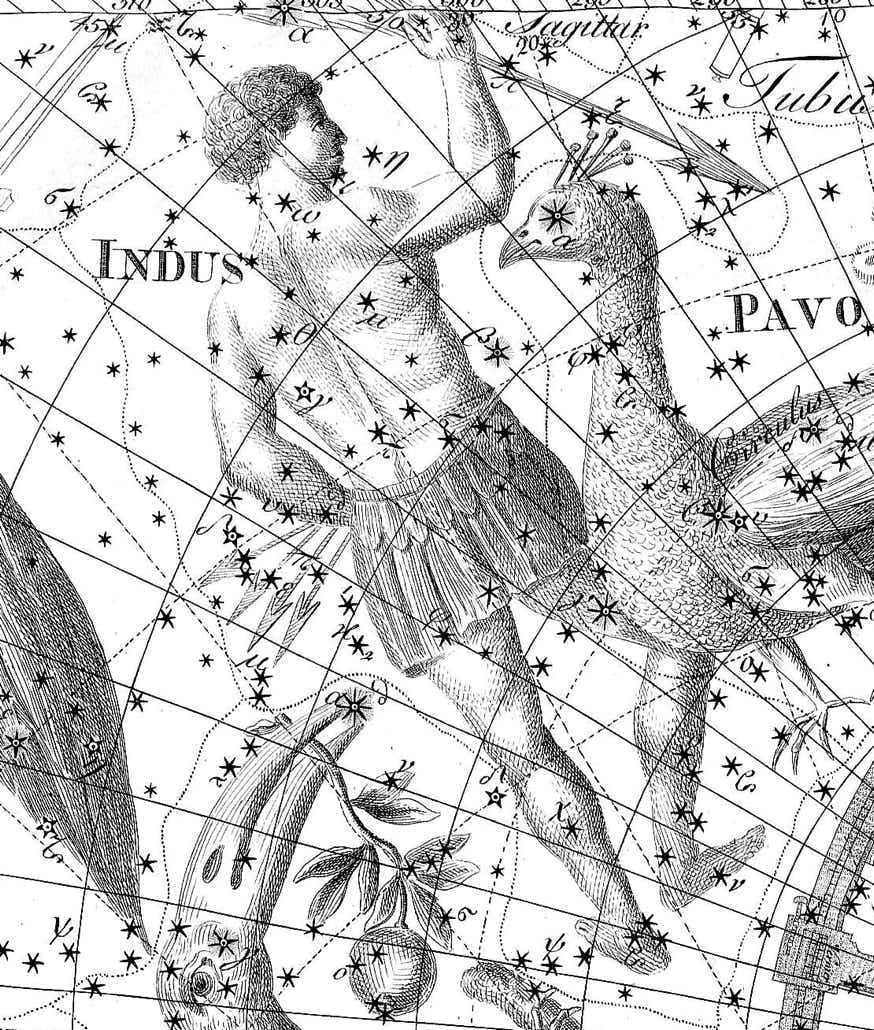
Indus, an Indian brandishing a spear in one hand and holding a clutch of spears with the other, as shown on Chart XX of the Uranographia of Johann Bode (1801). Bayer’s depiction in 1603 showed the Indian face-on with the spear in his left hand. Bode has turned him round so he is seen from the back, perhaps to make him right-handed. On Hevelius’s atlas of 1690 the figure is seen from the front and appears to be female.
© Ian Ridpath. All rights reserved
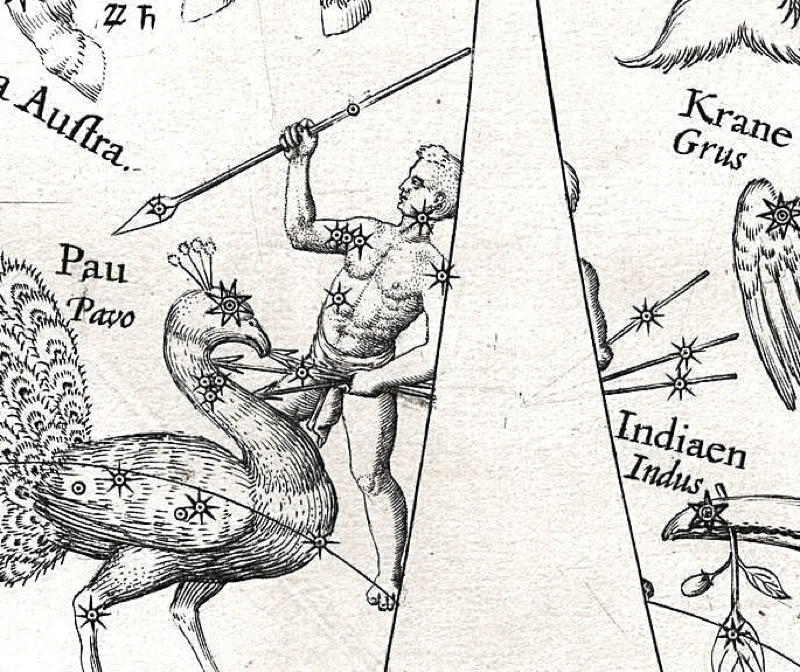
Indus and his spears spread across two gores from Petrus Plancius’s celestial globe of 1598. (Nicolai Collection of the State Library of Württemberg, Stuttgart)
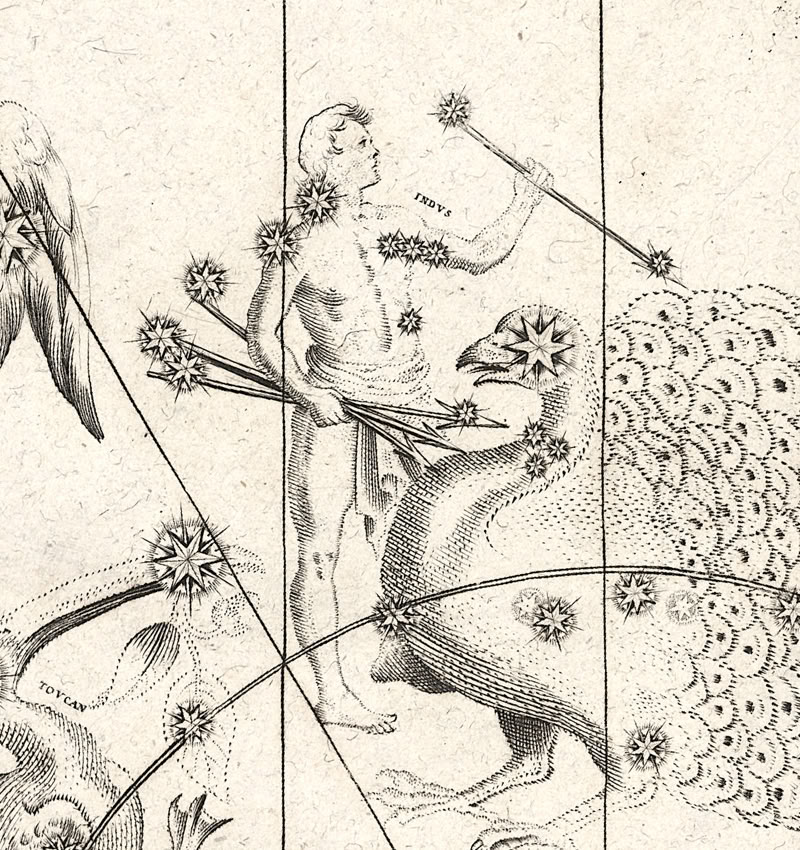
On Johann Bayer’s Uranometria atlas of 1603 Indus holds a spear aloft in his left hand. Unlike on globes such as that by Plancius of 1598, where the constellations are shown in reverse, Bayer drew them the way they appear in the sky.
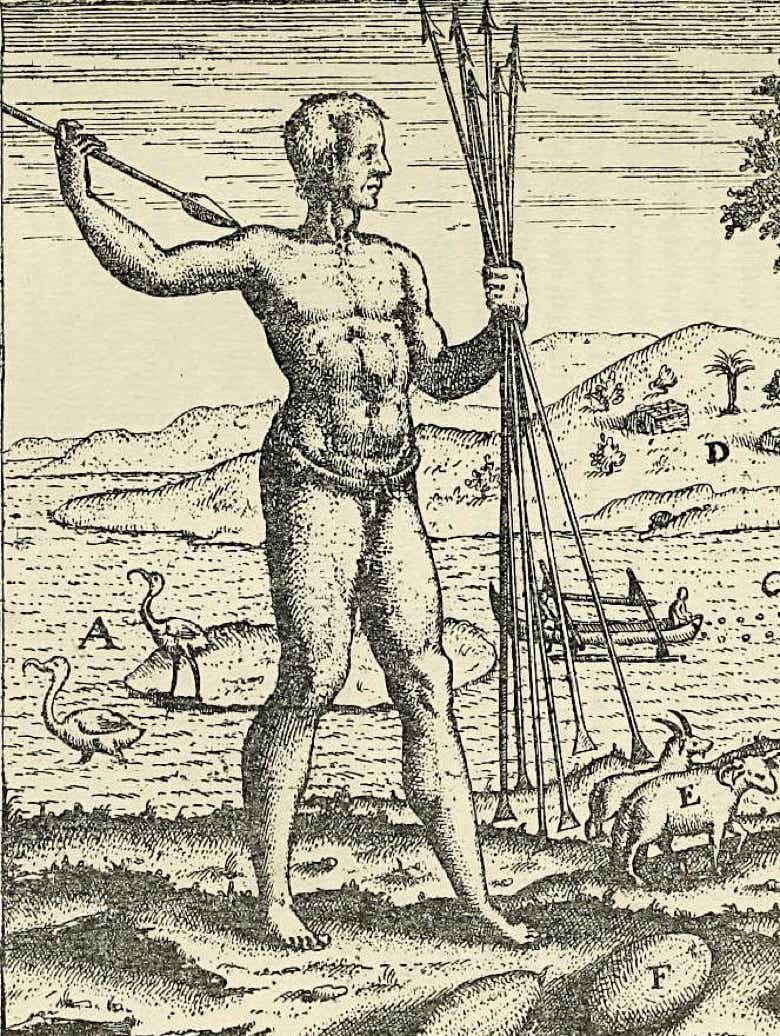
This engraving of a spear-carrying native of Madagascar resembles depictions of the constellation Indus on early globes and atlases. It comes from an account of the first Dutch voyage to the East Indies, De eerste schipvaart naar Oost-Indië onder Cornelis de Houtman, first published in 1598.