

Genitive: Hydri
Abbreviation: Hyi
Size ranking: 61st
Origin: The 12 southern constellations of Keyser and de Houtman
A small southern counterpart of the great water-snake, Hydra, with which it is not to be confused. This is one of several examples of the repetition of constellation figures in the sky, as in the Great and Little Bear, the Great and Little Dog, the two lions, the horses Pegasus and Equuleus, the Northern and Southern Crown, and the Northern and Southern Triangle.
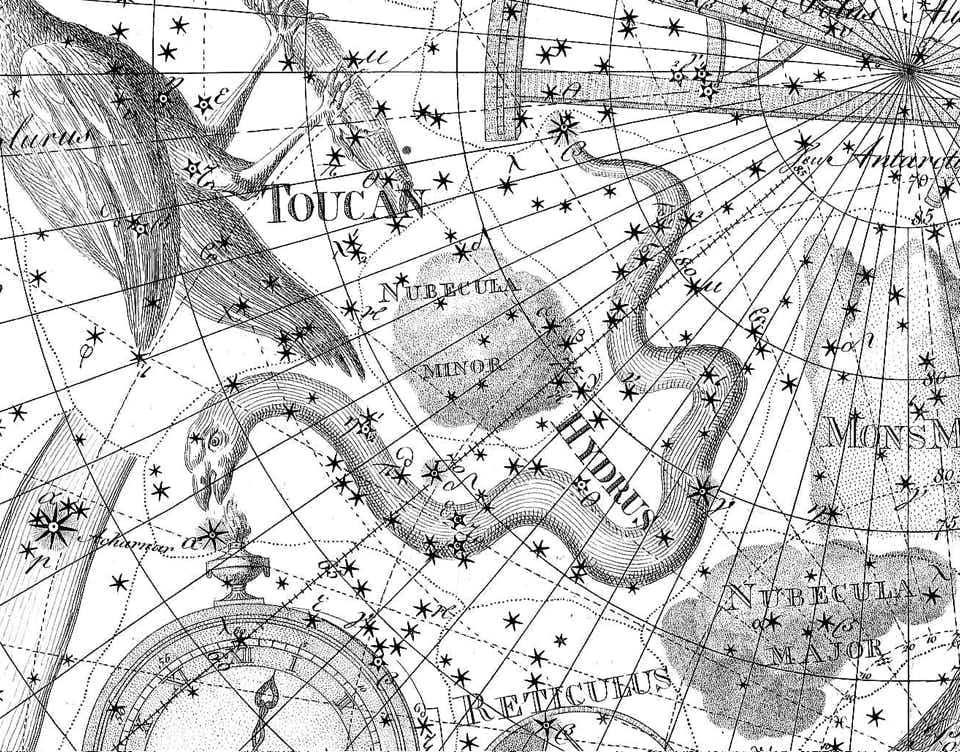
Hydrus winds around the Small Magellanic Cloud, here called Nubecula Minor, as shown by Johann Bode on Chart XX of his Uranographia (1801). The Large Magellanic Cloud, Nubecula Major, is visible in the bottom right corner. The south celestial pole is at upper right, and the bright star to the left of the head of the snake is Achernar in Eridanus.
Hydrus was one of the 12 southern constellations introduced at the end of the 16th century by the Dutch navigators Pieter Dirkszoon Keyser and Frederick de Houtman and first appeared on Petrus Plancius’s globe of 1598. It represents the sea snakes that the Dutch explorers would have seen on their voyages. Hydrus is a male water snake, whereas the much larger Greek constellation Hydra is a female. To emphasize the difference in gender, Nicolas Louis de Lacaille termed it l’Hydre Mâle on his planisphere of the southern skies published in 1756.
Hydrus has endured more redesigns than any other constellation. Originally it was visualized as wriggling beneath the feet of Tucana and Pavo, then curling past the south celestial pole before ending next to Apus, as seen on Bayer’s Uranometria atlas of 1603. This depiction was based on the now-lost star list of Keyser. In de Houtman’s slightly later catalogue published in 1603, the tip of the tail did not extend as far south, ending at the star we now know as Nu Octantis.
Differences between Keyser and de Houtman’s versions of Hydrus are well shown on two globes by the Dutchman Willem Janszoon Blaeu (1571–1638). The first, dating from 1602, was copied from globes by Plancius and Hondius that utilized Keyser’s observations. In this depiction, Tucana and Pavo each have a claw resting on the snake’s back. Bayer followed the same general design but introduced two artistic coils for the birds’ feet to grip.
On Blaeu’s second globe, made the following year, Hydrus plots a somewhat different course. For this globe Blaeu used the selection of stars in de Houtman’s catalogue which had by then just been published. Here, the tail of Hydrus ends under the feet of Pavo, pointing away from Apus, and the claws of Tucana do not touch the snake.
More severe changes were to come during Lacaille’s reorganization of the southern skies a century and a half later. He rerouted Hydrus to pass between the two Magellanic Clouds, transferring some of its stars to Tucana in the process (including the ‘star’ now known as the globular cluster 47 Tucanae). In addition, Lacaille docked the snake’s tail to make way for Octans, one of his own inventions. He also commandeered a couple of stars from Hydrus for Horologium and Reticulum, another two of his new figures. Lacaille’s truncated version of Hydrus terminated at Beta Hydri, as shown by Bode (above). It is this more compact snake that we see in the sky today.
The brightest stars of Hydrus are of third magnitude.
© Ian Ridpath. All rights reserved
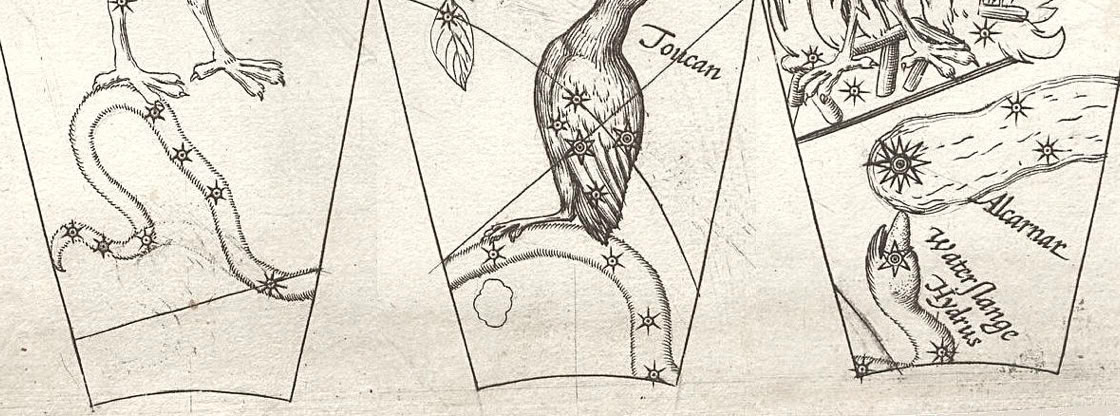
Hydrus (aka Waterslange) wriggles across three gores from Petrus Plancius’s celestial globe of 1598. The loop of the snake’s tail on the gore at left seems to have been erased by the engraver and diverted farther north to touch the foot of the peacock, Pavo. Later cartographers, notably Lacaille, rerouted the snake so it no longer touches the feet of either Pavo or Tucana. The bright star at right near the head of the snake is the one we now know as Alpha Eridani or Achernar, here given as Alcarnar, at the far southern end of Eridanus. (Nicolai Collection of the State Library of Württemberg, Stuttgart)
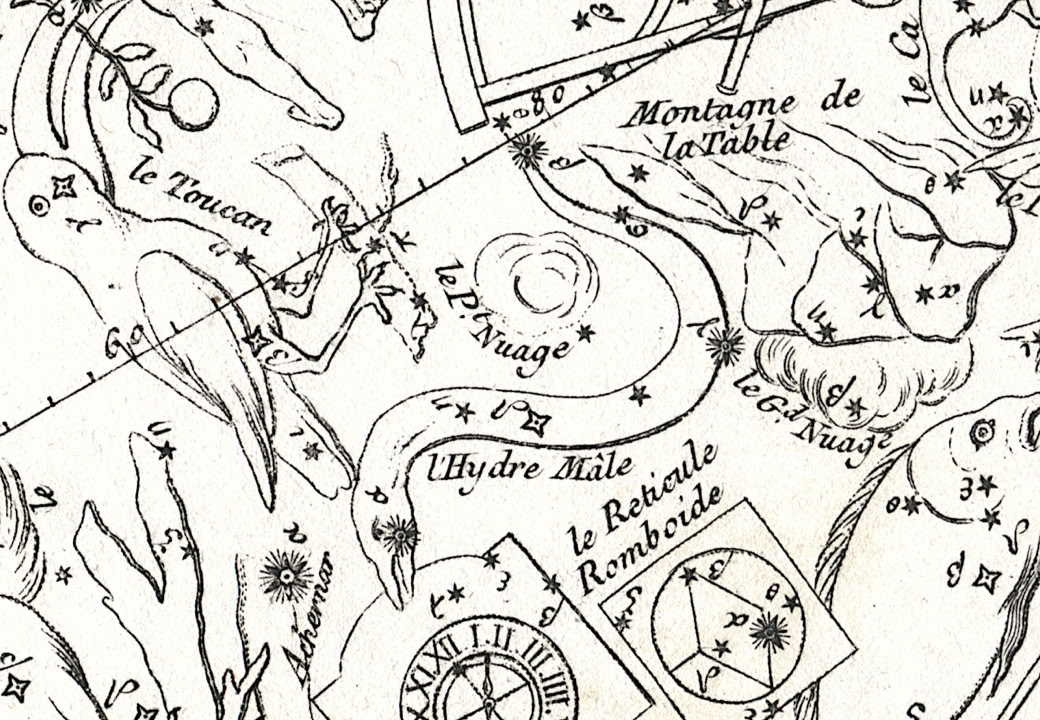
Lacaille’s version of Hydrus (here called l’Hydre Mâle) on his southern planisphere of 1756 was much truncated by comparison with earlier depictions of the constellation. He rerouted it between the two Magellanic Clouds and cut off the water snake’s tail to make room for his own invention, Octans, at top. The copy of the planisphere reproduced here is from the Atlas Céleste of 1776 by the French cartographer Jean-Baptiste Fortin (1740–1817).